Back Cover, New Artists, and Locus Awards


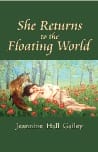
Hey there! Are you guys as excited to see the official back cover of my second book, She Returns to the Floating World, as I am? ARCS are next…
Through an artist friend, I’ve discovered this awesome myth/fairy tale artist – her name is Deborah K. Scott. Check out her Red Riding Hood/Target painting here:
http://www.deborahkscott.com/gallery/102551/2011
It’s pretty fierce.
Ellen Datlow was nominated for a Locus Award, as was the anthology she edited that I was lucky enough to be included in, Beastly Bride. Congrats Ellen!
Tonight I’m going to try to sneak in a quick visit to this fundraiser for the Japanese earthquake disaster – where some kickass artists will be donating their work:
http://tsunami.fundraising.iamebi.com/
That’s before I go to C. Dale Young and Luke Johnson’s reading at Open Books.
It’s a whirlwind tour this weekend, with another friend’s book launch party, and poetry, poetry everywhere. If I can make it to a third of the stuff going on this weekend, I’ll consider myself lucky.
Readings, Star Wars and Why We Become Writers
Grading and commenting on student poems has taken up all my time. Adjuncting a creative writing class: the work swells like those little sponge dinosaurs and absorbs everything around it.
I went to see Elizabeth Austen read at Open Books this week, from her book, Every Dress a Disaster. (Oops – it’s Every Dress a Decision. But my version sounds so much more dramatic!) She’s a great reader – she also works at KUOW, our local public radio, and so probably has a greater ear for poetry readings than most. The obsessions of the book: childlessness (or childfreeness), a dead brother, being a woman who wants to go camping alone – are pretty interesting to me.
We also hit the Star Wars Exhibit at the Pacific Science Center, which was in its closing weekend and was super crowded. Nevertheless, lots of fun stuff – the sand cruiser, Han Solo’s outfit, original props like light sabres and several giant Wookies. This is how you celebrate Mother’s Day when you don’t have kids and your mother is thousands of miles away! But I did thank my mom for having some really excellent musical taste over Facebook. Facebook is the new Hallmark card!
This week, if all goes to plan, I will see C. Dale Young read, Maya Zeller, and Rae Armantrout. What can I say? It’s a good town for poetry readings. I’ve been reading C. Dale’s Torn and really ended up loving the spiritual/scientific aspects of it, the way he marries the work of being a doctor and the consideration of the powers that be, and of course, the last title poem, which is a killer. I met Rae in San Diego briefly and I will make this observation; besides being kitchen-chef-knife-sharp, she is the kind of professor who attends every single student reading. And that is saying something.
I spent some time thinking about why we become writers. Can we point to any one thing – an encouraging teacher or parent, a tendency towards bookishness for whatever reason – that brought on the madness of trying to write? Here’s the list I came up with – you should try it too!
The Things Which Make Us Become Writers
Because I was colorblind, I wore purple and blue in layers, all shades of lavender to me.
Because I was dyslexic, and could not remember phone numbers or my own street address.
Because I was sickly, and missed family vacations and had all my toys burned.
Because I was allergic to the sun, I spent a lot of time indoors – with books.
Because I loved the images on television, but found the stories boring and so would make up new plots.
Because my father built robots but could not tell a joke without giving away the punchline.
Because my brothers are all much more interesting.
Because I considered myself an outcast in high school, though on greater reflection, I was not as much of an outcast as I thought at the time.
Because I love research and footnotes.
Because I am romantically attached to only one person, which saves a lot of time.
Because in my other life, I am a terrific lipstick sales person or software manager.
Because learning about botanical medicine made me want to draw pictures of plants.
Because I surround myself with words – words in the backgrounds of paintings, words on a screen, words on paper, words jumbled on the refrigerator.
Because my mother loved poetry, my grandmother loved Faulkner and my great-grandmother was the only literate person in her town and therefore postmistress. Yea, this is my great heritage as a woman of my bloodline – to be a person who reads.
Japanamerica, Roland Kelts Feature, and Monkey Business
Remember when I was telling you about hitting all the cons in Seattle in one weekend? Well, the biggest of these was SakuraCon, a huge anime-and-all-things-pop-and-Japanese conference in downtown Seattle in April. And I got to see someone I had corresponded with (I’d read his book, his interviews, even an article he wrote for Japanese Vogue – and had even planned to quote him in an article about Matthea Harvey some years ago…) but had never met in person.
Roland Kelts is the author of Japanamerica, a terrific exploration of the worlds of Japanese pop culture and their impact on American audiences. I’ve seen Roland interview Hayao Miyazaki – a fabulous experience – at Berkeley, and his interview with Haruki Murakami in the very first issue of A Public Space was the reason I bought the issue. I had the opportunity to sit down for coffee with Roland Kelts when he was in town for SakuraCon, and ask him a few questions.
Jeannine Hall Gailey: Roland, I had so much fun reading your book, Japanamerica, particularly because we share a love of Hayao Miyazaki’s work and writers like Haruki Murakami. Can you tell me your recommendations for three writers from Japan (besides the awesome Murakami) you think more Americans should be reading – they can be fiction writers or poets!
Roland Kelts: I would start with Yoko Ogawa. Her elegiac sensibility and normal depictions of abnormalities makes her an elegant distant cousin of Haruki Murakami, as does her simplistic seeming, eerily penetrating prose. I also like Hideo Furukawa, who writes like the world has already ended and we ought to accept the aliens we have already become–to others and ourselves. Finally, I’ve recently been enthralled by the work of Hiromi Kawakami, whose sense of neighborhoods and their absurdities, and our desperate need for them, resonates deeply in a world gone mad with so-called ‘globalization.’
JHG: You know I’m a huge fan of Miyazaki’s movies, particularly because of his strong female heroines like Princess Mononoke and Nausicaa and his haunting post-apocalyptic landscapes. Do you have a favorite anime series or movie you’d like to share? And why do you love it?
RK: There are so many series that are uneven but addictive, as you know. For films, I particularly like Satoshi Kon’s Millenium Actress, Makoto Shinkai’s Five Centimeters Per Second, Mamoru Hosoda’s The Girl Who Leapt Through Time, and that enduring classic, Isao Takahata’s Grave of the Fireflies. These are all stunning examples of how far Japan has taken animation.
JHG: You’re launching – and co-editing – a new magazine called Monkey Business this week in New York. What is the mission of the magazine, and why do you think people should read it and subscribe immediately?
RK: The mission of the magazine is actually quite humble: To introduce to Americans and other English-language readers the joys and edges of contemporary Japanese writing. Manga is equally thrilling, of course, but manga and anime artists are not the only creative Japanese giving us a vision of our fresh and daunting world. Americans who want to know what our new world will look, feel and smell like would do well to dip into the cauldron of contemporary Japan, a country that experienced apocalypse and lived to tell the tales.
And here’s where you can pre-order your very own copy of Monkey Business, the exciting new literary magazine:
http://www.apublicspace.org/pre-order_monkey_business.html
The manga and interviews alone make this a totally awesome package, but the short fiction and poetry are pretty wonderful, as well!
And, from A Public Space:
Fascinating interview with Motoyuki Shibata here about American fiction’s impact on Japanese writers:
http://www.apublicspace.org/look_heres_america_a_co.html
Big Poetry Giveaway Winner, Redheaded Stepchildren, Upcoming Feature with Roland Kelts
Happy May Day, readers!
The winner of the Great Poetry Giveaway of this blog (chosen by random number generator) is Matthew Thorburn! Congrats, Matthew! I’ll be sending two books – my Becoming the Villainess and Anna Rabinowitz’s Present Tense – your way as soon as you send me your snail mail address!
I would be remiss if I did not direct your attention to a magazine I’ve always loved the concept of, Redheaded Stepchild Magazine, which only publishes work that has been turned down by other magazines. My poem, “A True Princess Bruises,” appears in their Spring Issue, along with wonderful work by writers like Dorothy Barresi and Alex Grant!
I also wanted to announce that I’ll be posting an interview feature with Roland Kelts, the author of Japanamerica and editor of new lit mag Monkey Business, in the next couple of days, so keep your eyes on this space!
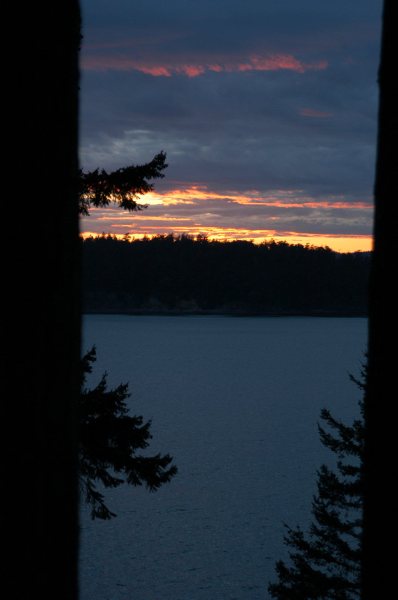
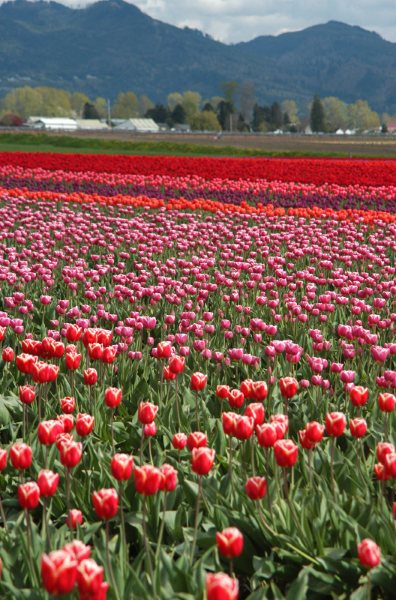
Had as wonderful a weekend as possible for my birthday – tiptoed (mostly unassisted on my own two feet a miracle in itself if you’d been in physical therapy with me even two weeks ago) through some tulips, and in a record-dreary April, actually had sunshine all three days I was up in Skagit Valley! La Conner’s Tulip Festival is really something if you’ve never been up this way. Here are a couple of pics – one is the view from our cabin on the water, another of tulips:
High School Students and Poetry, More Top Five Lists, and Tornado Tragedy
First of all, my heart goes out to all who were affected by massive tornadoes that swept across the south several days ago. Hundreds of people were killed, thousands impacted through destroyed homes. When I lived in Tennessee, the night of my oldest brother’s high school graduation, a small funnel cloud went through out front yard. I experienced several tornadoes while living in Cincinnati, once while I was babysitting two young children, and another that tore the front wall out of my gym, hit my former high school, and killed the parents of a fellow high school student by literally lifting them out of their second-story bedroom while they slept. As you might imagine, I had nightmares about tornadoes for a decade after I left the midwest. (I lived in Richmond when they were hit by a hurricane and some flooding, but somehow, it didn’t seem as scary as those tornadoes…) Although, I’m heading up to Skagit this weekend for the tulip festival/my birthday celebration, and they say a funnel cloud was spotted there yesterday! I’m hoping for better weather the next few days…just a little sunshine, please!!
I had the opportunity to judge a poetry contest for high school students and got to meet the winners at this little reading/award ceremony. It was really fun to meet the students who won and hear them read their poems, and see their proud parents sitting in the audience and clapping for them. I have to say these kinds of events really inspire me and help me to love poetry again. If you really feel too depressed about poetry, go work with some high school kids – it always reminds me of the reasons I fell in love with poetry to begin with.
Thanks to the lovely and talented Juliana Gray, who listed Becoming the Villainess in her top five books for the 32 Poems five fave books project. I can’t wait for her book to come out – she’s a great writer and helped initially inspire me to write about comic book themes.
So, I’m heading out to the Skagit Valley Tulip Festival, which I missed intensely while I lived in Calfornia – the huge swaths of multicolored flowers, the mist and mud and farmhouses, I love all that stuff. I won’t have much internet access, and hope to write a few poems – and I’ll be a year older when I return!
Lost Con Weekends, a new review, and more!
I swung by two conventions this weekend (NorWesCon and SakuraCon,) celebrated Easter, visited with several out-of-town writer friends, and attended various poetry events, as well as fulfilling obligations for my adjunct teaching job at National. Turned in final proof corrections for She Returns to the Floating World to the kind editors at Kitsune Books. Have now collapsed and plan to sleep until the next poetry event. (Dreams have been haunted by people in either Star Trek or Anime-influenced costumes carrying large fake swords.)
Have a new book review posted up at Rattle:
Jeannine’s review of Susan Rich’s third book, The Alchemist’s Kitchen
So check it out!
Also received an acceptance I’m excited about from a lit mag – don’t those acceptances seem to make all the other rejections sting a little less? I still get excited when it’s a magazine I really love or a poem I’m particularly fond of – and in this case, it was both! Let’s just say the poem has a hidden MST3K reference or two in it. Killer Shrews!!!
Did I mention it’s my birthday this weekend? My mother said I have her permission to go back in time a decade and turn 28 instead of 38.
If you ever need an article to convince young writers that they must, must, must read current literary magazines if they want to be published, look no further than this:
http://www.thereviewreview.net/publishing-tips/what-editors-want-must-read-writers-submitti
My horoscope is telling me to rest and relax and get away from the crowd, but my calendar keeps saying go go go!
32 Poems Fave Book Feature and More
Well, my five favorite poetry books feature is up at the 32 Poems Blog:
http://www.32poems.com/blog/2238/day-21-jeannine-hall-gailey-shares-her-five-favorite-poetry-books
May all the books listed sell a thousand copies. Great books, all of them.
And, yesterday, Kelli Russell Agodon’s five fave feature was up, which might have have mentioned Becoming the Villainess:
http://www.32poems.com/blog/2233/day-21-kelli-russell-agodon-national-poetry-month
The bad things about lists like this is I still feel I didn’t even get to talk about a third of my favorite poets. Rebecca Loudon, Karyna McGlynn, Suzanne Frischkorn, Kristy Bowen, Jeff Walt, Karen Weyant…OK, now I’ve listed another six poets that I love. And that’s just for starters.
I have a small haiku up at the new issue of Pirene’s Fountain. The whole issue’s pretty great, and Aimee Nezhukumatathil (another of my fave poets…see, the list just keeps going) is featured in it.
Thanks to a very generous donor, the drive to collect money for the Japan disaster – specifically, for Doctors Without Borders – by selling copies of Becoming the Villainess raised more than $200 for the cause. Thanks again! All proceeds will go to the charities.
More Poetry Month and a Sad Passing
I was very sad to read this morning on C. Dale Young’s blog about the passing of Jeanne Leiby, who had recently taken over editor-ship of The Southern Review. I thought she had a great vision for the magazine and she wrote me a very kind note while she was editor there. It’s a strange thing; in the age of Facebook, I said to my husband: “But she just posted to Facebook yesterday!” She was about the same age as my older brothers, in her mid-forties, and that just seems tragic and unfair.
I am reminded that we should tell all the people we admire and care for just how much we admire and care for them. I was so happy to see some of my old friends at poetry readings in the last week. Rebecca Loudon read her poem “Love Letter to the Whores on Aurora Avenue” which always makes me cry, and I saw Colleen McElroy, who spent time and energy mentoring me when I was just starting out as a writer/lit mag volunteer in Seattle – in fact, before I met her, she accepted one of my poems for my first “real” poetry acceptance (you know, outside of teen-y contests and high school mags and such.) She got up, rocking her skinny jeans and high-heeled boots, and was such a fierce poetry presence…it was really inspiring. If I could be half as fierce a poet as Rebecca and Colleen, well, I’d still be a pretty darn fierce poet.
Collin Kelley has started blogging for Poets & Writers. Check out his first post here!
During Poetry Month, I wanted to take a moment to encourage everyone to go buy poetry books from independent bookstores. Specifically, you should all buy books from Open Books, the poetry-only bookstore in Seattle. I recommend calling in and placing phone orders if you don’t live in Seattle. When I lived in California, I found myself constantly wishing I could just pop in and see John and Christine, the owners, who are always full of good advice and news, and check out the new poetry books propped up on the front shelf. For a poet, it is a magical place. Did I mention they also host some rollicking poetry readings? Lately I really enjoyed Martha Silano’s book debut readings, where she passed out little toy aliens and did physics experiments along with her poetry. I’m looking forward to a visit on May 12 when C. Dale Young will be making a stop in on his poetry book tour!
More Poetry Month Celebration – Busy busy busy
If you haven’t signed up yet for my poetry month book giveaway, do so now! And here’s Kelli’s links to even more poetry book giveaways!
Tonight I’m going to go see Susan Rich, Major Jackson, and Brian Turner read and do a Q&A together downtown as part of Seattle Arts & Lectures. This Sunday I plan to attend a reading with some of my fave peeps – Susan Rich, Kathleen Flenniken, Rebecca Loudon, and Colleen J. McElroy. I’m only attending like, 1/100th of the poetry events going on around Seattle for Poetry Month, yet I have something to attend almost every single day. Not to mention that Sakura-Con and NorWesCon are both going on next weekend, which means lots of socializing in a short time with out-of-town friends.
I’ve also spent some time each day proofing my manuscript (with help from other poet-friends and family members, whom I thank profusely) and teaching National U’s MFA program’s April/May advanced poetry workshop. I’m lucky to get one poem written a week in April, much less a poem a day! No time for loafing or leisure – it’s April! Ha! (I’m also formulating an idea of doing a class on speculative poetry on my own. Seems like there are lots of speculative poets but not a lot of speculative poetry classes!)
Hope to see some of you down at Benaroya Hall tonight!
More About Japan
And here’s a little bit about risk and probability and what we can learn from Fukushima – thanks for the link from Dorianne Laux.
The bottom line is, for companies, human costs are usually not as important as profits, and therefore, nuclear stuff isn’t built as safely as it should be.
Roland Kelts writes a beautiful meditation here on how physical distance from the tragedy has been affecting him: http://japanamerica.blogspot.com/2011/04/disaster-and-distance.html
Disaster narratives have been woven into the fabric of Japan’s art – ancient prints of giant waves hanging in museums, numerous tsunami-savior stories told to children, stone tablets set in the ground warning people not to build below a certain point. The famous Gamera and Godzilla movies, where the monsters were metaphors all about the ravages of the nuclear threat. I heard several versions of the following story, called “The Burning Rice Fields,” while I was researching “She Returns to the Floating World.” Here is one version of it I found online. The version I originally heard involved some self-sacrificing cooperation between an elderly farmer and a fox, and it inspired this poem from “She Returns to the Floating World.”:
“The Fire of Foxes”
In another story a man lights a fox on fire to save others, to warn them of tsunami. The fox is a willing partner, burning brightly in the night to tell the village and his own people to flee. The men and foxes see the fire and run. The water comes and swallows the burning fox, the old farmer who lit him, and all the farmland. But the families of fox and man are safe. The rice smolders underwater. The fox is rewarded with eternal life; his eyes and tail become stars in the sky. At least that is the version I have learned by heart.
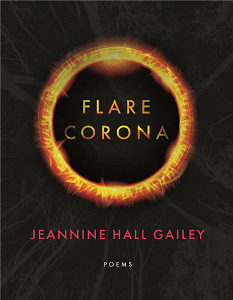
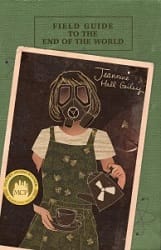
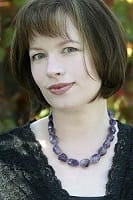 Jeannine Hall Gailey served as the second Poet Laureate of Redmond, Washington and the author of Becoming the Villainess, She Returns to the Floating World, Unexplained Fevers, The Robot Scientist’s Daughter, and winner of the Moon City Press Book Prize and SFPA’s Elgin Award, Field Guide to the End of the World. Her latest, Flare, Corona from BOA Editions, was a finalist for the Washington State Book Award. She’s also the author of PR for Poets, a Guidebook to Publicity and Marketing. Her work has been featured on NPR’s The Writer’s Almanac, Verse Daily and The Year’s Best Fantasy and Horror. Her poems have appeared in The American Poetry Review, Poetry, and JAMA.