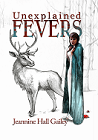
Unexplained Fevers Goes to Ireland – Book Announcement for 2013!!
- At November 13, 2012
- By Jeannine Gailey
- In Blog
 4
4

Unexplained Fevers plucks the familiar fairy tale heroines and drops them into alternate landscapes. Unlocking them from the old stories is a way to “rescue the other half of [their] souls.” And so Sleeping Beauty arrives at the emergency room, Red Riding Hood reaches the car dealership, and Rapunzel goes wandering in the desert – their journeys, re-imagined in this inventive collection of poems, produce other dangers, betrayals and nightmares, but also bring forth great surprise and wonder.
– Rigoberto González, author of Black Blossoms
Unexplained Fevers begins with that most familiar of phrases, “Once upon a time,” but the world we find inside these covers is deeply defamiliarized. Trapped by physical ills, cultural expectations, and the constraints of marriage, these heroines interrogate the world and propel themselves through it with cunning and sass. We follow, for example, Jack and Jill though a prose poem where they “somehow turned thirty without thunderous applause,” after having sworn they “would follow each other anywhere, but anywhere turned out to be a lot like Ohio.” At the center of these poems – urgent, mysterious, evocative – we find the great topic of all fairy tales, transformation. Read Unexplained Fevers, and be transformed.
– Beth Ann Fennelly, author of Unmentionables
Anticipation, New Mexico Poems, E-publishing, and a Tuesday Announcement!
- At November 11, 2012
- By Jeannine Gailey
- In Blog
- 2
I’ve been busy with things that involve anticipation.
I’ll have an announcement about my third book on Tuesday!
Helping my mom prepare for a big job interview (Good luck Mom!) and signing contracts (!) and thinking about planning events for Redmond all the way through next spring. And November and December are so busy! Also we’re trying to squeeze in all our doctor and dentist appointments before December 31 as our company health care plan is getting much more expensive and paperwork-heavy next year (I hate to say it, but mainly due to the government’s new health care changes. They hurt me more than they help me, but I know I’m probably in the minority that way.) Still, these things require planning. And I’m already worried about next year’s taxes! This is going to be our most complicated tax year ever, I think. So, onward…
I’d like to direct your attention to the innovative project “200 Poems for New Mexico” – and one of the poems is one of mine, “America Dreams of Roswell.”
And Rachel Dacus has an interested post about the lack of e-book publishing here. I would like here to make a pitch for those local to Seattle to come out and hear my friends Annette Spaulding-Convy and Kelli Russell Agodon talk about this very topic, e-book publishing for poets at the Redmond Library at 7 PM on December 6th, as part of the “Geeks for Poetry” initiative that I started as Redmond’s Poet Laureate. We’ll talk all about e-books, twitter, social media in general. It’ll be grand times! These guys know what they’re talking about, as they have already produced a fantastic e-book of women’s poetry called Fire on Her Tongue. You know, my new publisher is also interested in doing e-books! I think we poets need to embrace new ways to read poetry and get it out to as big an audience as possible.
I’m off to Annette’s reading for her first book, In Broken Latin at Open Books at 3 PM this afternoon. It’s a wonderful book. Check out this blurb. I wrote it, so you know I believe it!
“Annette Spaulding-Convy’s In Broken Latin is a collection that leads us with intelligence, wit, and compassion through a woman’s life in a nunnery and her slow disenchantment with the church. There’s a spark of hidden sensuality and humor hidden beneath the habit, as displayed in one of my favorite poems of the collection, ‘There Were No Rules about Underwear,’ where a fireman breaks into a nun’s room as she sleeps nude, saying he ‘needs to feel your walls to see if they’re hot.’ The poems here contemplate the gruesome origins of desserts created for saints, the daily rituals of women in the convent, performing a fascinating balancing act of playful irreverence and deep thoughtfulness about spiritual exploration.”
A new review on The Rumpus, and some upcoming readings you shouldn’t miss (but they’re not mine)
- At November 02, 2012
- By Jeannine Gailey
- In Blog
- 1
I’ve got a new (non-poetry) book review up at The Rumpus, of Jeffrey Skinner’s The 6.5 Habits of Moderately Effective Poets. I hope you enjoy it; I tried to have some fun, and the book itself doesn’t take itself too seriously, either.
Here are a couple of local events you all shouldn’t miss. They aren’t even my events, that’s how serious I am.
One is the debut reading at Open Books of Annette Spaulding-Convy and her new book on November 11, In Broken Latin. Here’s the link for more info: http://www.openpoetrybooks.com/calendar/archives/000546.html but just let it be known that you are in for some great poetry, AND it’s saucy nun poetry, which I don’t think really we have enough of. It’ll put you in a good mood no matter how worried you are about the election!
The other is the November 17 reading, at Redmond Library, of Washington state’s Poet Laureate Kathleen Flenniken, from Plume. And after I will ask her questions in a nice little Q&A session and you can meet her and buy books and get them signed and ask her questions about Hanford. There will be refreshments. Come out! Did I mention this is the kickoff reading for my ambitious plan as Poet Laureate to get everyone to read one book of poetry a quarter, called “Redmond Reads Poetry?” Well, it is!
The last note is: one more month til my second book, She Returns to the Floating World, is about to go out of print from Kitsune Books, as they are closing at the end of the year. So if you want to buy it in either print or e-book form, get on it! I hear it’s a pretty good book!
And, I may have good news to announce soon about my third book, Unexplained Fevers, which was orphaned after Kitsune Books decided to close. It may be that I’ve found a new publisher. Who might it be? Stay tuned to find out…
Looking for some good news?
- At October 30, 2012
- By Jeannine Gailey
- In Blog
- 3
The storm coverage is still swirling, NYC underwater, the Jersey Shore in tatters. Election coverage is an incessant background noise in everything from comedy sitcoms to twitter.
So I know we are all looking for some good news, some hope. And then, I don’t know, Disney goes and buys Lucasfilm and announces yet another (inevitably terrible) Star Wars movies? Penguin and Random House are merging. The world, for writers, is looking a little grim. But when has it ever been otherwise? (Yes, I’m also writing this post after a brutal dentist visit – three fillings today with no Novocaine, so perhaps I’m looking for a little cheering up.)
I want to call your attention to a couple of articles I thought were worth reading. One was about the proposition of value that publishers bring to authors. My little brother asked me recently, what is the purpose of finding a publisher for your poetry books instead of just publishing them yourself? In the old days, I would have had a much clearer answer – something about publishers offering authors marketing, financial support, distribution into bookstores, legitimacy, even. Now, in this new era, still emerging with its e-books and Amazon dominancy and ever-shrinking-and-hard-to-find-poetry-audiences, I’m not so sure of the answer. So, do publishers need to offer more value to authors?
Poets are generally so grateful to have a publisher that they will waive almost everything – marketing expectations (even modest ones, say, an ad in Poets & Writers or even on a web site somewhere,) promised prize monies, royalties, say to where and how their work appears – in order to be published, to be “legitimate”. Is the author’s only other option to go rogue, self publish, and push their wares at readings and on twitter? As a reviewer, I’ve often found that small presses’ books are inevitably more interesting and better written than either large press or self-published work. I am a fan of the small, struggling press with one or two people trying to make it work; they have the courage to have a point of view, an integrity of taste, that even when it isn’t your taste, you have to respect.
And onto reviewing – many years ago a female poet told me that I have a duty to review, that there are not enough women reviewing books, and not enough books by women being reviewed. I did start reviewing because I felt it was something I owed the poetry community, to find interesting books and talk about them in a way that might make a reader, you know, want to read poetry. In particular, I wanted to find poetry that other people weren’t already celebrating, poetry that deserved celebration.
Here’s a link to Margaret Atwood writing in 1976 – when I was three years old – about being a woman writer, and about the problem of reviewing in particular.
http://thisrecording.com/today/2010/8/29/in-which-we-change-diapers-and-collect-china.html
The same sexual put-downs, the old sexist stereotypes – is she an “Emily” or a “Sylvia?” – are still sadly pretty freaking wide-spread. Read VIDA’s count to find out if the numbers have changed, because, for the most part, they haven’t.
Did I promise you good news at the beginning of this post? Somewhere floating around the internets this morning was a picture of a big rainbow over NYC, a reminder of the Biblical flood and its inexplicably happy rainbow ending:
(Source: http://cdn.theatlantic.com/static/mt/assets/science/rainbow_real.jpg)
If we believe the rainbow, things will get better for us. We will keep writing, even if we’re unsure of our audiences, how to reach them effectively, even how to communicate with our fellow human beings. We will keep creating because it is in us to create, to paint the rainbow even if it is absent in the story, because we all want to believe in happy endings.
High School Poetry Visits and Library Book Groups and Invisible Illness Impacts
- At October 24, 2012
- By Jeannine Gailey
- In Blog
- 1
Tonight is the first ever “Redmond Reads Poetry” book group meeting at the Redmond Library. I’m excited to try this out, but I have modest expectations for tonight’s attendance. Although I love our first book pick, Kathleen Flenniken’s Plume, and think it will be really fun for a Redmond techie-type crowd to talk about. Hopefully some folks come and we have a good time. It’s been a long time since I’ve been in a poetry book club!
Monday I did a high school class visit at Redmond High, which I really enjoyed. Surprisingly, you might not believe me, but high school kids love Gluck. No joke, I have never had kids not love poems from Louise Gluck’s Meadowlands (the first poetry reading I took my then-seventeen-year-old little brother to was Louise Gluck when she was touring for Meadowlands, and he still has a signed copy of her book.) “Telemachus’ Detachment” has got to be one of the best teen poems ever. We also read some Lucille Clifton, and a poem from Becoming the Villainess and She Returns to the Floating World. The students were really attentive, they laughed in the right places during the class, they were excited to talk about their latest comic book/video game loves, they wrote really good persona poems and then actually spontaneously clapped at each other’s readings of the exercise poems. One in particular I remember was a young man’s poem in the voice of a supervillain, which seemed to be a revenge poem but turned into a really touching meditation on mortality. The kind of poem I wish I had written! The teacher was also enthusiastic and great to work with.”Oh my God,” my husband said when he picked me up outside the school, “I’m on the set of Degrassi.” It is a school full of bright, articulate, telegenic teens. They asked me really interesting and thoughtful questions, like, “Was getting the MFA worth it, or was it mostly stuff you could have done on my own?” And after I answered the standard answer, that the MFA gives you discipline and encouragement and the benefit of experienced mentors, and they followed up with: “And it’s really hard to get poetry mentorship outside of a graduate program, right?” I said: “Not a day goes by I don’t wonder about that myself!” No, I didn’t, but I thought it loudly. They already knew about the youth programs at our local literary center, Hugo House, and about Poet’s Market. They were sure more aware of the writing “game” than I was at seventeen or eighteen.
I have to admit that I think the Poet Laureate work has been taking a bit of a toll on my health, I seem to have a never-ending flu (for about a month I’ve been running 101 fever and waking up coughing in the middle of the night almost every night) and some new migraine/heart stuff I’ve never had before. It’s always an internal argument with me; my physical, emotional, and mental energies aren’t exactly at the same levels, and I need to decide what’s worth the physical energy output, how protective I need to be. This is difficult to talk about in a public forum (anyone with “invisible” health problems like autoimmune or bleeding disorders or rheumatoid arthritis or allergies or MS or etc already knows this, because you look “fine”) but I think it’s worth discussing because a lot of writers have health problems that limit what they’re able to do physically. In fact, Christian Wiman recently wrote a really touching essay recently on his cancer, about having kids and having faith/hope in the face on an incurable and increasingly debilitating disease. I’m learning more – as scientists research more – about some of my genetic conditions, like for instance, with PAI-1 deficiency, a chronic low level of plasminogen may lead to increased inflammation, which may be the root cause of some of these never-ending illnesses and joint problems (although it does seem to decrease my risk of diabetes, at least, in rats.) I may be oversharing, but then again, I want to be honest about the chronic health issues and how that impacts my life as a writer, working, family life, even minor things like not being able to travel to AWP every year because sometimes I end up in the hospital with flu, or have to cancel readings. And I have to be aware of how much I take on, how many social engagements I make, how often I shake hands with children (whom I love, but who are, how shall I put this, terrific vectors for all things infectious.) It puts limitations on a life I wish could be lived without limitation. Then again, if I hadn’t gotten ill, chances are I would probably have decided to become a doctor, or at least remained an upper-to-mid-level manager at a tech company, instead of a poet. The enforced time of rest, of required disengagement from ninety-hour work weeks, meant I have had time to write for the past seven or so years, time to write, in fact, several books and attend a low-res MFA program (as discussed above) and spend time sending out poems – time I might not have had if I was totally healthy, time I might have seen as extravagance I couldn’t afford. Anyway, I just have to make decisions based on the information and health levels I have at the time, and adjust as I go. I look forward to things – like celebrating my fortieth birthday (and hopefully, a third book) next year. Making new friends. Having a positive impact on my community when I can, and maybe even creating, you know, art that makes a difference.
Five Questions with Washington State Poet Laureate Kathleen Flenniken and Autumnal Doldrums
- At October 20, 2012
- By Jeannine Gailey
- In Blog
- 1
First of all:
A short interview with Washington State Poet Laureate Kathleen Flenniken is now up at my Redmond Poet Laureate Blog here:
http://redmondpoetry.blogspot.com/2012/10/five-questions-with-washington-state.html
Go read all about Kathleen and her new book, Plume (which I reviewed a little while ago for The Rumpus…) as well as her duties as a State Poet Laureate. It’s very inspiring!
So, I’ve been in a serious case of autumnal discouragement, which is odd, because usually September and October are my GO! times, when I’m full of energy and ready to move forward. Part of this has been because of some difficulties at work, some discouragement with the poetry world in general (so much work, so little reward…I know I’ve been doing this for over ten years now, but sometimes writing the checks and submission packets over and over and doing the balance sheets…) and the many little things like cars breaking down, encounters with unpleasant humans doing unpleasant things, long cases of unremitting flu, then the cell phone and refrigerator breaking – I mean, none of these things are tragedies, but all taken together, they certainly have taken the wind out of my normally (I think) perky sails.
The weird thing is that a lot of my friends have reported similar feelings. I mean, we are in the middle of a pretty darn terrible economy, the worst and longest I’ve ever lived through, and that financial woe can be wearing. The elections this year also seem tinged with ill-will and weariness (although I just filled my voter sheet out and felt very American and empowered.) The poetry world is full of stories of presses and magazines folding, universities cutting back, grants shrinking and opportunities overall less frequent. I mean, I still enjoy reading poetry as much as ever, but my own writing has definitely suffered in terms of time and energy in the wake of all the Poet Laureate work, and sometimes I feel like I’m making Herculean effort and ending up with very little to show for it. Is that a poet’s world, after all? Karen Weyant talked on her blog about starting to write short stories, and I admit that I too have been dabbling in prose, flash fiction and essays and non-poetry-book reviews, etc. The question I keep coming back to is: in the current world, is anyone paying attention to poetry? Should we keep at it or try to get our art out in a different medium? The current Poets & Writers talks about the future of poetry. I do believe in a future for poetry, but I’ll admit I’m not sure at this point what it looks like. Twitter haikus and e-books and textual poetry on Tumblr?
Monday I’m visiting a local high school to talk to kids about poetry, and then Wednesday running a book group at Redmond Library to talk about Kathleen’s fantastic Plume. I better get my energy up!
If you’re a poet and feeling discouraged, leave a comment! We should at least try to cheer each other on, right? I hope it’s okay to talk on the blog a little about the bad times as well as the good. At least it’s honest.
What I’ve Been up To…
- At October 14, 2012
- By Jeannine Gailey
- In Blog
- 1
What I have been up to, you ask, since I last posted.
1. I missed a really cool reading in San Francisco called “Flight of Poets” where I had a wine matched to my poetry and everything. The broken-down car, still non-working cell phone and a new nasty flu were all contributors to this sad missing of a great reading, along with being broke because of said broken-down car. (But this week is basically the Carnivale of poetry down in San Francisco, with events almost every night. It’s a great time to visit the Bay area, the time of LitQuake, if you can ever plan a trip like that for fun – it’s an every year occurrence.)
2. During fever-induced hallucinations (first a respiratory flu, then a stomach flu – pleasant, no?) dreaming of getting a job that pays me more than 10K a year. Any job. And also, not being too sick to work said job. Then being able to pay off not only things like broken cars but also student loans, described in my last post.
3. Got published in the really beautiful new speculative magazine Phantom Drift. They included a little check for my poem (from the Robot Scientist Daughter series) too (thanks guys!) It is really like an old-fashioned literary magazine, with heavy, glossy covers and artwork, lovely printing. Check it out if you’re into “fabulism.” I’m in “Issue 2.”
4. Speaking of fun poetry, check out my review, just posted at The Rumpus, of Juliana Gray’s book Roleplay. Zombie poems, odes to Nancy Drew, the kind of poetry that is right up my alley.
Career Advice for Young Poets
- At October 10, 2012
- By Jeannine Gailey
- In Blog
- 3
Is there such a thing as career advice for poets? I’m reading The 6.5 Habits of Moderately Effective Poets by Jeffrey Skinner and wondering if there is such a thing as useful advice for young poets. What could I at 39 have told myself at 25 that would be helpful? One professor at that age told me not to go into debt to get an MFA; in general, good advice for most, but if I had followed that advice, I just would never have gotten an MFA, because low-res programs, while more flexible for folks with families/jobs/health issues/people who live in isolated areas – in short, for everyone is who isn’t a single 25 year old unemployed person ready to move across country for the right scholarship – they aren’t cheap and definitely most of them aren’t fully funded. Was it worth it for me to get that degree, to get to work with great writers, to force myself to think of myself as “a writer” again after years as a corporate middle manager? Sure, I now have some student loans to worry about, and you know what? I have never made the kind of money as a poet, freelance writer, adjunct, or government-sponsored-arts-contractor (which I think my current position might fall under the heading of) that I did as a corporate middle manager that might enable me to make student loan payments easily. I don’t think the answer is straight-forward. A young female college student at my reading asked me about how to “be a poet,” how to “get published.” I mean, where, these days, do we start? I usually tell young people – or older people new to writing – to start with The Poet’s Market, where I started when I was nineteen, to read all about “the poetry business stuff” – writing cover letters, researching the literary magazines before you send to them, trying to get a local group of writers together to critique each other’s work and encourage each other. I tell the to read other poets, to read contemporary poetry especially people their own age, to read the people winning the Pulitzer prizes, to read the writers publishing around them. But what really can you tell someone just starting out? Would I tell myself at 25 to forget about it, that the work is mostly hard and lonely and unrewarding in the deepest possible sort of ways sometimes, that the audiences for poetry are sometimes hard to find, that being a poet is sort of like being a maker of medieval armor, in that there are very few specialists around to appreciate it even when your work is good? That a lot of the work is writing when no one tells you to and stuffing your work into envelopes (or submitting via online databases, somehow even more dehumanizing) and sending it out knowing that most of it will come back with barely any kind of acknowledgement? How to keep going in the face of that? That writing a book of poetry is hard work, that publishing a book of poetry is even harder work and that selling a book of poetry is harder still. This is not exactly sounding like an Oprah-esque you can do it speech, is it? You can always self-publish, I tell people, it’s getting easier every day. I don’t know what the answer is. What would you tell your imaginary 25-year-old self about being a poet? Writing is its own reward? Revising is as important as inspiration? That publishing is as much about persistence as it is about anything else?
Oh yes, and the most important thing: be yourself, for God’s sake. Embrace your own weird self and celebrate it. Write the way you talk, think in your poems the way you think inside your head, and display your own soul because that way, someone else might pick it up and say, “This is exactly how I feel.” You never know. And at least you won’t be derivative. As an editor, I would much rather read poems about driving a big rig or your enthusiasm about playing D&D or your interesting collection of spiders than another poem about a New England barn in the snow. Unless you grew up in a New England barn in the snow, in which case, I probably have very little in common with you anyhow.
I think now that some advice might have sped things up for me – someone to tell me, for instance, about the different schools of aesthetics for poetry, how Fence was different than Prairie Schooner and what the heck was the school of Quietude compared to Flarf, how poets from New York might differ from poets in LA, to patiently explain that sometimes a helpful rejection note from a good journal is better than an acceptance from a mediocre one, not to rush or worry too much, to just write and do the work, that some magazines are a waste of time because they are only publishing their friends – a closed system – and which ones those were. One really useful thing was a group of friends I used to have that brought in literary magazines I had never heard of and printed out sheets about obscure grant opportunities that we would share and discuss. The blog world of poets – almost eight or nine years ago – was tremendously helpful, as poets then would share the minutia of their lives – the way Kim Addonzio fumed about a bad review or Aimee Nezhukumatathil posted about her little dog or how Paul Guest searched for a job or Eduardo Corral wondered whether he should hold out for certain contests for another year – see what you guys missed out on before those guys got famous and blogs were left behind? About so-and-so’s NEA application woes and so-and-so’s trip to Yaddo or Macdowell. You would learn all kinds of things, you could share the same kinds of rarified weird problems. It was a different kind of world than the one-sentence brevity of Facebook or twitter. So I’m hoping this post might be helpful to someone just starting out, that people might comment with the most helpful advice they had as young writers, that we could reach out to a real community and provide some kind of springboard for new poets.
Things I Learned from my first big Public Event as Poet Laureate
- At October 07, 2012
- By Jeannine Gailey
- In Blog
- 2
Thanks to everyone who came out for the Inaugural Poet Laureate reading, yesterday. I’ve got some pics but they’re all from before the reading, because once it started, no one had time to mess around with the camera. Here are some things I learned:
–There are a ton of precocious smart kids in Redmond who are interested in technology and poetry. It gives me hope for the future. Sample quote from a ten-year-old: “My friends and I get together to write poetry together after our regular classes, but I was wondering if there was a way to bring technology and poetry together?” Yes.
–You have to do way more PR than you think (we had posters, an article in the local paper, I posted about it on Facebook, twitter and blogs) but eventually people will find out about stuff. The audience that I was hoping to reach out to – people I didn’t know who were interested in poetry and the arts in Redmond – came. College students, young adults, parents with kids…they were all people I didn’t know who were very interested in poetry. Once again, it made me feel happy! The crowd actually cheered when I talked about removing the barrier between “technology and math people” and “Poetry people.” And asked for “Poetry for Geeks” t-shirts. Huh. Maybe I’ve started a trend?
–I was very thankful for my friends and loved ones who came and helped out with the event. There is no way an event like that can be successful without, say, a husband who helps sell books, a friend who pours drinks, etc. I’m a pretty good people-person, but after the reading I was overwhelmed just trying to talk to folks and sign books (I hope I was coherent!) so I was really grateful for the support.(Thanks especially to my husband Glenn and my friend Annette Spaulding-Convy, pictured below)
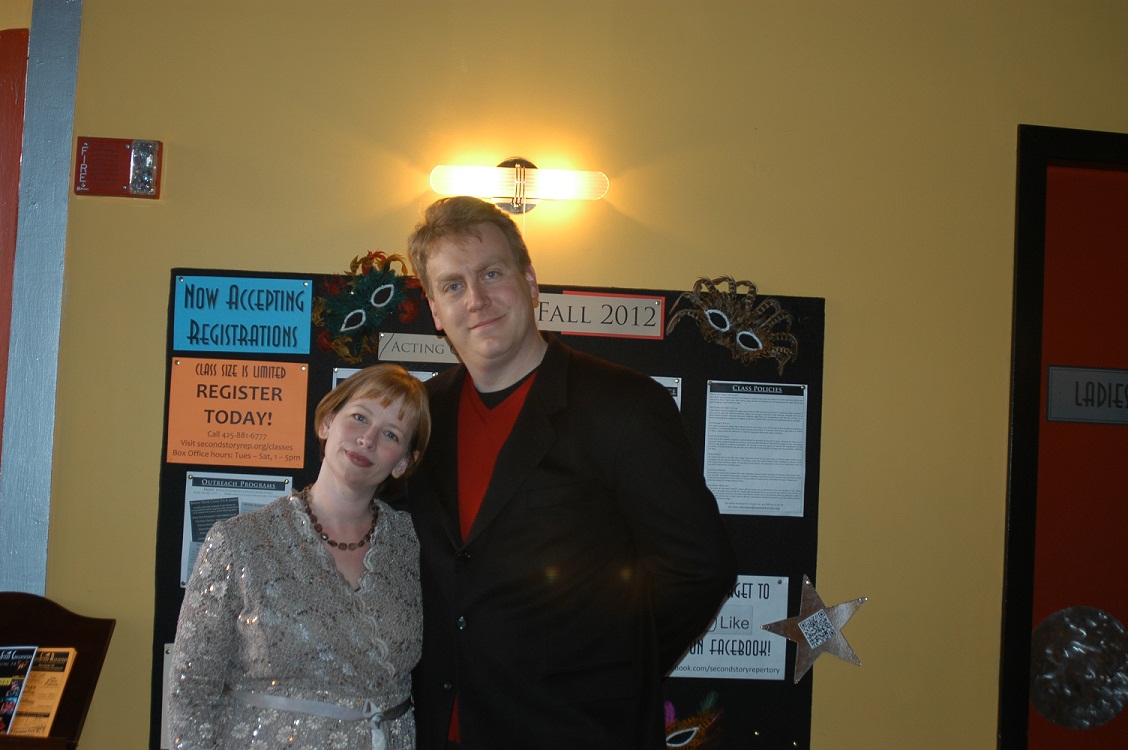
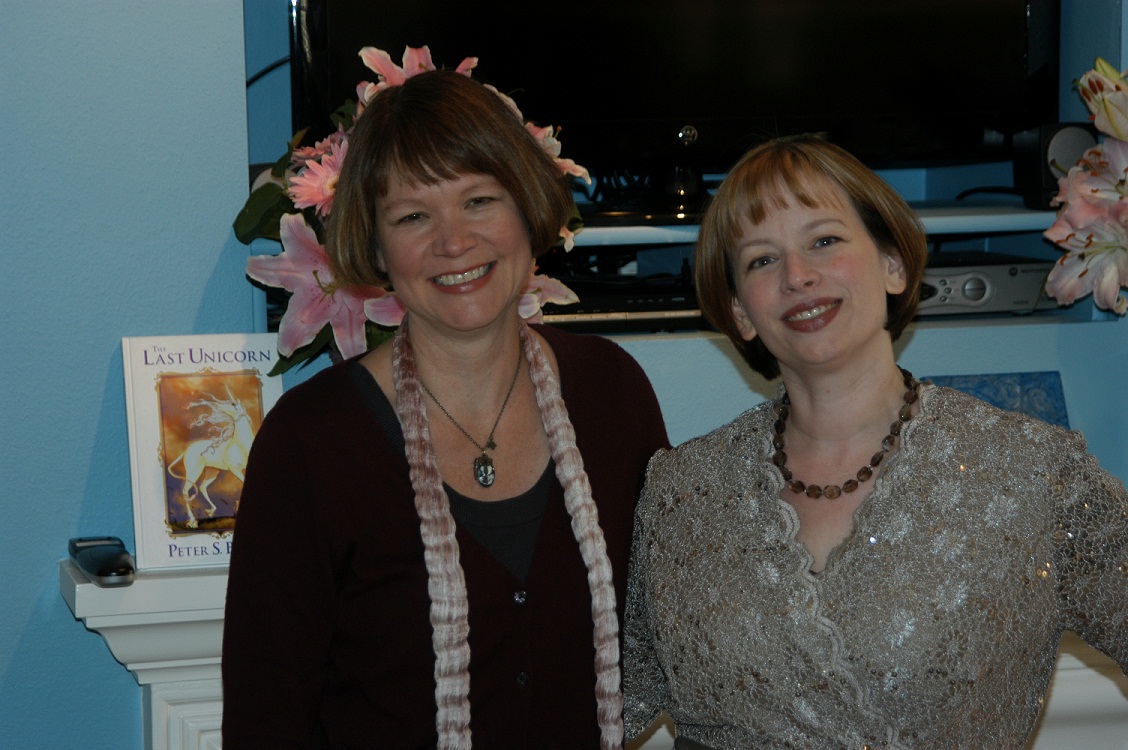
–I thought the combination of art and poetry went really well. People were interested in buying Michaela’s art and the SecondStory theater kept part of her art up as a several-week-long exhibition. We had an art show behind me on a big screen while I was reading, one sketch for each poem, and I think it helped keep people engaged. People specifically asked to be told about buying future books, and asked if they would have art in them! So that’s good! (Michaela and I pictured below – I’m only frowning because the sun was in my eyes, not because I wasn’t happy!)

–This event came at the end of a really stressful week for me, but those bad things didn’t ruin the reading. It’s good to remind ourselves that even though things might seem not that great leading up to event…the event will probably still be fine. Although now I would like to sleep for a week. It was a little like planning a wedding – with more of a performance aspect. So, I’m happy we did it, and happy it’s over, if you know what I mean.
My Inaugural Reading Tomorrow at SecondStory, A Story at Redmond Reporter and My Week of Unfortunate Events
- At October 05, 2012
- By Jeannine Gailey
- In Blog
- 2
If you are out on the East side and looking for something to do on Saturday afternoon, be sure to come by at 4 PM at SecondStory Repertory at the Redmond Town Center. I hear the new Redmond Poet Laureate is going to be reading for her Inaugural Poetry Reading and Party with an interactive art show by Michaela Eaves! (It’s similar to a laser show at a rock concert, but, you know, with poetry and art instead of lasers and rock music.) 20 minutes of poetry, followed by an hour of art and reception fun!
I’ve put together a good setlist of geeky poetry, appropriate for our techie-type community and my current Poet Laureate slogan (art work, of course, courtesy of Michaela as well,) there will be free snacks and drinks, and you will get to meet and mingle will all the artistic types on the East side and beyond! I promise you will have more fun than the usual poetry reading!
The Redmond Reporter kindly did an interview and article about the event and my goals as Poet Laureate here: http://www.redmond-reporter.com/entertainment/172850521.html
Thanks to Samantha Pak who wrote the article and did the interview!
Now, the last week, during which I’ve been trying to put together the above event, has been a little trying. It started when I knocked one of my front teeth loose, leading to emergency dental work. On the way home from the dental work, my cell phone died for good – right at the same second that our car, full of groceries, shut down unexpectedly – as in, everything turned off all at once – on the highway, forcing us to pull off and contemplate our lack of warranties or triple A service (our other roadside assistance program had, to our surprise, expired sometime during the last few months – along with our warranty.) All of this has led to a great deal of unexpected outlay of cash (Many dollars out of our budget, which was already stretched thin with the new townhouse and student loan payments) so we are now dead broke with a broken car and a broken cell phone a day before my very first official Poet Laureate event. Yay! (?)
I promise I have been trying to see the silver lining in the last few weeks’ events, which now include food poisioning, a concussion, a severely ailing-and-expensive car, I think I might have re-sprained my ankle again yesterday along with my jaw (emergency dental work not good for TMJ, note to self),,,on the plus side, the Northwest is having some beautiful sunny weather.
If you would like to send some positive energy, prayers, alien laser blasts, or anything else my way, I could definitely use it. For tomorrow and for general luck.
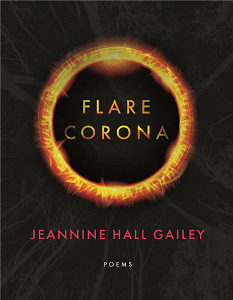
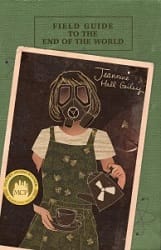
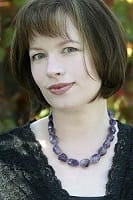 Jeannine Hall Gailey served as the second Poet Laureate of Redmond, Washington and the author of Becoming the Villainess, She Returns to the Floating World, Unexplained Fevers, The Robot Scientist’s Daughter, and winner of the Moon City Press Book Prize and SFPA’s Elgin Award, Field Guide to the End of the World. Her latest, Flare, Corona from BOA Editions, was a finalist for the Washington State Book Award. She’s also the author of PR for Poets, a Guidebook to Publicity and Marketing. Her work has been featured on NPR’s The Writer’s Almanac, Verse Daily and The Year’s Best Fantasy and Horror. Her poems have appeared in The American Poetry Review, Poetry, and JAMA.