MFA vs NYC Part I – a Personal Response and Review
- At April 01, 2014
- By Jeannine Gailey
- In Blog
 2
2

I have to admit that I started reading this book, published by n+1 Magazine, thinking I would hate it (though I’ve always liked n+1). First of all, I believe that “NYC vs MFA” is a false binary – there is no either, or, sometimes there’s both, or neither, or something in addition to…you get the point. And some of the essays were annoyingly out of touch and grating (um, people complaining about how fast they spent their quarter-of-a-million book advances…really?) but some I had some surprising “I have a lot in common with them” or “I really like these people” moments as well. The other response I’ll talk about in Part II of this post, but it has something to do with the “what else can I do?” question in regards to marketing books.
First of all, Tom Spanbauer is an amazing human, and all his little “in between” pieces (also in the “in-betweens” are writers like Meghan O’Rourke and Sloane Crosley) are worth reading and paying attention to – in some cases, more than the essays. There was also a shoutout from an Iraq war vet, Matthew Hefti, to the kind of online, friendly-to-folks-in-the-military program I taught in, National University’s MFA program, because – hey, getting an MFA from remote is hard, getting it while fighting in another country is even harder. Respect.
Eric Bennett’s “The Pyramid Scheme” contained some subject matter I’m very interested in – a bit of investigation of the Cold War era of CIA support for places like the Iowa Workshop, Paris Review, The Kenyon Review, and others. I wanted to immediately have coffee with him and then read his thesis. (Is this the equivalent of an intellectual crush? An intellectual crush, then.)
Melissa Flashman’s essay, “How to Be Popular,” contained the tidbit that she had worked at Luminant briefly during the dot-com boom. Me too, I thought! I wondered if I actually worked with her? Then she became a cool-spotter with trends and then did the same with books. Much hipper than my “became a middle manager at some large software company and then quit and became a poet” trajectory. The essay is fun to read, even if you haven’t worked at Luminant or been a trend-spotter.
“Nine Lives” by Lynne Martin was one of my favorite essays, because it was so fascinating to read about the work that is involved in publicizing books. “Etsy that shit out,” she explains, because most of the people getting the publicity packets are apparently 21-year-old girls. Message received. Hey, I’m still a 12-year-old girl at heart – I like stickers and clever packaging/stationary and pens that smell like cupcakes, so, I think “Etsy that shit out” is a good strategy. (Separately, but relatedly, there is another essay about a writer who, during her spare moments of boredom during her MFA, put some cards she had made in her downtime up on Etsy and got an order of 16,000 from Anthropologie. So, you know, that’s how she’s paying her student loans.)
Also interesting: a surprisingly charming and self-deprecating interview with Paris Review editor Lorin Stein, and the essay by Alexander Chee. On the ick factor side: a surprisingly “I’m okay with sexual harassment in the classroom” sort of essay on Gordon Lish (balanced by Tom Spanbauer’s dry remarks right before it) which made me remember why you should never, ever sleep with power-drunk editors, publishers, or professors, no matter what they promise you, because they are creepy, creepy slimebags, and besides, what would your mother think? Or Margaret Atwood? Any time you’re tempted to sleep with anyone to get published, ladies, just think of Margaret Atwood, shaking her head at you sadly. That’s the crap that made me not want to get an MFA in the first place. (A good commentary on that specific essay here on Bookriot: http://bookriot.com/2014/03/13/seduction-mfa-gordon-lish/) Also, the word “seduction” used in the essay’s title to reference what this creepy old dude was doing with his students makes me throw up in my mouth a little.
So, the overall message on this book from me is: read it, not just because you’re irritated by all the chatter surrounding the book, but because some of the essays are lovely writing by people you’d probably enjoy talking with, who are interesting and who know the workings of the “book biz.” A pet peeve, since this book is all by and about fiction writers, was how one essayist said the “poets all go to Phd programs” and just assumed that the only people doing MFAs were fiction writers, not poets or creative-non-fic. So, that seemed a little like, did you ignore half of your classmates at your program? Hello? Another surprise: though I’ve never lived in NYC and have an MFA and have taught in an MFA program, I identified much more strongly with the essays on the NYC side of the book than the MFA side. I like their energy, their sense of industry. Which I’ll talk about in Part II in my next post…
Rattle poems, ComiCons missed, Cover art and Planning for the next book
- At March 29, 2014
- By Jeannine Gailey
- In Blog
- 0
First of all, thanks to Rattle for featuring my poem Horoscope on their “poem of the day” feature today. It’s a super-old poem – published in 2003, probably written a few years before that – and one of the first three poems I ever had published in real, “legitimate” poetry journals (Beloit Poetry Journal and Seattle Review were the other two, and they all sort of came out at the same time.)
Second, I was supposed to read at Emerald City ComiCon for a panel on the Drawn to Marvel anthology today, but I’ve been fighting a bug all the week, and this morning was the morning it decided to really come out and play – I nearly fainted this morning getting ready, running a high fever, so decided to put the kibosh on going (even though it’s a wonderful Con and I really wanted to support the superhero anthology.) The weather has been pretty miserable lately, one of the wettest Marches on record for the Seattle area in general, which is saying something. Nevertheless, we did manage to catch a double rainbow on camera yesterday, so that was amazing! 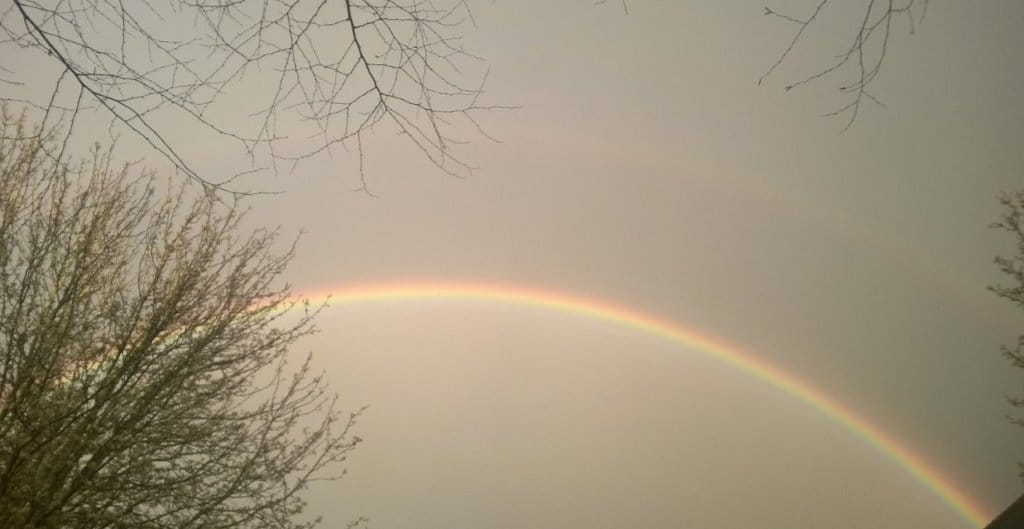
Since the giddiness of announcing the next book, The Robot Scientist’s Daughter, a few days ago, the Mayapple editors and I have been busy working and planning, mostly with the cover art. I think we’ve found something beautiful and I’ll be able to share it with you guys soon. The other thing I have to do is the terrifying part: getting blurbs. You’d think with (this makes) four books, I’d have gotten used to asking people, but I haven’t. It still makes me very nervous. And I write a lot of blurbs for other people, and hate to turn people down, so I’ve been on the other side of that question quite a bit too. Now, I’ve got to start planning, culling poems, deciding on formats and other kiddles and bits…but it’s pretty exciting that it’s really happening. There is almost no better time to work on a book than right after it’s been accepted for publication, because you’re really motivated after realizing “hey, other people are going to see this!”
Announcement – The Robot Scientist’s Daughter will be released March 2015 from Mayapple Press
- At March 25, 2014
- By Jeannine Gailey
- In Blog
- 5
OK, so here’s the official announcement I talked about a couple of posts ago: my fourth book, The Robot Scientist’s Daughter, will be published by Mayapple Press in March 2015! Mayapple Press is pretty interesting in that they have published women’s speculative poetry in the past, which is a fairly unusual thing to find! Feminist AND with sci-fi leanings? It’s a pretty cool fit.
I’m excited about it. The editors are great, this is the first time I will have SPD distribution, which is cool. I’m working on getting blurbs but I already have one really nice one I’m excited to share soon, along with some possible cover art ideas!
This book is probably my most personal, as it’s about my father’s work as a contractor for Oak Ridge National Laboratories, my childhood growing up around robots (cool!) and nuclear waste (not quite as cool) and some of the environmental fallout from both Oak Ridge and Fukushima. There are persona poems, but this book is probably my most autobiographical work so far. I remember Ilya Kaminsky, when he read my first book, said “Now you must make your own fairy tales.” I feel like this book is my attempt to do that.
Kelli Russell Agodon’s debut Hourglass Museum reading and writer movies
- At March 23, 2014
- By Jeannine Gailey
- In Blog
- 0
Just back from Kelli’s lovely debut reading for her newest book, Hourglass Museum.
It was an absolutely perfect spring day, the cherry blossoms were blooming, the mountains were all out, and I spent a great day at one of my favorite places, Open Books, with some of my favorite people, including those pictured: Kelli, Martha Silano, Kelly Davio, Kathleen Flenniken, and Peter Pereira. After the party, Glenn and I went for a quick walk at Green Lake park, just in time to watch the sun go down.
I just watched the indie film “Authors Anonymous,” about a writer’s group gone bad when one member finds unexpected success. I was reminded that the writing group where Kelli and I met over ten years ago is a very special group. No one has really imploded – at least not yet! And I think we try to really support each other, in success and in rejection. (That’s like, the “in sickness and in health” of writer friend vows, I believe.) And a lot of the people at the reading today were people that embraced and supported me when I first came to Seattle (gulp) fourteen years ago, (can it really be that long?) excited to be in a big time “reading” city and make friends with real writers! I also loved that at this reading, there were people of every generation, from 80 to under 18, it gives me hope for humanity when I see stuff like that. “Authors Anonymous” was a little dark and had a lot of cliches (some, sadly, true, but still), I preferred the other indie writer film I watched recently, “Adult World,” about a young, straight-A fresh-out-of-undergrad poet who spends all her money on writing contests, gets cut off by her parents and has her car stolen, and takes a job at a porn shop while stalking an older, bitter poet (one of her heroes who teaches at a local college) demanding that he mentor her (John Cusack in what I thought was a very charming turn.)

Announcement soon, Flannery O’Connor quotes and writers with illness
- At March 21, 2014
- By Jeannine Gailey
- In Blog
- 0
I will have an announcement to make soon 🙂 Hopefully you will agree with me that it is good news. I am always happiest when there is a flurry of activity around beginning or completing something, I think.
I’ve been reading “Conversations with Flannery O’Connor,” which is now out of print and hard to find, even in libraries and used bookstores, but worth reading. Flannery reminds me a bit of Frida Kahlo in that she puts a bit of herself, her view of herself, into her work – her stories are full of disfigurements and ailments, women who are deaf, women who have wooden legs, people with strange grotesque appearances. Of course, because of her lupus, she herself walked with crutches and it affected her appearance, so she was highly aware of not fitting in, of not being “normal.” Her continual focus on the Southern grotesque is a bit like Frida’s self-portraits – full of her own distorted imagery of her own body. She is imperfect, cantankerous, the language she used sometimes frightening, a Catholic who nonetheless wasn’t impressed with Lourdes except by the germs, by a visit to the Vatican, and who thought most nuns and priests undereducated. (I got a real sense of her personality from her collected letters, easier to find and also worth reading.)
So, her lupus set upon her fairly severely after a trip to the writer’s residency at Yaddo, requiring multiple hospitalizations, experimental drugs, home injections, and later, the crutches. Nevertheless, she didn’t let this affect her work schedule, her work socializing, even. Flannery went and gave readings and taught classes as much as she could, and when she was not quite as able, she hosted writers at her house. (A young writer from Atlanta said of her: “She’s certainly not a hermit, though she’s not an extrovert, either.” Sound familiar?)
Flannery is a bit of a ghost of mine, she haunts me. Flannery was a good writer at a very young age, having a good deal of success in her early twenties, befriending important people, even at that age aware that her work was good and deserved to be treated that way. She turned down a book prize’s publishing contract because they wanted to change her work – that took guts. Despite getting as much treatment for her lupus as the time and technology and her money could allow, she was dead at 39, a year younger than I am now.
Here are a couple of quotes I particularly enjoyed from “Conversations.” Most of them I have never seen before, on the web or anywhere else.
“There has been no interesting or noble struggle,” she said of her life. She lived with her mother and helped raise peacocks and fancy chickens and ducks, which supplemented her income (which increased as she got older) not mostly made up of book royalties but fellowships, awards, and grants. She used a lot of the money on hospital trips. She complained frequently of the low sales of her books, about bad reviews or (what she felt were) ignorant or misguided reviews.
Her advice to new writers? “start reading and writing and looking and listening. Pay less attention to yourself than to what is outside you, and if you must write about yourself, get a good distance away and judge yourself with a stranger’s eyes and a stranger’s severity.” (Probably still good advice, esp. for young college kids.)
Here’s a saucy description of the “average reader.”
Flannery: “The average reader, however, is a good deal below average. People will say with considerable satisfaction, “Oh, I’m an average reader” when the fact is they never learned to read in the first place, and probably never will.”
On “the writer’s temperament:”
“People seem to surround being-a-writer with a kind of false mystique, as if what is required to be a writer is a writer’s temperament. Most of the people I know with writers’ temperaments aren’t doing any writing.” (And remember, she was friends with such famous writing temperaments as Robert Lowell!)
As for her disease, in an interview, she said “the disease is of no consequence to my writing, since for that I use my head and not my feet.”
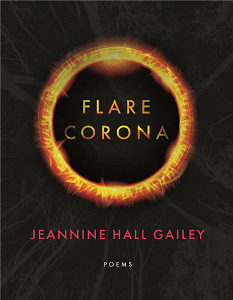
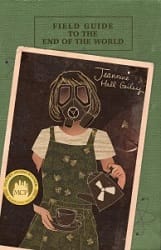
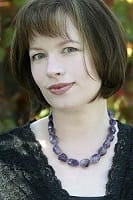 Jeannine Hall Gailey served as the second Poet Laureate of Redmond, Washington and the author of Becoming the Villainess, She Returns to the Floating World, Unexplained Fevers, The Robot Scientist’s Daughter, and winner of the Moon City Press Book Prize and SFPA’s Elgin Award, Field Guide to the End of the World. Her latest, Flare, Corona from BOA Editions, was a finalist for the Washington State Book Award. She’s also the author of PR for Poets, a Guidebook to Publicity and Marketing. Her work has been featured on NPR’s The Writer’s Almanac, Verse Daily and The Year’s Best Fantasy and Horror. Her poems have appeared in The American Poetry Review, Poetry, and JAMA.