Interview with Kelli Russell Agodon on the writing life, balance, and more

Today’s Summer Interview series is with Kelli Russell Agodon, whose recent book (Letters From the Emily Dickinson Room) just won the Foreward Magazine Gold Book of the Year Award, is also a good friend and a constant encourager. Here’s what I said about her second book:
“Agodon’s book is a bright, funny, touching meditation on loss, love, and the power of words. Her genius is in the interweaving of God and Vodka, bees and bras, astronomy and astrology, quotes from Einstein and Dickinson, a world in which gossip rags in checkout lines and Neruda hum in the writer’s mind with equal intensity.”
Kelli Russell Agodon’s current book, Letters from the Emily Dickinson Room (winner of the White Pine Press Poetry Prize) was recently named Book of the Year in Poetry by ForeWord Magazine. She is also the author of Small Knots (2004), Geography (2003) and an editor at Crab Creek Review. She lives in a small seaside town in the Northwest where she’s an avid mountain biker, hiker, kayaker, and is a new fan of longboarding (stand-up paddle surfing).
She blogs about living & writing creatively here: Book of Kells www.ofkells.blogspot.com
Connect with her on Facebook here: www.facebook.com/agodon and find her on Twitter here: kelliagodon. Her main homepage: www.agodon.com.
Letters From the Emily Dickinson Room (White Pine Press Poetry Prize) (2010)
Small Knots (2003)
Jeannine Hall Gailey: First of all, congratulations on winning the Gold Foreword Magazine Book of the Year Award in Poetry for your new book, Letters From the Emily Dickinson Room!
You’ve always inspired me by having a practical and hardworking approach to the impractical art of poetry. Could you talk a little bit about your goals over the past ten years and how you set them? What is your approach to the art of poetry submissions?
Kelli Russell Agodon: Thanks, Jeannine! It’s was incredibly exciting learning about the Foreword Prize, I’m still in disbelief of it, but feel very honored having been chosen.
As for my practical approach to the impractical art of poetry, I have always believed I go about things differently in my writing life because of my Capricorn nature. Many artists are right brain thinkers, some artists are messy and enjoy chaos, but as someone who has always been stronger at math and making lists, I have a lot of left-brain elements that have helped me organize my writing life, both in making time for it and setting goals.
My main goal for my poetry has always been to write a good poem, only to be followed by try to write a poem better than the last poem I’ve written. But I’m someone who looks at things in small steps—write a poem, submit a poem, put strongest poems together, write a poem in a similar theme, organize manuscript, submit manuscript, etc—and see them lead to larger projects.
Also, I have a great group of friends who I email my goals to as I realize I am more accountable to others if I have to report back whether I made my goals or not. It’s kind of a mind-trick, but it’s a good way for me to stay on track and get things done.
One way my goals have changed over the past ten years is that I’m not as attached to outcome as I have been in the past. My goal is write and complete good work. I am less concerned if these works go on to be published or win awards (though I do like this when it happens) and more concerned about the joy and satisfaction I get with the act of writing.
As for poetry submissions, my routine is random and haphazard, and I wouldn’t recommend it. I can go months upon months without submitting poetry. I believe in regards to submissions, the smartest writers have some sort of schedule like “submit one batch of poems every Friday.” This is what I’d recommend to poets who want to get their work published and out in the world.
My way is to neglect submissions until I realize I have nothing out to literary journals then send out a huge batch and neglect it again until I have nothing out. I find I become overly critical with my own work when I’m submitting it, so I have to put on my Personal Assistant hat and literally tell myself that I am Kelli Agodon’s assistant who is just submitting poems, not revising them. As I type this, I’m seeing a lot of the art in poetry goals and submissions are to play a lot of tricks on myself.
JHG: As one of the editors-in-chief of Crab Creek Review, could you tell us what the magazine is looking for, and what in direction you see it heading? What advice would you give poets trying to have their work published in literary journals? What’s the biggest mistake beginning poets make when they send work in?
KRA: Crab Creek Review is definitely working toward a more national presence. We’ve been in print since 1984 and have no plans of going out of print or becoming an online journal. We have a strong group of donors, subscribers, readers and writers who keep us going and we are so thankful for this. We’ve added some new features such as interviews (our current issue has interviews with Mark Doty & Todd Davis and our next issue will feature Nin Andrews), but we always focus on our goal of publishing the best writing from the Northwest and beyond.
For poets trying to publish their work, my advice would be—
1) Submit your best work and submit finished poems. That might sound funny to read, but you’d be surprised how many poets send off their poems prematurely. They are very close to being done, but had the poet done one or two final revisions before sending it off, it could have made the difference.
2) Learn about the journal you’re submitting to and what kind of work they publish, don’t just send blindly to places you’re not familiar with.
3) Don’t let rejections get you down. We all get rejected. If someone says they never get rejections, they are lying. It’s part of the deal with being a writer. Realize your work may have been rejected merely because the editor was tired when she read it or the issue was already full—don’t assume it was rejected because it was of poor quality.
As for the biggest mistake new poets make, here’s some do’s (and a don’t or two) I’d recommend (along with some mistakes I made myself when I was a beginning poet)—
1) Don’t trying to be cute, quirky, or whimsical in their cover letter or with their submission. As a younger poet, I have done very dumb things like handwrote “Enjoy!” with some weird cloud scene on a cover letter as if this is what would get me noticed. It probably did, but not in a good way.
2) Do start with your favorite regional magazines. Many times if you are published with them, you’ll be invited to their release party as a reader; this is a great way to learn about publishing and get a chance to read for an audience.
3) Do be humble and professional. Send a cover letter with any publication credits you may have, maybe something about yourself or something you like about the last issue.
I once wrote on my cover letter to The Paris Review something like, “I have returned to writing poetry and I wanted your magazine to be the first place I submitted.” I’m sure they were thrilled with this–Oh great, a new poet sending us her horrible poems. I never considered that this statement from me was probably a huge red flag that I had no idea what I was doing.
4) Don’t follow-up too quickly or be upset if it takes a while to get back to you. Remember that many literary journals are run by volunteers who are writers themselves and we have to balance our own lives, other jobs, family and our writing as well. We do our very best to respond in a timely manner.
5) Do read and follow the submission guidelines. If you don’t follow them, your work may not even be considered. Each journal is different and have certain ways they do things; they will look at your work with happy eyes if you’ve paid attention to these.
JHG: I ran into some recently graduated MFA students the other weekend, and I noticed a lot of them were a bit down and disoriented after graduation. They had stopped writing, stopped sending out, and felt discouraged and overwhelmed by trying to publish their theses. What three suggestions do have for post-graduate MFA students that you wish someone had told you before graduating?
KRA: One is that is okay to take a few months off and not write. I took quite a few months where I reconnected with friends, went out to lunch, and just enjoyed not writing. Getting an MFA is a lot of work and it’s okay to rest afterwards.
The second advice I’d give is to find a schedule that works for you and stick to it. You earned this degree for a reason—to be a better writer—now it’s your job to find time to do it on your own.
My final suggestion would be to find a group of writers who will be your support. They can be friends from your MFA program or other writers you know. Stay in touch, set goals, and hold each other accountable. Because the writing life is so solitary, it’s good to have a community after graduation to offer support and help each other out.
JHG: On your blog you often talk about trying to balance art with life. What advice would you give someone about trying to build more time for art into their already hectic schedule?
KRA: My main advice would be to simplify your life to what is important. I’m always surprised when writers say, “I don’t have time to write” and then in the next breath ask me if I saw The Biggest Loser last night or I see them posting on Facebook. It’s definitely challenging with all the distractions the world offers and the internet, while a very handy research tool, is also a tempting way for writers to lose a lot of time that could have been spent for writing.
But we each have the same amount of time and we each choose what we want to do with it. Choose your priorities. If writing is a priority for you, you’ll make time for it. It’s kind of tough love advice, but I truly believe it.
JHG: Any final words you’d give writers making their way in the world?
KRA: I recently read a quote I loved from Stephen Prossfield’s The War of Art—”If you find yourself asking yourself (and your friends), “Am I really a writer? Am I really an artist?” Chances are you are. The counterfeit innovator is wildly self-confident. The real one is scared to death.”
Doubt always exists in writers and artists. I read that John Berryman would wake up feeling like a genius and go to bed feeling like a fraud. It’s the negative voices we need to turn away from. But deep inside us, I have always believed that each of us knows exactly what we should be doing if we listen closely enough.
My inner compass has always been what’s directed my life and it’s always pointed towards writing. Every time I listened to my head, I was wrong. I chose the wrong jobs, the wrong everything. Every time I listened to that inner voice no matter how ridiculous it seemed, it’s always led me to where I needed to be.
As writers, we just have to trust that our paths can be quite different than the rest of the world. Sometimes we just have to trust it will all work out.
Thanks, Jeannine!
17 years and hoping for another 17…
 It was our 17th wedding anniversary today (it’s the furniture anniversary, but we can’t afford any of that this year!) I woke to a beautiful spray of pink roses and lilies from Glenn, and we went on our planned trip to one of the four places I really missed while I lived in California…the Snoqualmie Falls, one of the most beautiful waterfalls in the States and part of the opening credits of Twin Peaks. (The others were the tulip fields in La Conner, WA, which I got to visit for my birthday, the lavender fields in Sequim, WA, which I will see when I go up to visit the Port Townsend Writers Conference for a little reading in about a week, and the little Canadian resort town of Whistler, which they have probably ruined by Olympics-ing it.)
It was tremendous, a cloudless blue sky and the mist of the waterfall a wonderful mix with the warm sunshine, the falls as big as I’ve ever seen them for this time of year (usually in the summer it’s reduced to a bit of a trickle) and the wildflowers blooming over the edges of the falls. The drive up, about an hour away, reminded me of my childhood in the Tennessee mountains – nothing but winding roads around trees for miles and miles. No fancy dinner, no piece of jewelry, could make me as happy.
Interview with Helen Phillips, author of And Yet They Were Happy
Helen Phillips is the recipient of a Rona Jaffe Foundation Writer’s Award, the Italo Calvino Prize in Fabulist Fiction, The Iowa Review Nonfiction Award, the DIAGRAM Innovative Fiction Award, the Meridian Editors’ Prize, and a Ucross Foundation residency. A graduate of Yale and the Brooklyn College MFA program, she teaches creative writing at Brooklyn College. Originally from Colorado, Helen lives in Brooklyn with her husband, artist Adam Thompson.
Links: www.helencphillips.com
To her book, And Yet They Were Happy, on Amazon And Yet They Were Happy (LeapLit)
Helen Phillips’ new book, And Yet They Were Happy, is a mad conglomeration of marriage fables, Biblical tales gone wrong, dead brides and regime changes. As those who read this blog regularly already know, she had me at “fairy tale characters combined with Greek mythology with apocalyptic overtones.” But I was as taken with her form as I was with her subject matter. I’ve asked her a few questions that I thought my poet readers might find interesting!
Jeannine Hall Gailey: Helen, amazing work in your book! You’ve already won the Calvino Prize for Fabulist Fiction, and I read one of the reviews that called your pieces “surreal miniatures.” When I picked up your book, I’m not sure what I was expecting, but what I recognized inside was about two-page pieces that I might call “prose poetry” and that others might call “short-shorts,” “fables” or “flash fiction.” I also read that people described it as “experimental fiction,” but I don’t know if I wanted to label it an experiment, more like a different approach to storytelling.
When did you start working in this form? Can you talk a little bit about how you developed it? It seems unlike what most people think of as a novel, but very similar to a longer, thematically-linked book of poetry.
Helen Phillips: First off, Jeannine, I want to thank you for your insightful and generous description of And Yet They Were Happy—I love the “mad conglomeration” articulation.
I started working on this book in 2007, after I’d gotten fed up with the novel I was working on. I had so many ideas for narratives and metaphors that it was frustrating to be bound to one project that didn’t enable me to throw in, say, a trash-talking mermaid out of the blue. I wanted a project that would enable me to pursue every crazy idea I had. So (at the urging of my husband Adam Thompson, a visual artist who’d recently taken a break from painting to do a series of simple line drawings), I decided to give myself a simple assignment: each day I’d write a 340-word story (approximately one typed page). That was the one and only rule. Beyond that, anything was fair game—Bob Dylan and Persephone could be sitting around the breakfast table with me, as long as I told the tale in 340 words (I’d usually begin by writing 800 or 1000 words and then spend the vast majority of my writing time whittling it down). Somehow having that lone rule ended up being extremely liberating—I felt more alive and alert creatively than I ever had before.
I’m honored by your description of the book as a “longer, thematically-linked book of poetry.” I consider myself primarily a fiction writer (and got an M.F.A. in fiction); however, I believe that poetry is the most highly evolved form of writing. I’ve been enjoying the ambiguity of the book’s genre. Some reviews call it a short story collection, others call it an experimental novel, etc. I don’t care how it’s labeled, and love the idea that different readers perceive it as being different genres.
JHG: What I loved about it, its genre-hybridity, its resistance to classification, made it difficult for you sell at first (I read this in your Goodreads interview here and your Huff post interview here ) – but now it’s been praised by outlets such as Publisher’s Weekly and Elle Magazine, surely not known for embracing edgy fiction. Are you feeling a little bit vindicated? And how much do you love your publisher now?
HP: Yes, it’s been quite shocking/amazing (and indeed a tad vindicating!) that some more traditional media outlets have embraced the book, particularly given the fact that all the big publishers in New York turned it down with comments like “these are just too experimental and I honestly don’t think I could get them the attention they deserve on our list.”
I think perhaps this speaks to your earlier point—ultimately this book isn’t so wildly experimental, it’s more just a different approach to storytelling. There are still clear sentences and paragraphs on each page. There are still recognizable characters and situations. In fact, one of the most common comments I’ve gotten from readers is “This book is so relatable!” It’s a very raw and honest book about love, death, marriage, anxiety, family, etc.—granted, those themes are explored via strange transformations and magical occurrences and contorted fairytales, but all of that serves as metaphors for these central human concerns.
And yes, I will be forever grateful to indie publisher Leapfrog Press for taking the risk none of the big publishers was willing to take.
JHG: The subject matter ranges from weddings to monsters to apocalypses, yet retains an astonishingly down-to-earth (and often humorous) voice and tone. “Fight #2,” for instance, contains language that could be considered Biblical but also references that I thought might be to superhero characters (“WonderTwin powers, activate?” I couldn’t help but be reminded…) In “Wife #8,” Snow White pops up; in “The Helens” section, Bob Dylan and Jack Kerouac. Mermaids and characters from Greek mythology pop up as well. What are your inspirations and influences? A little classical here, a little pop culture there?
HP: I love juxtaposing myths/fairytales/Bible stories with pop culture, because those age-old stories about basic human desires and frustrations are still so relevant. At the same time, combining these mythical images with contemporary ones can make for interesting tension (and, at times, humor). I’m glad you see the humor in the book—that was actually a very important part of this project for me. I wanted there to be the lightness of that to counterbalance some of the bleaker components. I love Ovid’s Metamorphosis, I love the Coen brothers, I love Disney’s Beauty and the Beast, I love Dylan of course …
JHG: Have you ever read Matthea Harvey’s book, Modern Life? It would make a great companion piece for “And Yet They Were Happy” – apocalypse, regime changes, a strangely chipper narrator for grim future scenarios. I just read another book, Monster Party by Lizzy Acker, that also features yes, monsters and apocalyptic scenarios. Do you think our generation (well, I think we’re all mostly in our late twenties to thirties) is particularly interested in the end of world? (I think it has something to do with the nature of the television shows and children’s books popular in the seventies and early eighties, personally…)
HP: I don’t read nearly as much poetry as I’d like to, though I’ve recently been thrilled by Mary Ruefle’s The Most of It and Maggie Nelson’s Bluets (also not sure what genre those books are). I haven’t read Modern Life (I did love Matthea’s recent prose poem, “The Straightforward Mermaid,” in the New Yorker) or Monster Party—I’ll be sure to check them out.
Yes, I’ve been thinking a lot about this apocalyptic obsession. Statistically speaking, the world is better off than it’s ever been. More people live longer, healthier lives. But because of the internet, we have more ability than ever before to know about all the different ways people are suffering and dying. We see scenes of apocalypse all the time—in New Orleans, in Haiti, in Japan, in Iraq, in New York, in Pakistan, in Indonesia. It feels so near at hand.
There’s also a sense now of invisible, unexpected threats. Are our cell phones going to give us cancer? Are our children going to be brain damaged by the mercury in fish from the poisoned seas? In what unsuspecting place will the terrorists strike next? It breeds paranoia.
I feel the paranoia, I feel the fear and instability and loss, and in writing And Yet They Were Happy I was trying to talk myself into a state of greater bravery by confronting those fears head-on.
(I’d be curious to hear more about your theory re: ‘70s and ‘80s books and TV shows!)
JHG: What advice would you give a poet who wanted to try a foray into fiction? After reading your book, I suddenly felt it was a strange but tantalizing territory…you’ve really married an attention to language and economy of expression with a fiction-writer’s broader palettes of character and plot.
HP: Thank you, Jeannine. I teach an intergenre creative writing seminar at Brooklyn College, and we talk a lot about the intersections between the different genres. It seems to me that exploring those intersections is a good place to start if you’re moving from one genre to another. For instance, if you’re a poet interested in writing fiction, try writing a group of three prose poems in which each has the same protagonist. It can be intimidating/paralyzing to do something completely new, like going from writing poems to writing a novel, but there are many intriguing in-between places to explore along that spectrum.
Interested in Hybrids?
Hybrid Forms, that is. I am! My new book, She Returns to the Floating World, has a plethora of hybrid forms in it, including the Japanese haibun (which Aimee Nezhukumatathil wrote about in this season’s American Poet newsletter – this blogger discusses the article)
I’ve read three books recently that really turned me on to a new thing going on with fiction, especially the fiction of young women. Flash fiction with an ear for interesting language, sassy female voices tinged with sadness talking about subjects like marriage, war, apocalypse.
It all started with winning a zombie poetry prize – and a copy of Lizzy Acker’s new book from Small Desk Press, Monster Party . The pieces in the book are a couple of pages long, and the voice is a casual vernacular. The narratives go all over the place – couples bicker over video games, sure, but also, a girl ponders the birth of her mutant child and aliens play bingo. Sample sentences from “Baby:” Now you know baby I am thirty-two this year. The oldest human being left on earth. We’ve had a good run sugar but I know the symptoms of airborne syphilis and I feel these are my last moments with you…” I liked these pieces – and listening to Lizzy read them out loud, I noticed I could not immediately tell whether she was reading poetry or prose. Interesting, I thought.
Then I received a copy of Katie Farris’s new book from Marick Press, BoysGirls . The language inside is immediately recognizable to a poet (say, me) as poetry – careful, sonically graceful, and the sharp impact of the short piece. However, the pieces could also be described as little fictions – fables, fairy tales turned on their heads. The devil shows up and a girl grows to twenty stories. Sample sentences from “The Invention of Love:” “The Boy with One Wing sits in a waiting room, watching people enter, leave, examine the waitlist, attempt appointments. They carry their most precious, destroyed things.” My kind of work, right? Again, this was a kind of writing that resisted easy definition – was it poetry or fiction?
On the recommendation of no less of a highbrow literary publication than Elle Magazine (and hey, I discovered Louise Gluck through Cosmo, so…) I picked up a copy of Helen Phillips’ And Yet They Were Happy (LeapLit). Once again, I turned the page expecting long chapters and a traditional narrative, but found, instead, over a hundred connected short form pieces – about two pages apiece – with narrators that shifted, apocalyptic overtones, characters from Greek mythology and the Bible, and monsters. Of course, I fell in love with the book. (Snow White even makes an appearance!) From “Regime #6:” Because our government is concerned about the low number of infants being produced by our population on an annual basis, a National Reproduction Day is declared, and the lights on the subway are turned to their lowest, rosiest settings. Slender white candles are given out free of charge. All married citizens of childbearing age are ordered to stay home.”
It’s no coincidence that people describing both Katie Farris’ book and Helen Phillips new novel/collection invoke Calvino, because the combination of intelligence, whimsy, and wit are certainly there – but I think this is something new, more contemporary, some seizing of some momentary zeitgeist. I think poets should go pick up a copy of Monster Party, boysgirls, and and yet they were happy, and read them as we try to decide: what hybrid form will we wear today? what hybrid will be born to us today?
The Fourth of July, a review of She Returns to the Floating World, a Poem for Japan and some Recipes
Happy Fourth of July, Everyone!
Thanks to Sandy Longhorn for her beautiful review of She Returns to the Floating World:
http://sandylonghorn.blogspot.com/2011/07/what-im-reading-she-returns-to-floating.html
For some delicious red, white, and blue recipes, go check out my blueberry ricotta gelato and grilled watermelon salad recipes at my gluten free blog here:
http://glutenfreenorthwestadventures.blogspot.com/
On a somewhat more sobering note, I read the disturbing news that Cesium-137 traces have entered the water supply of Tokyo, Japan, as a result of the nuclear power plant disasters out there. This poem, “Cesium Burns Blue,” describes the contamination of my childhood home, Oak Ridge, with this same isotope. It was first published in The Cincinnati Review Winter 2010 issue.
Cesium Burns Blue[1]
Copper burns green. Sodium yellow,
strontium red. Watch the flaming lights
that blaze across your skies, America –
there are burning satellites
even now being swallowed by your horizon,
the detritus of space programs long defunct,
the hollowed masterpieces of dead scientists.
Someone is lying on a grassy hill,
counting shooting stars,
wondering what happens
when they hit the ground.
In my back yard, they lit cesium
to measure the glow.
Hold it in your hand:
foxfire, wormwood, glow worm.
Cesium lights the rain,
absorbed in the skin,
unstable, unstable
dancing away, ticking away
in bones, fingernails, brain.
Sick burns through, burns blue.
[1] Cesium burns with a blue light, explodes on contact with water, and has a highly radioactive isotope which was used in experiments at Oak Ridge. It can cause mental instability or other problems if absorbed through the skin or ingested; children ingesting produce grown in contaminated soil might exhibit mental symptoms as well as physical symptoms later in life.
You can see me reading the poem last year in San Francisco at a Fourteen Hills reading, here:
http://www.youtube.com/watch?v=NolDPaTkZDk
My husband Glenn (a chemical engineer) wants me to remind you that our blue fireworks use less dangerous copper salts, which can burn blue or green, not Cesium.
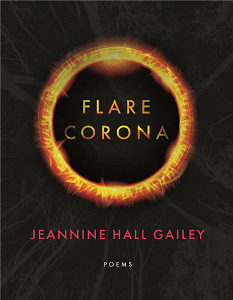
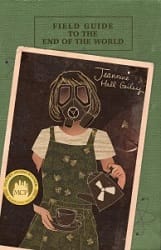
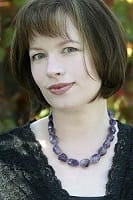 Jeannine Hall Gailey served as the second Poet Laureate of Redmond, Washington and the author of Becoming the Villainess, She Returns to the Floating World, Unexplained Fevers, The Robot Scientist’s Daughter, and winner of the Moon City Press Book Prize and SFPA’s Elgin Award, Field Guide to the End of the World. Her latest, Flare, Corona from BOA Editions, was a finalist for the Washington State Book Award. She’s also the author of PR for Poets, a Guidebook to Publicity and Marketing. Her work has been featured on NPR’s The Writer’s Almanac, Verse Daily and The Year’s Best Fantasy and Horror. Her poems have appeared in The American Poetry Review, Poetry, and JAMA.