Japan, anime, apocalypse

All the horrible news coming in from Japan. I still haven’t heard from one family friend from Japan, but most of the people I know in Japan are safe. But still, the images, the terror of the earthquake, the tsunami, and now the nuclear reactor threats, are so terrible, they won’t stop. I’ve been dreaming every night about Japan. Every morning when I wake up, the death tolls have gone up.
I remember someone wrote that anime was characterized by so much apocalyptic imagery because Japan is the only country that has experienced and survived a real apocalypse. The poems in my second book return to these symbols of destruction and pain in the history of the country, symbols we can only partially understand. Haruki Murakami wrote a book of short stories called “After the Quake” after the Kobe earthquake. Many of the stories dealt with the emotional aftermath of that destruction, the estrangement and non-trust of anything, the lack of a feeling of safety, not trusting what literally was going on underfoot. Still, these symbols and stories can only help us understand a little, like watching footage from thousands of miles away is not the same as understanding what it’s like to be there.
There is little I can do from here, the little amount of money I can donate, the prayers, of course, but really, it’s nothing in the face of so much.
A little while ago, I drove from San Diego to Berkeley to see Roland Kelts interview Hayao Miyazaki about his new film, Ponyo on a Cliff. The young girl of the title is an undersea being that falls in love with a human boy, in a sort of variation on The Little Mermaid, and in visiting him and determining to become human, she throws the universe out of balance, bringing storms to a small fishing village where the boy’s father works as a commercial fisherman and his mother works in an elderly care facility. The moon veers closer to earth, and a tsunami swallows the town, including the sweet elderly folks, the mother, and the two main characters. (Of course, this being a Miyazaki film, these characters aren’t in any way harmed, but are somehow protected inside a magic undersea bubble.) Primordial threatening giant fish prowl the streets of the town, now underwater, as Ponyo and the young boy sail around on a toy boat looking for the mother character. It’s very eerie now watching these images, the storm nearly overtaking the cars of villagers, refugees crowded into tiny boats looking for people to rescue, storms tossing boats into each other. Miyazaki, in this interview, said that it time of national disasters, like tsunami, that the Japanese people became very good at taking care of each other, that the feeling of community was increased by the disaster somehow. I only remember this odd comment now because of what has happened.
Two good places to donate (which have good ratings in terms of spending more on actually helping people than administration:)
—Doctors without Borders
—Northwest Medical Teams
Oprah and Poetry, More Girl Poets in a Boy’s Club
My thoughts are with everyone affected by the gigantic quake and tsunami that hit Japan last night. The biggest one that’s ever hit Japan, since the 1800’s when we started keeping measurements. I’m watching local news that showing tsunami surges in Seaside, Oregon.
Go check out these posts on Girls in the Boy’s Club by Kelli and January, definitely worth reading their continuations of the conversation.
Oprah Magazine’s April Issue is poetry focused. Check it out and make your own decisions about how this magazine helps or hurts poetry. Young up-and-coming poets in fashion layouts (weirdly – with no poems from the poets featured, sadly) and interviews with Mary Oliver and W.S. Merwin, little snippets from poets like Sharon Olds and Terrance Hayes. Wish there was more actual poetry in the magazine, but I guess anything that brings poetry to the masses…? Strangely ambivalent about this.
Girls in a Boy’s Club: Tips for Poets
Elisa had a post about the excellent manifesto, How to Be a Woman in Any Boy’s Club. As someone who has worked in a few boy’s clubs (working as a tech manager for a decade before my foray into writing) I will say that I think poetry has some of the subtlest but also most difficult sexism I have ever run into, which makes it more frustrating. Sure, you’re welcome to the party, but only if you’re this kind of girl – and even then you’re almost statistically guaranteed less in terms of awards, grants, publication, and reviews. As I commented on Elisa’s blog, a lot of the problem is summed up in the headline I saw recently: “Women more educated, still making less than men.” In the end, we can work harder, but we still get…less.
I identified with this essay quite a bit, as I grew up with three brothers and no sisters, and automatically gravitated towards hanging out with guys for most of my life, took up stereotypically “guyish” habits, etc. I’m not a tomboy by any stretch of the imagination, but as you can see with my poetic fascination with robots, comic books, anime, etc, I definitely felt (and feel) comfortable in the quintessential fortresses of male culture. Anyway, this made me think about what I was personally doing to help poetry become less of a boy’s club.
So, since I’m a take-action kind of person, I thought I would post some tips, some action items, for poets to help make the poetry world a little bit less of a boy’s club. (Hint: these tips work equally well for men and women.)
–When you buy a book of poetry, try one by a female! When you review a book of poetry, try a book of poetry by a female.
–When you review said book of poetry by a female, try to eliminate any references to Sylvia Plath, Anne Sexton, or Elizabeth Bishop. I’m so tired of reading comparisons to those three women poets, as if male reviewers haven’t read any other female poets besides those two or three. It just looks lazy, fellas.
–When you have an opportunity to pay readers, have a woman out. Remember, we’re making less money over our whole life span, so cut a sister some slack. Try to remember to invite a woman poet who is not already rolling in dough and awards – that would be extra nice.
–Female poets: start reviewing books. You have something to say about literature and your voice is just as valuable as a male reviewer’s voice. Remember, if you’re not part of the conversation, you’re letting somebody else drive it. Write like your work is something important. Send out like you already know your work is great. Don’t keep everything in an envelope in your desk hoping someone will Emily Dickinson you, because let’s face it, it’s probably not going to happen.
–Don’t automatically laud men who write a lot of sexist poetry. If I have to read one more poem comparing a woman’s body part to something edible…are we allowed to call male writers out when they compare women to animals, lessening women to the sum of their body parts, etc? I was just thinking about Tony Hoagland’s poem “The Change” and how it started a discussion of race. What about a similar discussion of sexism in poetry?
–Volunteer for literary magazines or book publishers that promote work by women. I’ve volunteered for The Seattle Review, Silk Road, The Raven Chronicles, and Crab Creek Review, and was amazed at what I learned as a board member, editor, reviewer, etc.
In a totally non-related moment: Interested in gluten-free recipes for creme brulee? Interested in gluten-free Northwest restaurant info? See my newish blog! First post has a lactose-free, gluten-free creme brulee recipe. I plan to chronicle my experiments in gluten-free cooking and restaurant-visiting there.
New poems out and about in the world, stylish bloggers, and truth versus lies
A few new poems out there in the world, including a few from my newest in-process collection called “The Robot Scientist’s Daughter:”
—Cerise Press’s Spring issue features two new poems, “The Robot Scientist’s Daughter [director or dictator]” and “Half-Life”. The issue also features work by Ann Fisher-Wirth, G. C. Waldrep, and Susan Musgrave.
—The journal Eleven Eleven (a beautiful little creation from the California College of the Arts) Issue Ten features three new poems, “The Robot Scientist’s Daughter, Before,” “She Introduces Her Husband to Knoxville,” and one of Kelli’s favorite titles, “On the Night of a Lunar Eclipse, a Missile Shoots Down a Spy Satellite”. This issue also features Megan Snyder-Camp, Hollie Hardy, and Mark Wallace.
–The new American Poetry Journal Number 10 is a hybrid creation, romanced by cover art of two intertwined peacocks, with National Poetry Review. My prose poem, “Seascape,” is featured on the “American Poetry Journal” side, along with work by friend and blogger Keith Montesano, and many of my poet friends are featured on the flip side in National Poetry Review: Mary Biddinger, Tom C. Hunley, and Amanda Auchter. It’s a two-for-one deal!
I feel like now we should have a party with all the poets in these three issues of journals, featuring a wide range of aesthetics and personalities. I think it would be a blast!
I was remiss is not thanking Kelli for nominating me for her Stylish Blogger award a week or so ago, and then I think I was supposed to reveal some truths and a lie. Seventeen truths and four hundred lies. So, I will also use the poems that came out this week as a jumping off point for some truths and lies. Can you guess which is which?
–My childhood home in Tennessee, a two-story brick house on eight acres of farm and woodland, was razed to build an insane asylum. Which then was never built.
—The poem “She Introduces Her Husband to Knoxville” is based on a lie, as my husband has never been to my childhood home in Knoxville.
–I have taken many job aptitude tests that told me I should be a dancer or a director.
–I have owned a Barbie “President” doll.
See if this week’s poems hold any clues!
Radio Interviews, Covers, and other poetry news
Yesterday I got to talk with host Xochitl-Julisa Bermejo and fellow female comic book superhero enthusiast Ramona Pilar Gonzalez about Wonder Woman, Joss Whedon as high priest of the religion of television, feminism and comic books, the need for goddesses in pop culture, the VIDA count, the Geek Girl Con, and a lot more. You can listen to it here.
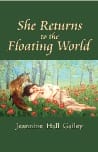
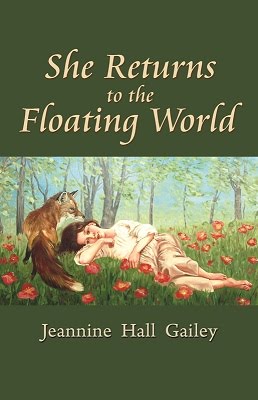
I promised you could see the cover of my upcoming book She Returns to the Floating World soon, and here you go. It’s only the front cover so far, but the front’s the exciting part, right? Let me know what you think. The art work is Rene Lynch, a piece called “The Secret Life of the Forest (A Different Sleep)” which works really well with the themes of the book, I think, all about dream worlds and transformations.
I got to see Martha Silano read from her new book, The Little Office of the Immaculate Conception. The last time I saw her read at Open Books, we were reading for our books Blue Positive and Becoming the Villainess, partners in crime with Steel Toe Books. Her children were babies then – now they’re darling children, complete with giant stuffed ponies and mops of hair, nearly teenagers! Ah, nostalgia. We had a lot of fun and got to hang out with a lot of poets I love that I don’t get to see very often. (Update: for a better recap – with pictures! – check out Kelli’s blog, )Of course, we were nearly done in by a surprise blizzard that shut down the road in and out of our apartment complex, but we managed to get in and out okay (when I got home and saw the news and all the wrecks on the road near our house, I felt like a big risk taker. Then I dreamed about being Buffy and getting electrocuted. So, all in all, a normal day.) This morning the world is frosted in snow, though this being late February, it’s sort of odd for Seattle to be quite this snowy. I am very ready for spring.
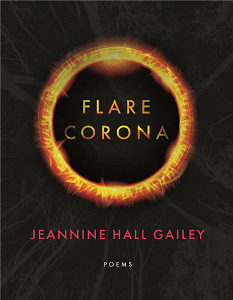
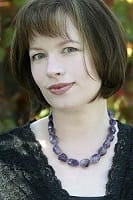 Jeannine Hall Gailey served as the second Poet Laureate of Redmond, Washington and the author of Becoming the Villainess, She Returns to the Floating World, Unexplained Fevers, The Robot Scientist’s Daughter, and winner of the Moon City Press Book Prize and SFPA’s Elgin Award, Field Guide to the End of the World. Her latest, Flare, Corona from BOA Editions, was a finalist for the Washington State Book Award. She’s also the author of PR for Poets, a Guidebook to Publicity and Marketing. Her work has been featured on NPR’s The Writer’s Almanac, Verse Daily and The Year’s Best Fantasy and Horror. Her poems have appeared in The American Poetry Review, Poetry, and JAMA.