
This article from The Chronicle of Higher Education combines the usual “too many poets, too many journals, too many MFA programs are ruining poetry” argument with Foetry–esque accusations of too much corruption and cronyism in the poetry world.
Sometimes these kinds of articles depress me. Besides the fact that I’m a fan of people outside a tiny circle on the East Coast writing and publishing poetry, I’m an optimist who wants to believe that the poetry world is a meritocracy, even when on the inside, I know it’s probably pretty corrupt – as easily corrupted, for instance, as environmental science (which recently experienced an embarrassing uproar about top scientists faking or mis-stating data about global warming in order to make their theories stand up) or politics. When I studied biology, and I actually researched papers – on genetic engineering, on carbon dating, and on tissue culturing, to name three topics where I went back to original sources – I was surprised to see that many papers that were used as references were later withdrawn or discredited because the data was corrupt and the scientists who wrote it exposed as cheats. Which depressed me then, maybe enough to keep me from going into research after graduation. Because, really, if you can’t trust your scientists and your poets, who can you trust?
It reminds me the orca who killed a Sea World worker today (and had previously killed two other people. This is one mad whale!) I used to think whales were sweet, because there are documents of whales saving people, and I personally love seeing them in the ocean, but then I found out sometimes they beat up other whales and dolphins too. I actually watched a bunch of orcas beating up a smaller whale of a different species. And dolphins themselves act like gang members, beating up smaller, lonlier dolphins. And I love seals, but a little while back a seal attacked and drowned a girl, a marine biologist who was my age at the time. Animal nature, human nature, both a little darker than we’d like to admit? I guess, once again, it’s up to the individual. Not all poets, scientists, or seals can be trusted.
Even if the poetry world is fairly corrupt, you’ve got to keep writing, keep sending out, keep believing that someone, somewhere will stand up for you even if they don’t owe you a favor. Am I too naive? I just read for a chapbook contest and didn’t think about anything beyond: “Which one is the most interesting and the best written?” Is it possible there are lots of judges out there doing the same thing?
Do you know why I like blogs more than Facebook? I can’t lose myself in someone else’s perspective on Facebook, but on the right blog, you get to lose yourself. You get inside someone else’s head. That is what I like about writing in general. Facebook is like seeing a bunch of people at a party; a blog is like going for coffee with someone you’re really interested in.
I think I was going to say something interesting here about judging the chapbook contest for Concrete Wolf, something about how there are so many good writers out there, all the finalists this year were wonderful, and how the decisions come down to – “These are equally well-written but I’m more interested in this subject matter” or “this type of writing is more interesting to me than that kind” which makes you think about how relative judgement about poetry really is. It could be all about the mood of the writer at that moment, about how much they like prose poems or narrative poems, about how they feel like they haven’t seen enough of blank and blank should be celebrated this year.
I’m also thinking about chapbooks, about how I might want to do another one.
I think I like Lost because Lost is about the struggle to understand suffering in life, to understand justice, to understand mystery. Lost is a lot like the Bible that way. You’re interested in the characters, but you’re more interested in the mystery.
I’d also like to know about any good superhero poems by female poets, if you’ve written one or have a favorite one by another poet. I’m always excited to find out about these kinds of things, but I’m trying to put together a good diverse sample of poems for my WonderCon paper.
I was so sorry to hear about Lucille Clifton passing away. She was one of my favorite poets, and her use of persona has always been terrific – she uses the voices of everyone from Leda to Satan. I like almost everything in the Book of Light, but here are two great persona poems:
adam thinking
she
stolen from my bone
is it any wonder
i hunger to tunnel back
inside desperate
to reconnect the rib and clay
and to be whole again
some need is in me
struggling to roar through my
mouth into a name
this creation is so fierce
i would rather have been born
eve thinking
it is wild country here
brothers and sisters coupling
claw and wing
groping one another
i wait
while the clay two-foot
rumbles in his chest
searching for language to
call me
but he is slow
tonight as he sleeps
i will whisper into his mouth
our names
won’t you celebrate with me
what i have shaped into
a kind of life? i had no model.
born in babylon
both nonwhite and woman
what did i see to be except myself?
i made it up
here on this bridge between
starshine and clay,
my one hand holding tight
my other hand; come celebrate
with me that everyday
something has tried to kill me
and has failed.
I’ve always thought of Barbie as a sort of totem for girls. This new one, computer engineer Barbie, just made me so happy for some reason:
http://www.msnbc.msn.com/id/35372184/ns/business-retail/
She has a pink laptop and she wears glasses. That’s my kind of doll. She is still very blonde, but she makes up for it by having binary code on her t-shirt.
(PS, if you haven’t read Kinky, Denise Duhamel’s book of poems on Barbie, go and do it.)
Yes, it’s been a week of doctor appointments, phone calls from doctors, and sometimes uncomfortable tests that doctors have ordered, but I’m back to thinking about poetry – and back to the blog (no, I haven’t figured out how to migrate the blog yet, though time is ticking down on how much longer they’re going to support this blog…stay tuned for the new link.)
I was thinking about the things that get us through difficult times. The belief in something larger than oneself. Our spiritual yearnings/faiths, for example, our loved ones, and the things that just keep sticking to us, giving us hope when times are hard. The big bunch of daffodils that Glenn just brought home for me that are blooming brightly in their vase by the window. So hard to be depressed, looking at daffodils. And it doesn’t hurt that the weather report, after weeks and weeks of gloomy, blow-y cold and rain, is saying we’re going to have some sunshine and sixty-degree days coming up.
It’s really hard to write poems about hope without sounding cheesy, much as it’s difficult to write about love without sounding sentimental or sappy, isn’t it? (See this article for more on the difficulty of the happy love poem.) But they are neccessary. And I find my poetry tends to be on the hard, colder edges rather than the comforting side most of the time. After all, many of my favorite poets tend to be on that bitter edge – I prefer Gluck and Atwood to Oliver. I usually prefer humour to sweetness. What about you? Do you have any favorite “hopeful” poems?
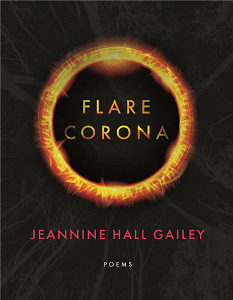
 Jeannine Hall Gailey served as the second Poet Laureate of Redmond, Washington and the author of Becoming the Villainess, She Returns to the Floating World, Unexplained Fevers, The Robot Scientist’s Daughter, and winner of the Moon City Press Book Prize and SFPA’s Elgin Award, Field Guide to the End of the World. Her latest, Flare, Corona from BOA Editions, was a finalist for the Washington State Book Award. She’s also the author of PR for Poets, a Guidebook to Publicity and Marketing. Her work has been featured on NPR’s The Writer’s Almanac, Verse Daily and The Year’s Best Fantasy and Horror. Her poems have appeared in The American Poetry Review, Poetry, and JAMA.