
If you happen to be in the Santa Cruz area, tune in to (88.9) KUSP’s the “Poetry Show” this evening with Dennis Morton, who will be reading five poems from Becoming the Villainess. You can listen to the podcast version, which will be up on Tuesday, here.
Thanks Dennis! I’m happy to be moving to Northern California already 🙂
Why Write Poems in Series?
I’d like to talk about the benefits (and problems) of writing poetry in series. I’ve talked to two other poets (Oliver de la Paz and Joannie Stangeland) about my struggle in trying to teach a lecture on this topic because of the lack of available reading material on the subject. If you know of any essays on writing poetry in series, will you point me to them? If you have any thoughts on the topic, please feel free to post them in the comments!
I write poems in series and I write “one-off” poems that have nothing to do with other poems. I usually get obsessed with an idea (say, female comic book superheroes or characters in fairy tales coming to dark ends, or fox-wives or Oak Ridge’s nuclear pollution or something) for a year and then I write poem after poem around that general idea. This has to do with my reading practices as well; the years that I wrote Becoming the Villainess, I was reading a lot of feminist criticism, Ovid, and Jungian theory about folk tales; while writing my current manuscript I’m reading a lot of non-fiction about the Manhattan Project. There are different speakers and different scenes in these poems, different tones and forms, but the subject stays generally the same. That’s not something I do on purpose; it just works out that way.
The reason I talk in my class about writing in series is because I think it helps students start thinking about larger projects: chapbooks, or full-length manuscripts, which generally are easier to shape if they have a controlling overarching theme or idea. It’s like building your final show for Project Runway; it really helps if the clothes in the show hold together in some way (the same kind of pleating, a Gothic sensibility) but aren’t exactly alike. If you get to the point where you, as a poet, want to put together a collection, and all you have are “one-offs” – a blue feathered jumpsuit, a crisp sailor outfit and a ruffled silk trench – then it’s harder to figure out the structure of the whole and harder to communicate to your audience what you are, as an artist, trying to say. (I watched Project Runway for the first time this summer, so forgive the clumsy analogies.)
But there are downsides to writing in series – what if the poems don’t stand alone, what if necessary information from one poem is missing in another or the interplay between poems is lost when poems are published independently?
Do you write poems in series? Why or why not?
New poem up at Cabinet Des Fees:
http://cabinet-des-fees.com/index.php/2009/09/01/rapunzel-considers-the-desert/
Check it out!
Sorry I haven’t been blogging much – been sick again. Hope to be better soon – and brainier…I guess not being able to eat for five days does something bad to my cognitive processes.
Can’t wait to be well. And then Napa!
Oh, ow! I cracked a tooth/filling, and now have to go tomorrow to get the broken part of the tooth removed and the filling and have it re-filled, then go back and get a crown – my first one! I’m so nervous b/c I’m allergic to novocaine-type medicines and can’t take codeine, so I’m going to try this with tylenol and NO2 (as per the dentist’s suggestion, who also offered IV sedation.) I thought IV sedation might be overkill, since I’ve done fillings with nothing besides tylenol before. Anyone have any advice?
Stupid toothache!
In other news, good reading: Miyazaki’s book of essays and interviews, Starting Point, reveals Miyazaki’s thoughts about religion, environmentalism, and female heroes, and includes notes on many of his films. Margaret Atwood’s book of interviews, Waltzing Again, which had some great quotes about teaching poetry and women editing magazines that I thought were very apropos, and she’s so funny and dry. The last book is Reading Real Japanese Fiction, which includes contemporary Japanese stories in both English and a combination of different Japanese alphabets, and a CD with a narrator reading the stories in Japanese. Tough stuff – but the fiction is so great!
Genre, genre, genre
I love it when people make weird, unsupportable broad statements – like “contemporary women’s poetry isn’t interesting” (Insert eye-roll by me here – honey, you’re just not reading the right books) or “Genre writing can’t be good.“
Elisa does a great job of talking about genre writing here and I had to pop up and add my two cents.
Genre doesn’t matter. Surprising and interesting writing matters. And I would say, sadly, that tooooo many “realistic” literary fiction books are both uninteresting and not terribly well-written. Plot – dare I say such a dirty word – matters. Characters matter. You can have both. My friend Felicity thinks that “realistic” literary fiction may even be on its way out. I mean, you’ve read “The Amazing Adventures of Kavalier and Clay” and “The Brief and Wondrous Life of Oscar Wao,” right? They’re just edging their way out of the mainstream bit by little bits, and critics are all up there saying “this is great!” Is it any wonder, in our post-apocalyptic-seeming lives, that we want more, well…wonder?
I think I’ve said here before that my favorite fiction writers by and large could be considered “genre” writers. Here’s a list of some of my favorite books of fiction:
Margaret Atwood’s Blind Assassin, Kelly Link’s Stranger Things Happen, Haruki Murakami’s After the Quake and After Dark, Osamu Dazai’s Blue Bamboo, AS Byatt’s Little Black Book of Stories…all of them have something a little genre, a little cross-the-line-into-an-alternate-reality, a little speculative aspect. (AS Byatt’s Possession crosses the line into the Victorian romance/mystery genre, I think.) Some of this has to do with what I read and loved growing up – a lot of Madeleine L’Engle, a lot of Andrew Lang’s fairy books and large tomes of Greek mythology. I liked to program computers – I read some of Asimov’s short stories (my Dad’s books, of course) when I was seven or eight – and I liked to play video games. I may not have been the poster child for “average girl,” perhaps, but I think there were enough girls liked me who would have been more interested in comic books if they’d had any useful female characters, who tried to find in books stories of remarkable girls doing remarkable things. In fact, I think I’m still trying to find books like that.
It occurs to me as I write that this may be why my books of poetry get passed up by mainstream publishers and contests – well, they have references to Japanese anime, obscure folk tales, comic books and computer programming – my poetry gets all marked up with “speculative” and “genre” fingertips.
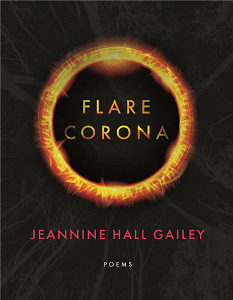
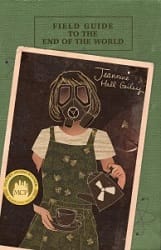
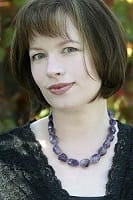 Jeannine Hall Gailey served as the second Poet Laureate of Redmond, Washington and the author of Becoming the Villainess, She Returns to the Floating World, Unexplained Fevers, The Robot Scientist’s Daughter, and winner of the Moon City Press Book Prize and SFPA’s Elgin Award, Field Guide to the End of the World. Her latest, Flare, Corona from BOA Editions, was a finalist for the Washington State Book Award. She’s also the author of PR for Poets, a Guidebook to Publicity and Marketing. Her work has been featured on NPR’s The Writer’s Almanac, Verse Daily and The Year’s Best Fantasy and Horror. Her poems have appeared in The American Poetry Review, Poetry, and JAMA.