
Snippet day!
Allison Joseph, an excellent poet who also happens to edit the Crab Orchard Review, was chosen from the last Steel Toe open reading series…read more here!
Annie Finch talks about women poets and mentoring here…and Barbara Jane Reyes continues the discussion here…
Amy King has a great take on the “greatness” issue here
In the mail: my contributor’s copy of The Magazine of Speculative Poetry, and a little check with it! Hey, if every lit mag and journal paid us just a tiny bit, we poets would at least be able to cover our postage!
People have been discussing the influence of books of poetry, so I thought I’d bring up and discuss this poem, one of my favorites as a kid (when I had to look up the definitions of “Dirge” and “denouement”) It ended up being very influential to me. Kenneth Fearing not only wrote poetry but was also a freelance journalist (who dabbled in pulp fiction.) His use of advertising and comic book language, his anti-lyricism, and irony seeped into my work – I even named a poem after this one, “Dirge for a Video Game Heroine.” Also, he loves the serial comma.
This poem seems appropriate for our times given that is was written during the Great Depression and focuses on the disillusionment with the excesses of capitalism and the emptiness of America’s material obsessions. He was once asked whether he was a Communist in a witch-hunt trial, and he responded “Not yet.” Like another of my favorite poems, T. Roethke’s “Dolor,” this chronicles the unique sorrow of white collar work.
Dirge
1-2-3 was the number he played but today the number came 3-2-1;
Bought his Carbide at 30 and it went to 29; had the favorite
at Bowie but the track was slow –
O executive type, would you like to drive a floating-power, knee-action, silk-upholstered six? Wed a Hollywood star? Shoot the course in 58? Draw to the ace, king, jack?
O fellow with a will who won’t take no, watch out for three cigarettes on the same, single match; O democratic voter born in August under Mars, beware of liquidated rails-
Denouement to denouement, he took a personal pride in the certain, certain way he lived his own, private life,
But nevertheless, they shut off his gas; nevertheless, the bank foreclosed; nevertheless, the landlord called; nevertheless, the radio broke,
And twelve o’clock arrived just once too often,
Just the same he wore one gray tweed suit, bought one straw hat, drank one straight Scotch, walked one short step, took one long look, drew one deep breath,
Just one too many,
And wow he died as wow he lived,
Going whop to the office and blooie home to sleep and biff got married and bam had children and oof got fired,
Zowie did he live and zowie did he die,
With who the hell are you at the corner of his casket, and where the hell’re we going on the right-hand silver knob, and who the hell cares walking second from the end with an American Beauty wreath from why the hell not,
Very much missed by the circulation staff of the New York Evening Post; deeply mourned by the B.M.T.
Wham, Mr Roosevelt; pow, Sears Roebuck; awk, big dipper; bop, summer rain;
Bong, Mr., bong, Mr., bong, Mr., bong.
On a more personal note:
I am happy to hear that in a week I will probably be walking again. The bones are healing nicely and the tendon too. The sprain in my right hand is healing up, slowly, but is getting better every week. I am so ready to go out in the sun and walk, walk, walk. The several-flights-of-stairs may still be a problem as I heal, but still, it’s getting better all the time, as the song goes.
With all the time not spent at physical therapy and doctor appointments, I have been reading, writing, reading, and writing. (Well, and a little movie-and-television watching: Vicky Christina Barcelona, it was great to see you!) I have been researching my childhood backyard, Oak Ridge National Labs, part of the Manhattan Project where the very first nuclear bombs were born, and the environmental damage it may or may not have caused (the DOE and EPA don’t see eye to eye on this one, and believe me, the local papers sure as hell won’t say anything negative about the city’s main employer.) So much about this place is still classified, and everyone who worked there forced to sign papers that basically forbid them from saying anything, ever, about anything, so it’s a bit frustrating – a lot of obscure scientific journals have been pored over. Suffice it to say there’s a lot of evidence but not a lot of full disclosure. Leukemia rates, thyroid cancer rates, radioactive white-tailed deer and swallows’ nests…tantalizing data but all leading up to…what?
Writing about my childhood is odd, too – I’m not, by nature, a nostalgic person, and I’ve never been much of a “confessional” poet, so my ability to reach back and conjure up stories and poems is flexing some of my unused writing muscles. In a not-at-all-metaphorical related fact, my childhood home – not only the two-story brick building but the sight of acres of roses, daffodils, lilacs and strawberries, oak trees and woods – hey, it might have been environmentally poisonous but it was still beautiful in that fertile, Southeast-river-and-mountain-valley way – has been razed to dirt. There is literally nothing left to sift through.
But I’ve managed to put together fifty-plus pages now, a new manuscript born into a world of too-many-poetry-manuscripts-and-not-enough-publishers-or-readers. Whispers of the oak trees, the odd neighbors, my childhood friends who were all the children of physicists from other countries – the Geiger counter my father always had out at all hours, his warnings about radiation exposure from snowmen – they are all ganging up on me, demanding to be heard.
Update: Another mini-review, but it’s not poetry. The Angry Genie by Karl Z. Morgan and Ken M. Peterson is a non-fiction account of one man’s work with nuclear bombs, nuclear safety regulations, and nuclear power.
If you’re interested in whether nuclear power is safe (no), whether the government knew what it was doing when it poisoned hospital patients, African-Americans, and Native Americans in radiation experiments in the 50’s and 60’s – including a high-profile case of an evil SOB at my Alma mater, University of Cincinnati – (yes) and the scientific health hazards of working at the Manhattan Project (including descriptions of safety regulations at Oak Ridge National Labs, Los Alamos, and Hanford) – then you might want to read Karl Z. Morgan’s account of working to develop the first nuclear bomb and research what is called “health physics”. Fascinating and horrifying, this is research for my next book project about Oak Ridge – but should be required reading for every American, since guess what – you’ve probably been affected by the radioactive fallout from government experiments. The writing isn’t fantastic (this guy’s a physicist, not an English major) and the guy spends a lot of time apologizing for his bad decisions – but the information included (including the author’s theory that Karen Silkwood was murdered for speaking about about her plutonium poisoning and how many files have not been released by the government for self-protective reasons.) is vital to understanding the government, the environment, and unfortunately, some of our chronic health conditions.
Mini-review of Steven D. Schroeder’s Torched Verse Ends from BlazeVOX books
Having followed S.D.S.’s work (and blog) for a couple of years, I was happy to find his trademark wit, word-play, and pop cultural references in his first collection from BlazeVox. (The cover art, by Rebecca Loudon’s son Page Loudon, is quite remarkable as well.) Of course, I loved “Robot Rhetoric,” with all the expected robotics in-jokes (yes, Asimov’s laws are referenced) and the fairy-tale-with-an-edge nature of “All the Better to Eat You With, My Dear” and “Fairytale.”
A few sample lines from “Fairytale”
“Alone in a tangle of ambulatory trees
among tattered Safeway bags
and smokers’ aerosol coughs,
the puffs of dragons cranky overhead.
Only old growth. The woodcutter,
hauling his ax, hurries homeward…”
The quotes that separate the sections from Charles Schultz, the Simpsons, and Douglas Adams, give you a kind of map to the mind of Steve. But there is also a solemn edge to the collection, barren and toxic landscapes, and relationships with family gone sour. Schroeder is funny, but don’t mistake this for “light” verse. His underlying themes – alienation, loneliness, and a celebration of the comic elements in otherwise bleak situations – make this book a thoughtful, entertaining read.
Love Poems in Honor of Valentine’s Day
I don’t write a heck of a lot of love poetry, but here are three – all dedicated to my sweet husband G.
From The Bedside Guide to the No Tell Motel anthology
After Ten Years Together, We Sneak Off to Make Out in Someone’s Closet
Snuffling, bumping elbows against mops,
hitting our knees at awkward angles,
I squeeze the beeswax candle on accident
instead of you, and you hit your head
on a box of matches, scattering sparks
around us in the dark as we breathe
sweat and dust and the now-familiar soapy taste
of our skins, here amid fly swatters, empty
milk bottles, your back pink and smooth with its knots
of muscle like pulled taffy under my fingertips.
Two blind naked mole rats reaching
closer after ten years of marriage, trying to find
the magnets within us under clavicle, scapula,
hip bone, sternum, that repel and attract us,
the volcanic fissures that separate me from you.
From Rattle’s Summer 2008 issue
Advice Given to Me Before my Wedding: A Pseudo-Ghazal
Better to be the lover than the beloved, you’ll have passion.
Better to be the beloved, a sure thing, a lifetime of that.
He is more beautiful but you,
you have more power. Which is to say,
you are just like your brother. Lift your eyes
and people do what you say. Who knows why.
Men are like breakfast cereal. You have to pick one.
Fish in the sea, a dime a dozen. They are singing for you, now.
Keep your own bank account. Keep working.
Give him a blow job, and he’ll volunteer to take out the trash.
You are mine, says the beloved, and I am yours.
Whither you go I will go. Honey and milk are under her tongue.
Cancer and Taurus, very compatible.
You’re the hard-charger, he’s the homemaker.
Don’t stop wearing lipstick. Don’t put on any weight.
Don’t buy the dress too soon. If you go on the pill, your breasts will swell.
One day you might regret. You might do better.
You could do worse. One man’s as good as another.
Wear my old pearls. Here’s the blue, a handkerchief embroidered with tears.
If you won’t wear heels, you’ll look short in the pictures.
If you don’t wear a veil, people will say you’re not a virgin.
Good luck, glad tidings, a teddie, a toaster. So long, farewell.
From Ninth Letter’s Fall/Winter 2008 issue (still available on newsstands now!)
Married Life
You sing in your sleep, he told her.
He rubs her stomach counter-clockwise.
Everyone says I’m lucky she says
to have you.
She washes his hair with lemon and chamomile
to make it more golden.
He chops vegetables on a wooden tablet he made himself.
She thinks she ought to be better with her hands.
You make my life easier she tells him.
I curse like a sailor since I met you he says.
Buyer’s remorse? An empty cradle,
a woman sharper and shorter-haired than he’d married.
They break things made with care,
watch a pair of otters in the river
twisting and grooming and biting.
They look like they’re trying to drown each other.
What do I sing? She asks him.
I don’t know. I can’t understand the words.
Snatches of song like you’re underwater.
Sometimes, it sounds like you’re laughing.
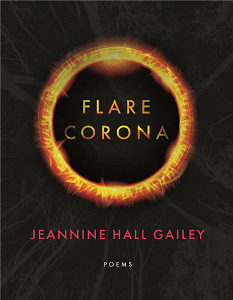
 Jeannine Hall Gailey served as the second Poet Laureate of Redmond, Washington and the author of Becoming the Villainess, She Returns to the Floating World, Unexplained Fevers, The Robot Scientist’s Daughter, and winner of the Moon City Press Book Prize and SFPA’s Elgin Award, Field Guide to the End of the World. Her latest, Flare, Corona from BOA Editions, was a finalist for the Washington State Book Award. She’s also the author of PR for Poets, a Guidebook to Publicity and Marketing. Her work has been featured on NPR’s The Writer’s Almanac, Verse Daily and The Year’s Best Fantasy and Horror. Her poems have appeared in The American Poetry Review, Poetry, and JAMA.