
I’m done with my stint as a faculty-artist-who-teaches-high-school-students-etc at Centrum. The sun is shining and after a chilly week, it is 80 degrees.
The class was full of amazingly intelligent, sophisticated girls, already as subversive in their writing at 16 as I can ever hope to be. When they got up to read their work on the last day of the class, and the room of parents and students and little siblings applauded them, I was so so proud. You can only do so much in a classroom setting. You encourage them to read. You encourage them to write. You give them exercises that (hopefully) help them think in new ways about poetry, character sketches, mythology, comic book characters, persona. You talk about rejection, revision. You sit with their work and talk about expectation, cliche, tone, surprise. You read them poems, in class we read out loud together chapters from Kelly Link’s “Stranger Things Happen” or a chapter from “The Amazing Adventures of Kavalier and Clay.” You talk about your favorite writers, why you love them. You mention life as an artist isn’t as glamorous as they probably think.You talk about sitting in front of a blank screen all day.
But what they bring to class – their unique skills, humor, imagination – are the real gifts. Anyway, it was all very rewarding and fun, if exhausting. They really were little teenage comic book superheroines.
For some reason all week I kept seeing seals and otters at the Fort Warden beach. One day I got within five feet of an otter napping in the sun underneath an old log before I saw him. They swim and look at you, swim and look away, dive underwater and come back up to peek at you again. They do not seem afraid. It makes me think of the selkies. I think, if I came back as an animal, it might be as a seal.
Now I am ready to sleep and get back to my friends, my family, writing, blogs…
A quick note from the high-school creative writing class trenches
Before the students came in for a quick 20-minute class tonight, I set up the room, putting an array of my own books on each table: Japanese folk tales on one, Greek and Roman mythology on another, “The Armless Maiden” and “The Poet’s Grimm” and “Mirror, Mirror” on another, and the last one filled with comic books (Fray, Buffy, Witchblade, one called “Fables,” X-Men, Neil Gaimon’s Sandman “The Dream Hunters” with his fox-wife-type story, etc.)
When they came into the classroom, there was an audible “Whhoooshing” sound as they ooh-ed and ah-ed over the books. I tell you, is there anything better than people who love books? They even asked for extra time at the end to sit and read. Good times. These high school kids know Persephone, the Selkie wife, Miyazaki. It feels like a magical common language.
Also, the new Fall 2008 Willow Springs is out, and my poem “Risking Our Lives” is in there (from my third fairy-tale manuscript) along with poems by Tony Hoagland, Michele Glazer, Elizabeth Austen (among many others!) and an interview with Tess Gallagher…
Yes, I’m deep in work mode right now, reading and re-reading in prep for my upcoming high school class on “mythology, comic books, and you” for Centrum: “The Amazing Adventures of Kavalier and Clay” by Michael Chabon, re-reading Kelly Link’s “Stranger Things Happen” to decide which story to use in the class, and a book on the history and origins of superheroes called “Comic Book Character.”
But, I had to surface briefly before I disappear for a week in the class to direct you to new poems on 2River View:
http://www.2river.org/2RView/12_4/default.html
You know, the editor took two poems that I wrote at very different times, but put together, they tell one story. I didn’t realize it until I was recording them both. That’s the subconscious for you.
And, to show you the wonderful work my Becoming the Villainess illustrator, Michaela Eaves, continues to do – here’s the upcoming cover of indie-sci-fi-lit-mag, Talebones! Nice work, right?
First, sunshine! Yay! Finally!
In the media and sort of related:
I made the local paper, but they misspelled my name. Despite that, a good article – sign your high-school writer up today! Fresh air, sunshine, the ocean, and comic book/mythology creative writing exercises…
http://www.ptleader.com/main.asp?SectionID=101&SubSectionID=329&ArticleID=21140&TM=56653.35
This warms my heart. The rise of girl geeks AND the article name-checks Buffy:
http://www.newsweek.com/id/140457?GT1=43002
(Update: Also in the media, poet Aimee Nez has a post up at the Book Critics Circle blog you should check out:
http://bookcriticscircle.blogspot.com/2008/06/small-press-spotlight-aimee.html)
And congrats to my Mom, who just graduated with her Phd!
There have been some interesting discussions going on about book and manuscript organization – see here for Kelli’s and here for Anne’s, where she discusses the impact of Bruce Springsteen on her MS. So I thought I’d put in 2 cents of my own…
For me, organization isn’t a set thing – it’s organic and keeps happening. I’m always shuffling around the order of poems, especially the first ten and last ten, and adding and subtracting poems as I make up my mind about them.
With Becoming the Villainess, the decision to turn it into five sections that mirrored the anatomy of a comic book was made right around the time I sent it to Steel Toe Books, and a major rearrangement (making the narrative arc a little darker, rather than ending on a lighter note) happened around the same time. A re-titling happened at the same time as well. This was about a year after I started sending it out, and things just seemed to come together in a new way. Getting other people to read and respond to the MS was really key too – not because I neccessarily took their advice, but the advice got my brain to work in new ways, and the bouncing around of ideas was important to me.
The arrangement and organization of my two current manuscripts are both still in flux – I arrange poems chronologically, by theme, and then try a different tack. I start writing a new set of poems, and decide to include them, then lose an old poem that feels now like “filler.” I’m trying to keep the manuscripts as close to fifty pages as possible (one’s sixty, one’s fifty-three) because I don’t want readers (who may have to read 1000 manuscripts) to be overwhelmed. I do all the usual stuff – I read the TOC to see how the titles flow and if I’ve got too many of the same kind of poem next to each other, I put the pages all over the floor and furniture (difficult to manage with two curious cats, but…) to see if they want to group together, I think about theme and how I want the reader to feel starting and finishing the book. I play different music and see if that jolts things together. Also, when I re-read the MS, I often find little tweaks I want to make from poem to poem – wow, when those poems are next to each other, I want to drop this couplet, I want to eliminate the repetition of this adjective, etc, etc.
So what about you, dear blog reader? What are your magic organization tips and tricks?
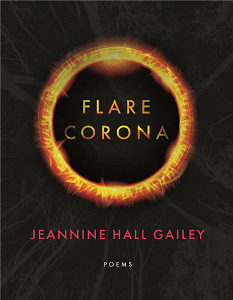
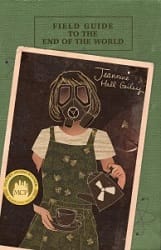
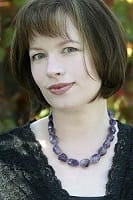 Jeannine Hall Gailey served as the second Poet Laureate of Redmond, Washington and the author of Becoming the Villainess, She Returns to the Floating World, Unexplained Fevers, The Robot Scientist’s Daughter, and winner of the Moon City Press Book Prize and SFPA’s Elgin Award, Field Guide to the End of the World. Her latest, Flare, Corona from BOA Editions, was a finalist for the Washington State Book Award. She’s also the author of PR for Poets, a Guidebook to Publicity and Marketing. Her work has been featured on NPR’s The Writer’s Almanac, Verse Daily and The Year’s Best Fantasy and Horror. Her poems have appeared in The American Poetry Review, Poetry, and JAMA.