
The Thyroid and two Poetry Books Everyone Will Love…
So, got back from a thyroid specialist yesterday who told me I’ve had a weird thyroid problem for some time (manifested by odd lab results and by the big old swollen thyroid I’ve had for years) where it switches from hypo-to-hyper, and has to do with the immune system. So I’m starting a new med, this time a synthetic t4 thyroid hormone. Oh, the excitement of me and my new medications…(PS some problems that can be symptoms of thyroid problems – constant sleepiness or sleeplessness, blood pressure fluctuations, joint problems that mimic arthritis, and of course, the weight fluctuations that come out of nowhere. and puffy eyes. It’s really the puffy eyes that got me. Puffy eyes? I’m such a girl…)
On to Poetry!
Dorianne Laux’s first book, the truly great Awake, is soon going to be re-issued by Eastern Washington University Press, and good for them! This book has long been one of my favorites of hers, a little rawer but certainly as powerful as anything in the later books, including a certain poem called the “Tooth Fairy” which may be Dorianne’s best poem EVER! (Buy it from the Press here: http://ewupress.ewu.edu/poetry/awake.htm) It makes a great holiday gift!) I hate it when good books go out of print too early, and Awake was definitely one of those books. Kudos to EWU Press!
I have to admit that, though I loved Matthea Harvey’s poetry in journals like A Public Space, when I bought her first two books I liked, but not loved, the work – certainly you could tell Harvey was a clever and funny writer, but the whole books seemed a little intimidating, or opaque. Her newest book, Modern Life, I have fallen in love with the entire thing. It’s not just the references to robots (of course, I’m always game for those) or Japanese anime classics (her “Robo-Boy” being a clear reference to “Astro Boy”) because even the standalone poems in the book are outstanding, as are the poems in the series “Terror of the Future/The Future of Terror” that was based on a dictionary list of words between “Future” and “Terror” and manage to evoke our post 9/11 anxiety in a new and chilling way.
Here’s a link to buy it at Amazon:
Modern Life at Amazon
And, Matthea Harvey is coming to Seattle to read at Open Books on November 14!
Note: Blogger is doing some weird-ass stuff in the last few days, including deleting this post and comments on this post and the previous one, so if it appears twice, I apologize, blogger keeps erasing it…and I can barely upload a new file with blogger, it just won’t update! Grrrr…
Annie Finch has some good points about the numbers game….
In this e-mail from the Wompo list re: the Chicago Review/gender bias debate…I got her permission to post it here. I think she is saying great things about editors taking responsibility for their content – what do you think?
“I know we had a long discussion about this issue–ratios of women to men being published–on WOMPO a few years back. Does anyone have an idea where it was? I’ve been searching the archives but I can’t find it. I’d love to re-send a post or two I remember writing at that time…
in a nutshell, though, I’d just say what’s been said before: to blame the slushpile for the contents of a journal (or book, or reading series, or anything else) is naive at best, willfully ignorant at worst. To edit seriously is to create, not simply to mirror. Passive mirroring of the slushpile is not the norm; it is a choice of the status quo, an active and political act.
I’m not surprised that, as pointed out in the article and blog, the submissions to many journals skew heavily male, and of course white; that has been true of just about everything I’ve ever edited or run. But the submissions are just the starting point and don’t have to bear much relation at all to the finished product. Otherwise, what is the creative satisfaction of editing? Shaping each of my edited journals or books, I have paid central attention to race as well as gender. It’s inconvenient and difficult and often fails. And afterwards it rarely seems enough. But how could I not? It amazes me how an editor could not, and aim to have a living, exciting, responsible, mature journal or book as a finished product. But it seems many of them don’t.
And of course, patterns of acceptance become a self-fulfilling prophecy. The Chicago Review’s ratio of 1/3 is pretty much the standard across the board lately, it seems: 1/3 women is considered perfectly “normal” on a masthead. I bet it relates to the psychological tests that show when there are more than 1/3 women in a room men feel as if the room is mostly full of women. And where race is concerned, I doubt they’ve even done those studies yet. . .
I remember when I first found out that things were just about as sexist in the innovative poetry world as they were in the formalist poetry world, in spite of the high-profile exceptions (Rae Armantrout, Lyn Hejinian, Susan Howe, Harryette Mullen, etc). At first I was really surprised. Then I realized it made total sense.I’m glad this discussion has finally come out into the “mainstream” literary world. It might spur more women to take on the kinds of active literature-shaping projects that will begin to make a difference.
Annie”
A Little something on Ecotone, Feminism and Publishing, and Feminism Being Sexy
I just published a little piece of creative non-fiction…If you’ like to read about how I’m like the X-Men, or Laurel Snyder’s thoughts on circumcision, or Alison Stine’s earrings, check out the new Ecotone Blog…
As if you needed more more proof that feminists are sexy…see this link to a study, courtesy of Annie Finch…
Chicago Review recently ran an article called “Numbers Trouble” by Juliana Spahr and Stephanie Young which discussed gender iniquity in things like anthology showings, awardsm, and poetry jobs, an the Chicago Review editor included a very interesting statistics supplement that showed that many mainstream magazines have gone from publishing 13-17% women to 30-something percent in the last thirty years (see some of the numbers here)…and this caused a bit of a furor on the Poetry Foundation blog.
Here are some excuses I don’t buy: “women don’t submit enough” (see below and an upcoming post from Annie Finch) and “women are too busy with children to write good poetry” or editors who claim “we don’t look at the gender, we just pick the best poetry” (weirdly, often with a white, male, upper-class author – surprising?)
One of the Chicago Review editors, who compiled the journal numbers, says he only gets 35% of his submissions from women, and that may be true of other, typically male-skewered journals as well. After all, if women don’t see women in a journal, they’re probably less likely to submit. (I’m pretty sure Reb Livingston covered this in her blog a few weeks back)
But I have been saying for years that, especially in circles of power, criticism is written by men, and therefore, they get to be the judges of what is “good” and “bad.” Of course, it doesn’t help that the editors in charge (I’m looking at you, New York Times Review of Books) usually really don’t like women or want to advocate women’s writing at all. Women writers need to put their voices out there in essays, reviews, and other ways that allow them to become equal arbiters of taste. And, though I think “women don’t submit” is merely a lame excuse meant to hide gender bias in editing, and at the three magazines I’ve worked as an editor, I’ve had just as many women submit as men, if not more, please, women poets, take this as a sign that you should be blanketing the top mags with your work. And queries about articles. And interviews. And reviews. Do it.
(Addendum…The Chicago Review recently made the article “Numbers Trouble” available online…so read for yourselves!)
Art and Poetry Reviews, and more about the Move…
Yesterday, because soon we will be living over two hours away from the mecca of Seattle arts and culture, Glenn and I snuck out at lunch time to a downtown art gallery called Roq La Rue, which specializes in art they call “pop surrealism,” which, if you think about it, doesn’t only explain the art I like, but is also a good description for the kind of poetry I write (and like.)
The art exhibit was by a Japanese artist named Yumiko Kayukawa, who does these acrylic/oil paintings that kind of look like Japanese candy ads but also illustrations of Japanese fairy tale books or eighties rock album covers. Here was my favorite from the exhibit, called “Zen Candy,” which features a girl, two wolf kits, and some floating pink rice crackers…
http://www.sweetyumiko.com/display.php?collection=20&art=3
but there was an equally cool one of a girl running with a herd of hyenas. I think this artist’s work would look great on the cover of my as-yet-unpublished Japanese-pop-folk-tale book, when it gets published, don’t you? She’s probably out of my price range, though, as her pieces run between two and three thousand dollars. If you want to go see her, her show is only open til tomorrow, November 3rd.
Rachel Dacus’ new chapbook from Small Poetry Press, “Another Circle of Delight,” on a related note, had a dark, nature/religion/science-y tinge, and the two poems I really latched onto were about bones: one, called “Green Heart” about the fossilization of dinasaur bones
(“After sixty-eight million years, the collagen
in your bones might just begin to ossify…
Now she sees that she too
might leave behind a body green at heart
in a hardening world…”
and the other, about an x-ray and a missing bone in the body, “Wish Bone:”
“The absent bone in my spine x-ray
leaves a delicate arch of emptiness,
impied bridge over epidural space.
The gone bone is a bone of wish
that my walk wouldn’t pinch and wobble,
that I wouldn’t know I am incomplete?
How much else was missing at my birth?
…Now the missing piece
just keeps pulling and pulling
and only the words snap.”
Mmm, I just love the words “ossify” and “epidural” in poetry. Don’t these little poem pieces make you want to run out and buy this chapbook?
The Move: the Saga Continues…
Keep having nightmares about the move, which often happens to me around moving time. One involved a serial killer stalking the owners of different houses in my new neighborhood, and another involved shooting a rat. In real life, yesterday the headlines of the small-town paper of the place I’m moving to ran something like “MSRA! Deadly bacteria shuts down local high school” and “Level 3 Sex Offender Moves to Town.” Eek!
I am setting up new utility accounts, boxing up books, cleaning and wiping down furniture, deciding what to pitch and what to keep. Seriously, I should write a women’s magazine feature article called “How To Move – by someone who’s moved every freakin’ six months on average over the past ten years.” Unfortunately, I have not yet learned how to make moving easy and painless. It always seems effort-y and painful. I am going to sell back some stacks of books and magazines I’ve accumulated today. On the plus side, moving does make you clean and organize, and probably has some other benefits too. I do like the town I’m moving too, and the new rent for a modest little ranch house is downright affordable, which is a clear sign from the universe I should continue being a poor poet instead of a practical technical writer, right? Of course, if the universe wants to start throwing monetary poetry prizes and poetry jobs at me, I’ll take those too…
- At October 31, 2007
- By Jeannine Gailey
- In Halloween, pumpkins
 1
1

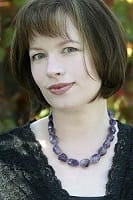 Jeannine Hall Gailey served as the second Poet Laureate of Redmond, Washington and the author of Becoming the Villainess, She Returns to the Floating World, Unexplained Fevers, The Robot Scientist’s Daughter, and winner of the Moon City Press Book Prize and SFPA’s Elgin Award, Field Guide to the End of the World. Her latest, Flare, Corona from BOA Editions, was a finalist for the Washington State Book Award. She’s also the author of PR for Poets, a Guidebook to Publicity and Marketing. Her work has been featured on NPR’s The Writer’s Almanac, Verse Daily and The Year’s Best Fantasy and Horror. Her poems have appeared in The American Poetry Review, Poetry, and JAMA.