
Yes, it’s that time again…time for us to move…
This time we are looking to rent in a small town about two hours from Seattle that is right on the ocean. It’s a very picturesque, writer-esque place to live. If I start to write about waves and sand, you’ll know why…I am blogging from the upstairs of the local grocery story (which offers high-speed internet – I mean, it’s still the Northwest) sipping a cafe mocha, looking at a very gray ocean and some long branches of pine and madrona trees. On the drive/ferry trip up here, we stopped at a crepe stand (plain lemon and powdered sugar for me, ham and swiss and mushroom for Glenn) and saw bald eagles gliding along the roads. The people I am staying with told me I appeared in their paper a few days ago. I love small towns! Off to scope out some more houses for rent…
(PS the stores here don’t sell women’s shoes with laces. As if lacing your shoes is too much trouble. I find this odd.)
The Crab Creek Review reading went really well, I thought – I’m really proud of all the poetry in there, and think the new issue (the first one the new set of editors had real editorial control of)really illustrates what can be fresh and exciting about Northwest writing – it ain’t all herons and salmon any more! It’s a good time to subscribe if you’ve been thinking about it…
And Aimee and Oliver’s reading at Open Books was packed. Oliver gave his best reading ever, and Aimee made me laugh so hard I cried, which, really, doesn’t happen all that often at poetry readings. We took Aimee to Trophy Cupcakes before the reading (she’s a fan of the cupcake as art form.) Oliver was very gracious, though he did admit to a little bit of girly-overload when Aimee and I started to talk about the glitter stationary they had on sale…at least Glenn was there so they could talk about football or something as an antidote. We also got to meet Oliver’s friend Mary, who works as a fiction editor at Image Magazine.

And, in the “Oh, Snap!” department, a shout out to Paul Guest, who just won the $50K Whiting Award, one of the most prestigious awards a young poet can get. In this interview, Paul is very…Paul…no surprises for those who read his blog, but I bet the interviewer was all like, “Is he being serious?” http://www.ajc.com/living/content/printedition/2007/10/24/poet1024.html
Anyway, congrats!
A little news, a little cold, a few readings that I’m going to attend…
Thanks to some friends who alerted me that a few of my poems are online with Contemporary Haibun Magazine.
And to another friend who alerted me to my presence on a list of finalists here (and the winners haven’t been announced yet – cross your fingers for me!)
http://www.smartishpace.com/home/erskinej/info.html
I’m proud to be on the list with fellow blogger Rachel Dacus.
Been under the weather with that cold/sore throat thing that’s been going around, you know, the combination of the crappy rainy cold windstorms and the usual germs when it turns cold, so I’ve been kind of out of it and not very productive, but I’m looking forward to doing some socializing and such at several readings this week.
The first is the Crab Creek Review new issue debut (the first one that I helped edit!) reading:
http://crabcreek.blogspot.com/2007/10/roots-and-writers-reading-october-23.html
Tuesday at 7 PM at the Richard Hugo House with readers like Oliver de la Paz, Jenifer Lawrence, John Davis and Janet Knox and my former classmate at Pacific University Thea Swanson.
Then, Oliver strikes again at a reading at Open Books with Aimee Nezhukumatathil at 7 Pm on Thursday: http://www.openpoetrybooks.com/calendar/index.html
which should be really fun as well.
OK, sorry for that cranky rant yesterday. I just get very irritated when poets, of all people, on the Poetry Foundation site, of all places, complain about how hard it is for them to read poetry. Grr.
So, on to happy news of some friends:
Aimee Nezhukumatathil’s poem “After Challenging Jennifer Lee to a Fight” will be featured today on Garrison Keillor’s Writer’s Almanac on NPR. You can read and listen to it here: http://writersalmanac.publicradio.org/programs/2007/10/15/#thursday
Laurel Snyder’s new book is out! Say hi!
Mary Biddinger not only has organized poetry shelves but will become the Editor of the Akron Series in Poetry! Go congratulate her!
Back at my laptop again…and is there ever such a thing as reading too much poetry?
Yes, getting back into the old swing of things here, wrote a poem, sent out a couple of subs, edited my third manuscript a little more. Caught up on phone calls, e-mails. Now I’ve got an editing project, and an article to follow up on, and must stock the shelves with groceries again.
Hope I’m not flamethrowing: How many poetry books constitute too many?
Read an article today at the Poetry Foundation where Paisley Rekdal complains about how arduous it is to read five books of poetry a week. I’ve met Paisley, who was very sweet and an intelligent thoughtful feminist type, so I hope that what I’m saying doesn’t seem like I’m putting her down. I guess I don’t consider it a “chore” at all to read five books of poetry a week, and it seems like a bad idea to say to poets -“well, it’s hard work to read poetry so just give up.” I’ve had months where I’ve read ten to twenty books in a week, on average, and some of those were big books of criticism and essays, so I can’t say five books of poetry a week seems like too much work. Five books is an easy week for me, especially if it’s all poetry, which tends to take less time than other genres. I’m a fast reader (I credit being dyslexic, because I had to learn to read whole words, sometimes phrases, at a time, since individual letters would turn around on me) the caveat being that I probably retain less than I should, and the one exception is when I’m reading to review: that means more dogears, underlining, re-readings, so I’m a little slower. To be honest, I’m not crazy about reviewing, selfishly, because it robs me of the freedom to just enjoy whatever I’m reading, I have to hunt down the details of where and when and why, in short, I must become a journalist of poetry, instead of a consumer, and a little of the magic gets lost. When I read for inspiration, it’s faster, from one illuminating poem, skimming a few duller ones, to the next one that lights up the pinball machine in my head. But usually I pick up a book and read the whole thing at a time, to the end, front to back, like a novel. And like a novel in which a chapter or two are boring, sometimes I skip to the end. And if I run into a book of poetry I don’t like, I’ll try to look at the organization or the layout or other creative aspects I can learn from, try to understand the author’s intent. Mmmm. That happens a lot, maybe half the time.
Right now I have a stack (half that I’m looking forward to, and half that – well, I’ll just have to work to get through) of books beside the laptop waiting for reviews. I just heard great things on my trip from Mary B. about Nin Andrews two books, so I’ll have to grab one of those soon too. And I’m looking forward to whenever Ms. Atwood’s new book comes out in the States. Then on top of that every time I go to the library and come back with armfuls of books on Japanese folk legends or feminist fairy tale theory (my pet subjects right now,) then I start all of them at once, and publishers send me random new releases…you can see why I’m constantly moving books in and out of the house, along with boxes of literary (and other) magazines.
Maybe some of this difference in reading quantities is accounted for by these things: I work freelance at all hours of the day and night, and reading fits around my schedule really well. There are no children at home here, just the husband and cats, and the occasional friend or two. I’m also an incurable insomniac, so it’s either reading or Adult Swim after midnight. And, reading has never been “homework” for me – I’ve always loved reading more than playing outside or shopping or anything else, even when I was really young. Glenn and I listen to books on tape when we’re stuck in traffic, usually not poetry, stuff like “Freakonomics” or some literary fiction I’ve heard good things about but seems a little slow in print. So I get to read more than someone with a “normal” job and “normal” family, I bet. I spend a lot more time reading than writing, for sure, even writing for work. I also spend a LOT of time in doctor’s offices, which is kind of a bummer, but you can get a lot of reading done there. You can only spend so much time with Allure before you turn to something a little more engaging, and poetry is often what I carry around with me (it’s light!)
So how many books of poetry a week for you? None? Two? Five? Ten? How does your lifestyle affect what you read? Do you even like reading poetry? Does it seem boring, like too much work? Maybe this is part of the problem of no one buying poetry, all of these books of poetry and people, even practicing and teaching poets, are reading one or two books a month, or even one or two books every four to six months. Or maybe none at all, like the New York poet Paisley cites in her article.
Seems like this is maybe the dirty secret of poetry: poets are writing but not reading. I say, if you think poetry reading is a chore, maybe you shouldn’t be adding to the chores of others. Or, spoken more positively – if you want others to read your poetry, please read the poetry of others.
This is your poetry service public lecture. And remember kids, reading can be fun!
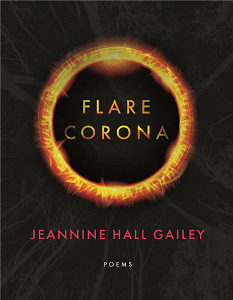
 Jeannine Hall Gailey served as the second Poet Laureate of Redmond, Washington and the author of Becoming the Villainess, She Returns to the Floating World, Unexplained Fevers, The Robot Scientist’s Daughter, and winner of the Moon City Press Book Prize and SFPA’s Elgin Award, Field Guide to the End of the World. Her latest, Flare, Corona from BOA Editions, was a finalist for the Washington State Book Award. She’s also the author of PR for Poets, a Guidebook to Publicity and Marketing. Her work has been featured on NPR’s The Writer’s Almanac, Verse Daily and The Year’s Best Fantasy and Horror. Her poems have appeared in The American Poetry Review, Poetry, and JAMA.