
I’m at the beach at Port Townsend for a few days…more when I get back…til then, happy holiday weekend!
Back to work: Angst and more angst…
Okay, dear readers, I need you all to give me your opinions on this:
Last year I had an early version of my Japanese pop culture/folk tale manuscript in circulation. I’ve changed it since last September, re-organized, cut poems, added poems, but the core remains. So, do I send it back out to contests/publishers I’ve already sent it to? Or only send it to places I haven’t sent it before?
I usually have a policy that unless I’m a finalist/get a note etc I don’t want to send it back to the same place…
Oh, and now that I have a third manuscript, should I send both to the same places? Will they be sick of me if I do this?
Job phone interview went okay, I think. It sounds like a fantastic opportunity. But it might require a move. I’m not going to have angst about that til I get to the next round of interviews, though…and in the meantime, is it just me, or are there a TON of poetry teaching jobs around these days? None in my area, of course, but still, that’s got to be good for poets.
Hey, a blog post with real poetry CONTENT for once. Amazing, you say!
When I started writing poetry, really reading and trying to write “good” poetry (you know, trying to be better than song lyrics) I was eight years old. And I mostly wrote environmental/anti-nuclear war poetry with images of mushroom clouds and “boys in green raincoats.” I’m not sure exactly where this environmental stuff came from – possibly from living in the back yard of Oak Ridge, Tennessee (where they made and processed nuclear weapons) and possibly from reading Madeleine L’Engle’s Swiftly Tilting Planet (about averting nuclear war with time travel!) at an impressionable age.
But, as things went on, and I was chided by professors for trying to obviously to “say something” in our work, etc, the environmental stuff sort of dropped out of my writing. But suddenly, it is back.
It started with writing about Japan, and how Japanese anime is really created out of the shadow of the Hiroshima/Nagasaki nuclear blasts, and then about my father’s work as a high-tech cleanup consultant at various nuclear sites (including Oak Ridge and Fernald in Ohio.) It turns out I knew at a pretty young age that nuclear waste wasn’t easy to contain, protect people from, and certainly the term “Clean up” is awfully optimistic when you’re talking about radioactive waste with a multimillion-year half-life.
Now with my new book I’m writing about this again, more personally – like being exposed to cancer risks (did you know that folks within a ten-mile downwind area of Oak Ridge have a 53% risk of getting cancer, whereas most Americans have about a 5% chance at any given time? This was in my recent research, probably not available even ten years ago to people looking for explanations…) It’s a recurring theme in the short stories of Hakuri Murakami, people who get sick for vague reasons, an undercurrent of paranoia about genetics/the body.
The whole mythology of the X-Men and Heroes has been so fascinating to me, because it challenges us to think of the upside of things like mutagenics. I did a bit of research on PAI-1 deficiency, my own personal genetic mutation, and it seems that although the downside is pretty rough (it acts much like hemophilia) the upside is that studies in mice show that PAI-1 deficiency might have a protective effect against some tumors, cardiovascular disease, and diabetes. Although it has a negative effect in gram-negative pneumonia-catching (which could explain why I spent a few years having pneumonia all the time until I got an pneumonia vaccine.)
Anyway, I’m thinking more about how to incorporate my brain and heart into my poetry – keeping the work interesting artisticly and linguistically, but somehow also having a passionate message. Few poems that are explictly political are spectacular. But there’s got to be a balance. Trying not to write something because you are afraid it might be lame is not an excuse to not write something more ambitious socially.
I wasn’t afraid to write about feminist stuff – violence against women et al, and no one has really smacked me on the head about the content of my first book (although I do get the annoying student questions like “Why are you so angry at men?” occasionally. ) And I don’t want to be afraid to write about this enviro-stuff either. I understand it and I’m interested in it. Is that enough?
My dear friends,
Well, I was getting better from the wrist sprain when I managed to screw up a joint in my shoulder and my old shoulder tendinosis (a degenerative condition where my tendon has holes in it) has reared its ugly head and couldn’t use my neck or shoulder for a few days. I’ve been joking with people that whoever’s been sticking pins in my voodoo doll should really stop now.
I was finally better enough today to stop lying in bed and walk around outside in the sunshine, go grocery shopping, and some other normal-person stuff. Made me feel a lot better.
I got an exciting call about a job interview next week, hopefully something works out there…Looks like I might be busier post-MFA than I expected.
No poetry news in the mail, fall is coming, and my goal is to be healthy…so, endocrinologist, rheumatologist, and physical therapist, bring it on, baby!
Finally the wrist is feeling well enough to type a little more, so I’ll write this quick entry:
-I have officially signed on to teaching two weeks of middle school students in March 2008 and one week of high school students in June 2008 at Centrum as part of their Young Artists Program. I’m excited but also a little scared…I’ll be trying to squeeze an introduction to mythology, mythology connections in comic books, and creative writing exercises all into a week. On top of this, Centrum offers the folks who teach in the program an opportunity for a residency there in Port Townsend, which will be nice. My first ever independent, non-school-related residency.
Creating a whole new twisted generation of comic book poetry fans is a fun prospect. I haven’t worked with middle-school aged kids before, should be an interesting challenge (anyone with advice please leave comments!)
-I’ve had a chance to catch up on my reading (what with the tonisllitis and sprained wrist and all – this is the upside of downtime) – some mythology texts, a pretty decent anthology of prose poems, Atwood’s You are Happy. And I got to watch some episodes of Buffy season I, which I call “when Buffy was still fun,” which always makes me happy. Even wrote a couple of poems – three in two weeks, which is pretty good for me. I’m not the poem-a-day type, although I admire the effort others have been making this August.
-The new 41 cent Superhero stamps are out at the Post Office. Elektra and the X-Men make appeareances. I now have two sheets.
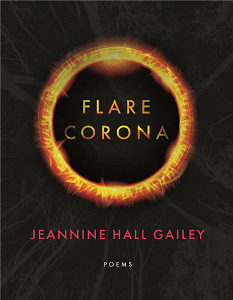
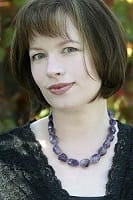 Jeannine Hall Gailey served as the second Poet Laureate of Redmond, Washington and the author of Becoming the Villainess, She Returns to the Floating World, Unexplained Fevers, The Robot Scientist’s Daughter, and winner of the Moon City Press Book Prize and SFPA’s Elgin Award, Field Guide to the End of the World. Her latest, Flare, Corona from BOA Editions, was a finalist for the Washington State Book Award. She’s also the author of PR for Poets, a Guidebook to Publicity and Marketing. Her work has been featured on NPR’s The Writer’s Almanac, Verse Daily and The Year’s Best Fantasy and Horror. Her poems have appeared in The American Poetry Review, Poetry, and JAMA.