
Terribly sad over Madeleine L’Engle’s death (see my reference to L’Engle’s work on my concepts of time travel a post or two ago.) Not only did she have a cool name, she had wonderful insights into science and human nature. Her nuanced portrayal of an older sister and younger brother, Meg and Charles Wallace in the Wrinkle in Time trilogy, seemed very close to my own relationship with my little brother, except, as far as I know, we were never able to save the world with angels, witches, unicorns, and time/space travel. Read Laurel’s article on her work in Salon here.
Got two encouraging rejections today, one very sweet one from Barrow Street, and another from my query to Sarabande only a few weeks ago (ten pages from my third manuscript) that had a little note on the bottom that said “wonderfully original work!” I felt nearly as happy as if someone had given me a basket of flowers. Sometimes nice rejections are almost as good as acceptances. Now I am ready for some fall subs. It bolstered me on an otherwise depressing day of doctor appointments.
Back from a cool and rainy beach, where we saw the following: six baby peacocks and a white parent peacock, ten baby quail and parents, a mother and baby racoon, 12,000 fawns and various deer, otters, harbour seals, and a multitude of seagulls. After reading Lucia Perillo’s I’ve Heard the Vultures Singing, I can even identify the kinds of seagulls. Yes, that’s my takeaway from the poet’s book: the wildlife biology.
Well, I came back to a Tempest on the Wompo list over whether writing poetry in persona was proper, ethical, allowable, etc. I had to write a little post on the topic, and here it is:
Dear Wompo crowd,
My goodness! What a passionate discussion about something I thought was an accepted truth in our literary world – that the speaker is not the poet. We do not assume writers of plays, or novels, or songs, etc must always write as themselves, but somehow the poet is expected to do so. I love to write dramatic monologues and fiction, but I happen to be a poet, so I use persona poetry.
Perhaps it’s because of some of my favorite poets write in persona, such as Gluck and Margaret Atwood and Lucille Clifton, to name a few, or perhaps I find persona poetry a nice contrast, to the I-was-walking-through-the-woods-and-had-this-epiphany poem you find all over the place or the sixties-era confessionalism that still seems to be one of the main modes today. I hope we can all agree there’s room for that kind of poetry, and for poetry that allows us to create character, plot, and dialogue in our minds as well.
In a little class I prepared for college students, I talked about the benefits – or the reasons why – of writing persona poetry.
Here’s a condensed version:
-Empathy. Allowing us to put ourselves in the shoes of the “other.”
-Imagination. Getting out of the prison of your own life and circumstances, and into someone else’s. Or a different universe altogether. This is one of the reasons it is the mode of writing I’m most strongly drawn to.
-Especially for women, allowing their full range of voice in a society that may or may not be happy to hear what they’re thinking or feeling. The three poets above (Gluck, Atwood, and Clifton) are pretty sly in the way they critique society through their personas, in ways they would maybe not be able to get away with writing as themselves. I’m also thinking of HD here. There’s a social aspect to giving voices to the voiceless…the midrash – to re-writing mythology and history by using a woman character’s voice to critique the social situations they found/find themselves in. I mean, Mary Magdalene didn’t get to write her own story. or Leda, Philomel, Helen of Troy. Or, come to think of it, Wonder Woman. Sure, these women are fictional, but don’t they deserve to be heard?
The two cents of a passionate persona poetry lover and writer, Jeannine Hall Gailey
I’m at the beach at Port Townsend for a few days…more when I get back…til then, happy holiday weekend!
Back to work: Angst and more angst…
Okay, dear readers, I need you all to give me your opinions on this:
Last year I had an early version of my Japanese pop culture/folk tale manuscript in circulation. I’ve changed it since last September, re-organized, cut poems, added poems, but the core remains. So, do I send it back out to contests/publishers I’ve already sent it to? Or only send it to places I haven’t sent it before?
I usually have a policy that unless I’m a finalist/get a note etc I don’t want to send it back to the same place…
Oh, and now that I have a third manuscript, should I send both to the same places? Will they be sick of me if I do this?
Job phone interview went okay, I think. It sounds like a fantastic opportunity. But it might require a move. I’m not going to have angst about that til I get to the next round of interviews, though…and in the meantime, is it just me, or are there a TON of poetry teaching jobs around these days? None in my area, of course, but still, that’s got to be good for poets.
Hey, a blog post with real poetry CONTENT for once. Amazing, you say!
When I started writing poetry, really reading and trying to write “good” poetry (you know, trying to be better than song lyrics) I was eight years old. And I mostly wrote environmental/anti-nuclear war poetry with images of mushroom clouds and “boys in green raincoats.” I’m not sure exactly where this environmental stuff came from – possibly from living in the back yard of Oak Ridge, Tennessee (where they made and processed nuclear weapons) and possibly from reading Madeleine L’Engle’s Swiftly Tilting Planet (about averting nuclear war with time travel!) at an impressionable age.
But, as things went on, and I was chided by professors for trying to obviously to “say something” in our work, etc, the environmental stuff sort of dropped out of my writing. But suddenly, it is back.
It started with writing about Japan, and how Japanese anime is really created out of the shadow of the Hiroshima/Nagasaki nuclear blasts, and then about my father’s work as a high-tech cleanup consultant at various nuclear sites (including Oak Ridge and Fernald in Ohio.) It turns out I knew at a pretty young age that nuclear waste wasn’t easy to contain, protect people from, and certainly the term “Clean up” is awfully optimistic when you’re talking about radioactive waste with a multimillion-year half-life.
Now with my new book I’m writing about this again, more personally – like being exposed to cancer risks (did you know that folks within a ten-mile downwind area of Oak Ridge have a 53% risk of getting cancer, whereas most Americans have about a 5% chance at any given time? This was in my recent research, probably not available even ten years ago to people looking for explanations…) It’s a recurring theme in the short stories of Hakuri Murakami, people who get sick for vague reasons, an undercurrent of paranoia about genetics/the body.
The whole mythology of the X-Men and Heroes has been so fascinating to me, because it challenges us to think of the upside of things like mutagenics. I did a bit of research on PAI-1 deficiency, my own personal genetic mutation, and it seems that although the downside is pretty rough (it acts much like hemophilia) the upside is that studies in mice show that PAI-1 deficiency might have a protective effect against some tumors, cardiovascular disease, and diabetes. Although it has a negative effect in gram-negative pneumonia-catching (which could explain why I spent a few years having pneumonia all the time until I got an pneumonia vaccine.)
Anyway, I’m thinking more about how to incorporate my brain and heart into my poetry – keeping the work interesting artisticly and linguistically, but somehow also having a passionate message. Few poems that are explictly political are spectacular. But there’s got to be a balance. Trying not to write something because you are afraid it might be lame is not an excuse to not write something more ambitious socially.
I wasn’t afraid to write about feminist stuff – violence against women et al, and no one has really smacked me on the head about the content of my first book (although I do get the annoying student questions like “Why are you so angry at men?” occasionally. ) And I don’t want to be afraid to write about this enviro-stuff either. I understand it and I’m interested in it. Is that enough?
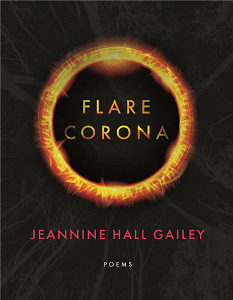
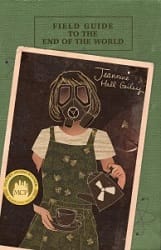
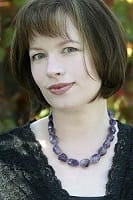 Jeannine Hall Gailey served as the second Poet Laureate of Redmond, Washington and the author of Becoming the Villainess, She Returns to the Floating World, Unexplained Fevers, The Robot Scientist’s Daughter, and winner of the Moon City Press Book Prize and SFPA’s Elgin Award, Field Guide to the End of the World. Her latest, Flare, Corona from BOA Editions, was a finalist for the Washington State Book Award. She’s also the author of PR for Poets, a Guidebook to Publicity and Marketing. Her work has been featured on NPR’s The Writer’s Almanac, Verse Daily and The Year’s Best Fantasy and Horror. Her poems have appeared in The American Poetry Review, Poetry, and JAMA.