Poem on Verse Daily Today – The Last Love Poem
- At July 21, 2017
- By Jeannine Gailey
- In Blog
 0
0

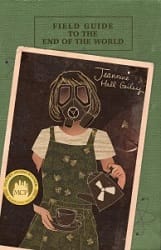
So pleased to have some good news to announce – my poem from Field Guide to the End of the World, “The Last Love Poem,” is up on Verse Daily today!
Sylvia wanted to remind you that summer is sometimes a slow season for poetry sales, so pick up a copy of Field Guide to the End of the World now. She’s so commercial, that kitten!

In all seriousness, it’s nice to have good news to share in a month that has been challenging (besides our dental woes, I had a bout of food poisoning/stomach flu a few days ago, which was un-fun.) It’s been beautiful weather here but I’ve been too sick to do much exploring of the lovely beaches, mountains and woods. Luckily I’ve been able to watch the clouds, birds, rabbits, and our little garden around our house, which is blooming, finally, all the things I planted last fall when I was so worried and gloomy, the lavender humming with bees, strawberries and blueberries, roses and mint. Happy July! I’m hoping to get a few poems written, a few submissions, maybe even a book manuscript sent out, before the end of the month…
New Poem about Middle Age in Contrary Magazine, Things Fall Apart in July
- At July 11, 2017
- By Jeannine Gailey
- In Blog
- 3
I’m so glad Contrary Magazine decided to publish this particular poem this week: “April in Middle Age”
It was a good reminder to me about this feeling of falling apart. This is really the first day I could even think straight for the last week. During the July 4 holiday weekend, I managed to knock out part of my tooth and its filling (no pain), got an emergency dental appointment on the 5th, and then spent about six days in so much nerve pain from the temporary crown that it nearly crossed my eyes (apparently the nerve gets irritated, which can cause enormous pain. I was like, why do I try to do anything to my teeth??) Then my poor husband knocked out one of his crowns! We celebrated our 23rd anniversary – instead of picnicking by the waterfalls like we planned – by eating soft foods and with me generally trying not to complain about the pain. I got vertigo from my TMJ (a side-effect of the dental appointment and two sprained jaw injuries in my past) so bad that I nearly passed out taking a walk on Lake Washington. Nevertheless, we saw two sets of little ducklings on the water, and I got dressed up. This is part of getting older – things start falling apart, literally. Here’s a picture of us on our anniversary this year, the ducklings on Lake Washington, and the night we got engaged when I was 20.
-

- Anniversary by Lake Washington

-

- Ducklings!

-

- The night of our engagement – I was 20!

It’s so frustrating when your body slows you down. I was finally able to get some sleep last night after my physical therapist worked on my jaw and recommended a small dose of a muscle relaxer which I had never thought of before (I can’t take many pain drugs, due to the bleeding disorder and allergies.) Therefore my brain is a bit brighter, as is my mood, today. I am still being instructed to take it easy, but I have two packets of poems to look and a review I’m supposed to be working on. Beth Ann Fennelly’s Heating & Cooling, as displayed here by my kitten Sylvia:

I have noticed that my health usually takes a dive in July for whatever reasons – my autoimmune system doesn’t like heat or sun, or just things tend to happen when you have the time to go to doctors and dentists. Anyway, it’s a reminder that this is more of a regular than non-regular occurrence, part of getting older, part of me. I am reminded that summer takes its own toll, though it’s mostly a time for other Northwesterners to frolic outside, I’m usually stuck indoors, avoiding the sun or heat, but also forced into a closer relationship with my books. This is probably a pattern I’ve had since I was a kid in Tennessee, avoiding the midday Southern sun and storms, hiding myself in a tree in the shade or a corner of the house where I would be left alone to read. This is why spring and fall feature so strongly in my poems – and not usually summer.
July 4 Weekend – Apocalypse Poetry, Poetry and Kittens, Summer Submission Doldrums
- At July 02, 2017
- By Jeannine Gailey
- In Blog
- 1
Well, happy holiday weekend! And how better to celebrate than with a discussions of Apocalypse Poetry!
Trish Hopkinson hosted me on her blog to do a guest post where I talked about the trend towards apocalypse poetry. Books by Dana Levin, Jessie Carty, and Donna Vorreyer are discussed (I got Apocalypse Mix by Jane Satterfield too late to include, but it certainly falls into this category as well, and is a really fun read!) I discuss everything from Cold War angst to neural lesions to the current political climate and Murakami. Check it out!
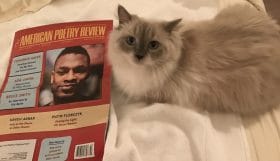
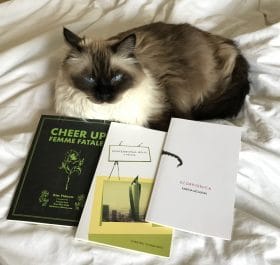
I’ve started a new Twitter called @literarykittens where my cats Sylvia and Shakespeare pose with literary materials – new books, literary magazines. At some point the cats might even start doing microreviews. Hmm…Here’s Sylvia with the new American Poetry Review and Shakespeare with my new load of books from Open Books – Kirsten Kaschock’s Confessional Sci-Fi, Scorpionica by Karyna McGlynn, and Kim Yideum’s Cheer Up Femme Fatale (with translations by one of my fave writers and translators, Don Mee Choi, as well as Ji Yoon Lee and Johannes Goransson.) I made a less-television-more-reading goal for this summer, and so far, so good!
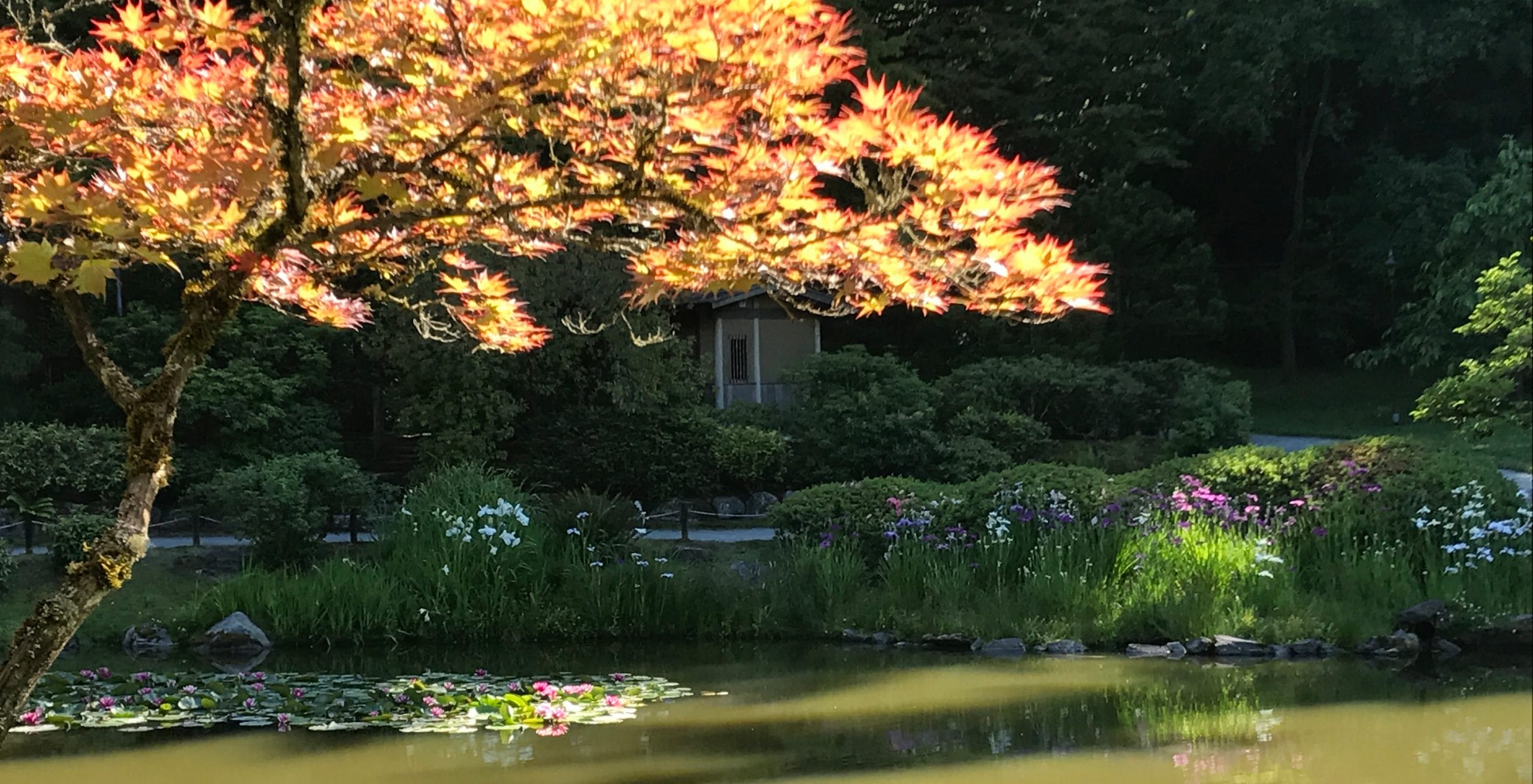
I also got to meet up with charming President of the Science Fiction Poetry Association, Bryan Thao Worra, at Open Books, where we talked all things sci-fi and poetry. It’s been so nice to get to meet up with literary friends as they travel through lovely summertime Seattle! Then some local scenes – Seattle’s Japanese Garden and some Woodinville scenes of roses and hummingbirds.
-
- Bryan Thao Worra and me at Open Books

-

- Japanese Garden, iris and water lilies
-

- Japanese Garden, iris and water lilies with heron

-
- close-up of bathing blue heron

-
- Glenn and I in the roses

-

- a local hummingbird gets curious

Are any of you experiencing summer poetry doldrums? I always, always have a hard time getting motivated during Seattle’s three summer months. Maybe the sunshine that lasts til almost 10 PM is part of the problem – it throws off my biorhythms so I’m sleeping in and staying up later. I have been reading more and writing at least a little but sending out? I’ve been seriously slacking off. Here is a wonderful list of places to send in July: https://entropymag.org/where-to-submit-june-july-3/ It’s not an endless list, which makes summertime submitting harder, too – so many lit mags take the summer off! What are your tricks and tips? Ooh, if you’re around and not out barbecuing, come share them as the Twitter #poetparty is on tonight at 6 PM!
First Day of Summer and Summer Reading Resolutions, Poems in the lovely F(r)iction and Redactions
- At June 21, 2017
- By Jeannine Gailey
- In Blog
- 0
Welcome! It’s the first day of summer (it hasn’t felt much like summer here – while the rest of the country has been pelted with high heat, we’ve been putting on sweaters for 60 degree grey days here in Seattle) and the beginning of my summer reading resolutions. One of the goals I have for the summer is to watch television less and read more books. I’ve already started doubling up on books by the bed and audiobooks in the car, on my phone, and everywhere else it would be convenient to grab a book. When the weather’s nice here, you have to take advantage of it, hence my cancelling of Netflix and avoiding the temptation to keep the television on at random. Seattle’s summers are usually splendid – lots of wildlife, finally clear views of mountains, green trees unshrouded with mist. Just this week, we’ve seen deer in the backyard, baby bunnies on the street, eagles and herons in the air and an otter in Sammamish river, along with plenty of ducklings. You sort of have to grab the ability to walk outside without heavy clothing while you can.
Anyway, in keeping with my reading goals, I took several bookstore buying sprees, including one at local poetry store Open Books, and another at University of Washington’s bookstore, which really has wonderful poetry and fiction and local non-fiction sections. This is a picture of visiting writer Julie Brooks Barbour with me in the poetry section of the UW bookstore! (She also really liked the manga section!) And then after we dropped Julie off, we discovered the beautiful Renton Gene Coulon Memorial park – right by Boeing’s R&D building, hence the plane in the background! And a picture of my kitten Sylvia with other cat Shakespeare with my Open Books purchases. (Hothouse by Karyna McGlynn, There are More Beautiful Things than Beyonce by Morgan Parker, and Jane Satterifeld’s Apocalypse Mix.)


And it also seems to be the season for contributor copies! This last week I got a copy of the beautifully designed F(r)iction, as well as the Gambling/Surrealism issue of Redactions. Here’s the kitten Sylvia modeling both, and a page from my own illustrated work in F(r)iction. (Did I mention Sylvia has started a literary Twitter feed – @literarykittens? She welcomes pictures of other literary kittens and promises to retweet and like!)


I also finished up most copyedits of my PR for Poets book, almost ready to turn in to my editors at Two Sylvias! Now I’ve got two book reviews in front of me, Beth Ann Fennelly and Victoria Chang’s new books. So, do you have any summer reading/writing/submitting goals you’d like to share?
Port Townsend and Poet Trips, Rain Taxi review
- At June 13, 2017
- By Jeannine Gailey
- In Blog
- 0
Just home from a several-day trip, I woke today to see that there was a wonderful review of my latest book, Field Guide to the End of the World, in the very esteemed journal of reviews, Rain Taxi! The Summer issue, which just came out, contains a review by Sarah Liu of the new book. “In Gailey’s field guide, the language of the body is subsumed in that of the apocalyptic and vice versa. The speaker-as-guide of her poems provides a dialectic of tension and comfort…” Thanks Sarah and Rain Taxi! There’s also a great interview with Denise Duhamel in the issue. Here’s a picture of the kitten, Sylvia, posing with the summer issue. Check it out!

Kitten Sylvia with her copy of Rain Taxi
Just got back from a trip out to visit my poet friend Kelli Russell Agodon in her beautiful sea-view home over the water, then on to a couple of days in Port Townsend. It was wonderful to spend some time out with a poet friend and then in nature, enjoying the ocean, watching the heron, seals, deer, eagles, goldfinches, and observing everything in bloom along the journey – from roses to rhododendron to red hot pokers and cherry blossoms. Travel is a little more difficult for us these days than it used to be, but it’s good to sometimes have a change of scenery. We used to live in Port Townsend – now it’s been about ten years – but the town still feels like a former home, with all the nostalgia. Of course, since we got caught in a ferry backup on the way out, and a Hood Canal Bridge closure on the way back, the irritating realities and isolation – and the fact that I seem to be allergic to everything in town, from the picturesque historic old buildings to the local paper mill – it also helped us remember why we moved away. Coming home to the much less exciting scenery of Woodinville, I felt peaceful – happy that we had made the trip, and that we were home again, where we belonged. But if you want to see what makes the Northwest beautiful, Port Townsend isn’t a bad place to start. Also, the shops – including the Imprint Bookstore – are a bonus in an area where you could spend your entire time outdoors. There are colorful umbrellas, great book selections (I think I came home with about ten more books!) and more to browse through if it turns grey and rainy.
I also re-read The Egg and I by Betty MacDonald, about the trials of chicken farming in the thirties in the Port Townsend area. Betty MacDonald was a rarity in her day – a woman writer who was fairly financially successful – she also wrote children’s books and even sold movie rights and created the characters “Ma and Pa Kettle” – and was also sued several times. It was 1. way more racist than I remembered and 2. while I delighted in the descriptions of the towns and the gardening and the seasons, the book became much more for me the sad portrait of failed marriage and failed farm than the lighthearted humor book I had remembered. I had bought the local book “Looking for Betty MacDonald” for my mom, which had rekindled my interest in the subject.
-
- Glenn and I at Fort Warden

-
- in front of Discovery Bay view

-
- Roses at Chetzemoka park

-
- Glenn and me at North Beach

-

- Under inexplicable cherry blossoms

-

- Pirate Ship in thre Bay

-

- Poppies


-
- Glenn and me in the rhododentdron garden at Fort Warden

-
- Discovery Bay Sunset

-

- Port Townsend deer

-

- With Kelli, waterfront

New Poems in UCity Review, Wonder Woman, some news, Seattle landscapes and fluffy cats and cars!
- At June 04, 2017
- By Jeannine Gailey
- In Blog
- 1
First of all, my thoughts and prayers to the victim’s of yesterday’s attacks in London and the victims and families of victims in Portland. It hasn’t been very long since my last blog post, which was right after the attacks at Manchester. There has been too much terrible in the news lately.
I’ve got four new poems in the brand-new issue of UCity Review – you can read them here. Two of them were inspired by the recent accident at Hanford, and the other two are the musings about luck and destiny.
In other news, since I last wrote, I got an MRI and the test results (no change in the liver lesions, which is pretty good news – not as good as them disappearing, but definitely better than growth or spreading.) I decided to lease a new car, an experiment since we have not been a two-car family in over ten years (as you know, I struggled with some neurological issues for some time that limited my mobility, but physical therapy and training have really improved – as have safety features that make it a little easier to drive!) I feel like a teenager vrooming down my street. I forgot how fun it is to drive! It was also something I promised myself when I was diagnosed last year with that terminal cancer (the terminal part might not be coming so quickly after all!) – that I was going to be able to drive myself around again. I doubled up on my physical therapy and here I am!
The reading in Tacoma was fun. It was great to meet Kendra and I got to hang out a little with my artist friend Michaela Eaves. It was a beautiful night to be in Tacoma, too – and King’s Books is always fun to visit. Here are a couple of pics. Also, me with the new car and I didn’t mention that right after I got the car, I stopped into Woodinville’s Barnes and Nobles and got to chatting with one of the employees, and he showed me my book on the shelf!
-
- Michaela and me

-
- Kendra and I with our books!

-
- Me with Field Guide at Woodinville’s Barnes & Nobles!

-

- Posing with the new blue car

We’ve had some beautiful weather and you just want to capture all the fleeting beauty of the flowers that bloom for a week under the blue skies that peek out in May and early June. Also, my cat is very fluffy. That has to be attested to in pictorial form every so often.
-

- Me at the Japanese Garden

-

- Roses at the Herbfarm in Woodinville

-
- Krkland’s Carillon Point in bloom

-

- Fluffy!

-

- Glenn and I under wisteria at the Japanese Garden

It was Wonder Woman Day yesterday, and I’m getting ready to see the (long overdue) new move tonight. I’m so excited. I’m going to post my poem, “Wonder Woman Dreams of the Amazon,” here along with a movie poster and a bit of art I got at Seattle’s ComicCon years ago.
-

- Wonder Woman art

-

- Wonder Woman Dreams of the Amazon

-

- Gal Gadot’s Wonder Woman

Reading Tomorrow in Tacoma and Writing Poetry in Dark Times
- At May 24, 2017
- By Jeannine Gailey
- In Blog
- 0
Reading in Tacoma
Tomorrow I’ll be reading with San Francisco poet Kendra Tanacea, at King’s Books in Tacoma at 7 PM. I hope to see some of you there! I’ll be reading some end-of-the-world poems from my latest book, Field Guide to the End of the World, and Kendra will be reading from her new collection A Filament Burns in Blue Degrees from Lost Horse. I haven’t read in Tacoma for a while, so I’m excited abou tit!
Poetry in Dark Times
I can tell you I’m troubled when I read the news lately, and you probably are, too. The Manchester bombing in particular was so upsetting, I think because so many of the victims were young girls and boys. I did notice on Twitter a dramatic positive response from people in Manchester – offering to look for people, offering rides and cell phones and food, offering places to stay.
I have a poem in Field Guide to the End of the World called “The Narcissist’s Apocalypse,” in which the speaker, on learning she may be about to die, imagines the world ending as well. I actually think that the opposite happens with many people – when confronted with the worst things possible, their tendency is to reach out and help others. There are many stories of people going to the aid of the injured at the concert in Manchester, homeless men helping injured children, children helping each other, parents helping other people’s children. When I was told I had cancer last year that might be terminal, my instinct wasn’t to destroy, but to celebrate the beautiful things around me – the flowering trees, my loved ones, animals. (I have often joked that my camera became strangely full of tree pictures last year.) But I think when people are confronted by too much bad news, however, they have a tendency to either go into denial, try to hide from it, or become callous to it. I think poetry is one way to fight against that tendency to shut ourselves down or turn our emotions off.
Maggie Smith’s poem, “Good Bones,” has been making the rounds as a kind of comforting example of what poetry can do in a crisis, as does Adam Zagajewski’s “Try to Praise the Mutilated World.”
The act of writing poetry itself can be an impulse against darkness, towards creation and healing, even if the tone is angry or hurt or despairing. A poem can be a thing that connects the writer with an audience, something that connects one person to another with a tremulous strand of empathy, perhaps part of a healing web we can spin around each other all the time, this empathy, this desire to connect instead of severing connections, to celebrate and reach out instead of destroy. What can we do to help heal our mutilated world, or to try to make it more beautiful? Instead of tearing each other apart with apathy, hatred, prejudice, how to help build each other up, build a world that we can imagine being…better? Can we respond to terror and despair with more scientific achievements, more stories, more beautiful work of art or architecture, even computer code that might help the world rather than wreck it?
Part of the theme of Field Guide to the End of the World was about my own response to catastrophe, how we might imagine surviving the worst possible scenarios, how we might respond to chaos and disaster. This is how I ended the book, with “Epilogue.”

Poem Up at Rise Up Review and Five Things I Learned While Writing PR for Poets
- At May 19, 2017
- By Jeannine Gailey
- In Blog
- 2
First of all, thanks to the Rise Up Review for featuring my poem, “In Which I Declare My Resistance,” at their site. As you may know, I don’t write a tremendous amount of political poetry, but something (something!) about the last few months has inspired me to write in that vein.
Five Things I Learned While Writing PR for Poets
I’m almost ready to turn my non-fiction book, PR for Poets, into the editors at Two Sylvias Press (just waiting for copyedits from my hard-working student intern) and I thought I might share a few things I learned while writing the book.
- There are very few resources out there for poets who are looking at how to market poetry books. Poets and Writers magazine and Writer’s Chronicle – plus most MFA programs – don’t cover this stuff at all. People either assume poetry doesn’t sell, poets are above worrying about book sales, or I guess that somehow poetry books will sell on their own. I read through mountains of PR books for “regular” authors, and frustratingly, most of their advice didn’t really apply to us. (The stuff that did already exist was mostly written by Robert Brewer. Thanks Robert!) I also learned that marketing book for authors suddenly started having saucier titles, shorter chapters and larger fonts. Is this a millennial thing? Does everyone assume our attention spans are shorter? Anyway, this impacted how I organized my book in the end. I tried to make the book a little more accessible and easy to use without dumbing it down.
- Each poet will have a different path for marketing their book, so it’s really hard to write “one-size-fits-all” advice. I know several poets who have been ultra-successful at selling their books, and all of them had unique reasons and methods for selling books. This means we each have to think of the natural audiences for our book, the things that are unique about us. A doctor-poet friend sold his book at medical conferences; another poet toured the US on a bus, stopping at nearly every city. Some poets have irresistible charisma, and that’s not something you can manufacture, but it sure helps book sales.
- Some things involved in book promotion are beyond our control. Right after I’d completed my first draft of the PR for Poets book, I was diagnosed with fatal metastatic cancer in my liver. This was a few months before Field Guide to the End of the World was due to come out. Pretty awesome timing. I put the non-fiction book on hold for nine months that passed in a blur of tests, treatments, and more tests. Later I was forced to cancel part of my book tour (a trip out to Missouri) because my immune system decided not to work for a bit and I caught every bug going around (and this was a particularly weird flu season.) This stuff happens when you put out a book – you lose a job, you get pregnant, a loved one passes away, you get sick – and you have to pick and choose where you put your energy. For Field Guide to the End of the World, I wasn’t able to give as many readings, so I tried a few other methods to promote the book that I could do from home. (PS: If you are interested in buying, reviewing, or otherwise promoting Field Guide to the End of the World, I would be very grateful! Please contact me. PPS: Amazon reviews are appreciated more than you know!)
- Sometimes giving stuff away for free makes sense for poets. A few examples: beautiful broadsides or bookmarks that allow people who come to a reading to walk away with a visual reminder of your work. Goodreads giveaways. Sending books to reviewers, even though most reviewers will ignore it. Same with book prizes. You never know when a well-placed giveaway will work out in a way that might work to make your work do the miraculous and “go viral.” (For good info on poems going viral, check out the journey of Maggie Smith’s poem “Good Bones” by Kelli Russell Agodon.)
- Celebrating your book with family and friends is maybe the most important part in terms not of sales, but of value. In my memory, in terms of what will mean most to me later on, it’s those happy moments when there’s champagne and people who are genuinely happy to be holding your new book. You may not remember most of your readings, or the first time you see your book in a bookstore, but you will remember those celebrations with loved ones. So be sure to take the time and energy (and a little money) and put it towards a celebration.
Okay, hope that was helpful to you!
What I’ve Been Up to in May – reports on writing a non-fiction book, goslings, concerts – and getting May submissions done
- At May 13, 2017
- By Jeannine Gailey
- In Blog
- 4
I’m almost finished with my non-fiction book for Two Sylvias Press, PR for Poets. Let me say, it’s 150 pages and soooo much more work than a poetry book! Luckily I’ve had my husband, my mom, and a wonderful student intern to help me do a final editing pass before I turn it in, and then I’ll be ready to send to beta readers for some early feedback! (So let me know in the comments if you want to be one of the beta readers for me!) I feel much more confident about the book now than when I finished my first draft last year. But once again, waaaay more time-consuming than I initially thought – but hopefully the book will be helpful for lots of poets who feel (like me) that they had no resources to learn how to sell their own poetry books!
In poetry news, I have a poem coming out soon in the Rise Up Review and I’m getting ready to do another reading for Field Guide to the End of the World at King’s Books in Tacoma on May 25. I hope some of you will be there!
Besides being busy with writing the PR for Poets book, I’ve been working on writing a new poetry manuscript – I’ve even sent it out once already! It’s a very personal book, but I notice once again there’s a little bit of apocalypse sneaking in to the personal aspects. A few days ago there was an accident at Hanford. (You can read more about it here.) Even though I’ve already written one book, The Robot Scientist’s Daughter, about my own experiences growing up in a very nuclear-immersed household, it still surprises me how little politicians – and people in general – know about the risks of their local and national nuclear sites, like Hanford, San Onofre, Oak Ridge National Labs, or the White Plains plant in New York. It surprises me how little the government tells us about the risks, and what people don’t know about protecting themselves from the long-term effects of nuclear pollution.
As you may know, I’ve been diagnosed with thyroid nodules and thyroid autoimmune disease, mysterious brain lesions, an autoimmune deficiency, and, most recently, tumors in my liver (and I’m due for another MRI of the liver tumors on Monday, always nerve-wracking.) I often wonder how many of my health problems are connected to my childhood exposure to Cesium-137-contaminated food, water, air, dirt – I grew up on a farm, after all, eating food that was grown there, playing in the mud on rainy days. I’ve been writing nuclear-related poems again, so I guess the subject isn’t exhausted in my poetry yet! I found out, for instance, in doing some research that children exposed to Cesium from Chernobyl exhibited some of the same problem with autoimmune IgG levels that I have. And of course, Cesium can be absorbed in the brain and liver, as well as skin and bones.
It hasn’t been all grim work and research – I’ve had time to get out to an Aimee Mann concert at The Neptune (good, singing some of my favorite lesser-known songs, with some quirky local talent and geek rocker Jonathon Coulton), discover some goslings along the Sammamish trail, and observe some new lilac, pink dogwood and wisteria blooming. I did sprain my ankle recently (yet again, sigh) and it’s mostly been too cold and wet to go out and have too much fun (plus I acquired a little spring cold, which didn’t help matters.) That’s okay. The downtime isn’t all bad. More time to work on edits. And submissions! As you may know, so many places stop taking submissions after May, so this is the time to get as many poetry subs out as you can before the month is over! Then you can relax over the summer. Lots of good places are still taking work now – so check out Entropy’s great list of places to send!
-

- Pink Dogwood

-
- Lilacs

-

- Goslings

-

- Aimee Mann with Jonathon Coulton

Birthdays, A Review of Magdalene, Sleeping Poems, and the End of Poetry Month
- At May 02, 2017
- By Jeannine Gailey
- In Blog
- 1
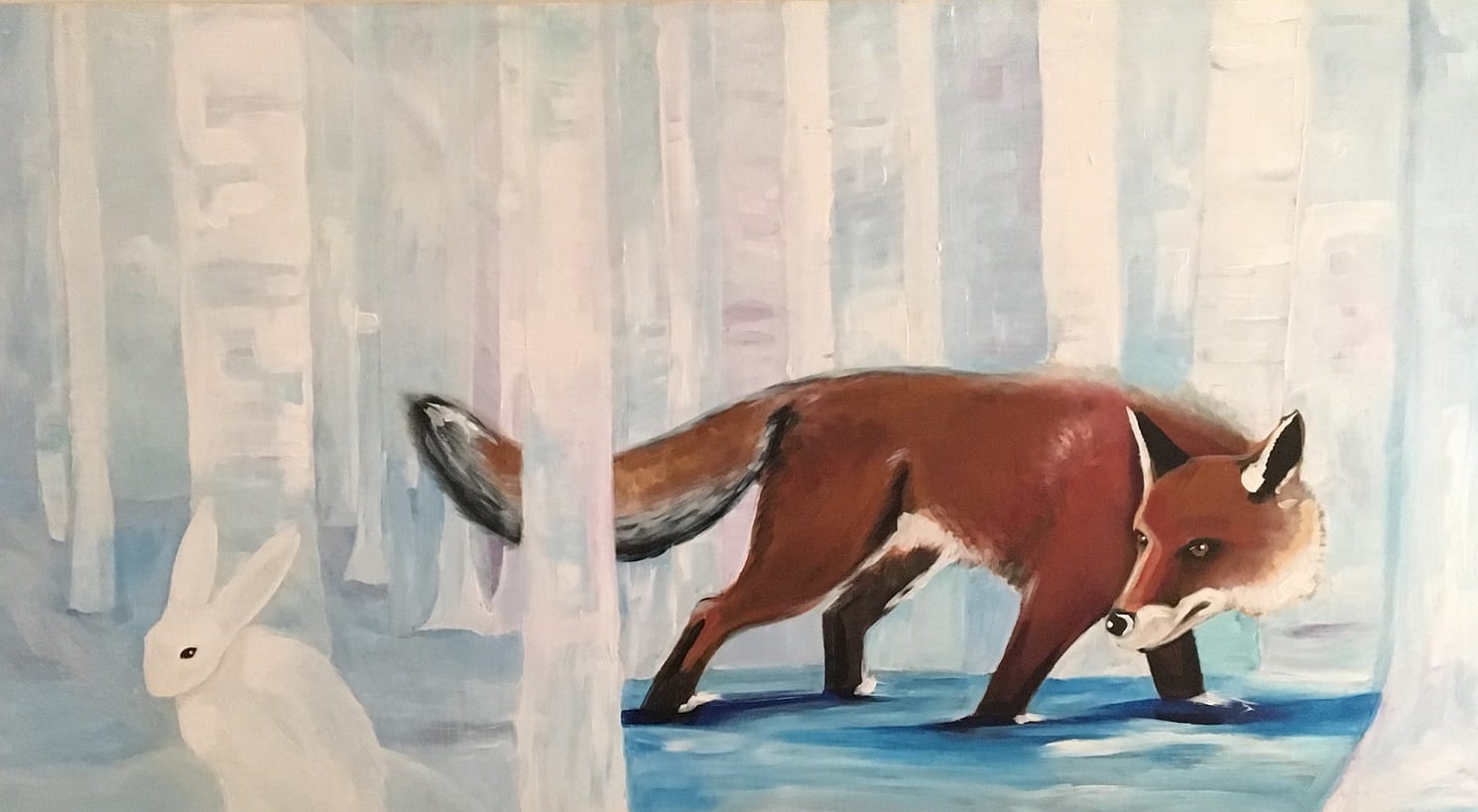
I decided to have a birthday celebration this year for my 44th. It seemed appropriate – last year at this time I was so stressed and down I barely went out in between cancer testing. I was worried I had about six months – maybe longer. So this year I wanted to celebrate turning 44! It seems miraculous. I invited over a few friends, Glenn made cupcakes, it was rainy and cold outside, but inside we had some fun. Michaela Eaves brought me some pieces of art (she and Glenn conspired to get me this painting of a fox and hare in a forest.) Here are a few pics:
-

- Michaela’s original Becoming the Villainess sketch art

-

- MIchaela Eaves fox and hare painting
-
- Natasha Moni and me

-

- Kelli Agodon and me

-
- Three poets – Kelli, Natasha, and me

-

- poets & artists: Michaela Eaves, Kelli and her daughter, and me

Life is short. That’s what I keep saying – we really do have to pause in the middle of grumbling, in the middle of bad news replaying constantly, in the middle of threats of wars and rumors of wars – we have to celebrate beauty and goodness, friends who make art, cupcakes. (PS Most of the friends in this picture I have known more than a decade now!)

In that capacity, let me know what you think of this review of Marie Howe’s newest book of poetry, Magdalene, up at The Rumpus a few days ago.
http://therumpus.net/2017/04/magdalene-by-marie-howe/
And these sleeping-themed poems up at Sleepyhead Central, as part of the poetry month celebration. One poem imagines a sleep deprivation clinic, another imagines alternate stories for Sleeping Beauty:
I almost thought my party might not happen – two days before, I sprained my ankle – and a day before, I woke up with one of the worst allergic reactions I’ve ever had (a new medicine, I think, sparked it) with purple welts and general miserableness. Happily, I woke up on my actual birthday with no welts and feeling fine (the sprained ankle, however, will take a little time to heal. Boo hiss.) It certainly has been an exciting time!
Now National Poetry Month is over, things can slow down to a little bit more of a regular pace. I’ve almost finished up PR for Poets to turn in, I have a Webinar to record this week (!), a poetry reading down in Tacoma with Kendra Tanacea at Kings Books on the 25th, I’m going to go see awesome writer Karen Russell this week, and I’ve got an Aimee Mann concert next week. They say we might actually have a little more sun now that it’s May. It’s been tough to go out and capture all the flowers that have been blooming despite the rain – but here are a few shots:
-

- a neighbor’s lilacs

-

- me in the cherry tree

-
- cherry blossom closeup

-
- Glenn and I with a background of cherry trees, Japanese Gardens

-

- Glenn in the cherry blossoms

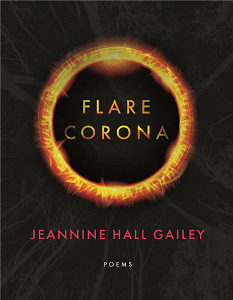
 Jeannine Hall Gailey served as the second Poet Laureate of Redmond, Washington and the author of Becoming the Villainess, She Returns to the Floating World, Unexplained Fevers, The Robot Scientist’s Daughter, and winner of the Moon City Press Book Prize and SFPA’s Elgin Award, Field Guide to the End of the World. Her latest, Flare, Corona from BOA Editions, was a finalist for the Washington State Book Award. She’s also the author of PR for Poets, a Guidebook to Publicity and Marketing. Her work has been featured on NPR’s The Writer’s Almanac, Verse Daily and The Year’s Best Fantasy and Horror. Her poems have appeared in The American Poetry Review, Poetry, and JAMA.