National Poetry Month, Cherry and Magnolia Blossoms, and an April Apocalypse Poem
- At April 02, 2017
- By Jeannine Gailey
- In Blog
 0
0

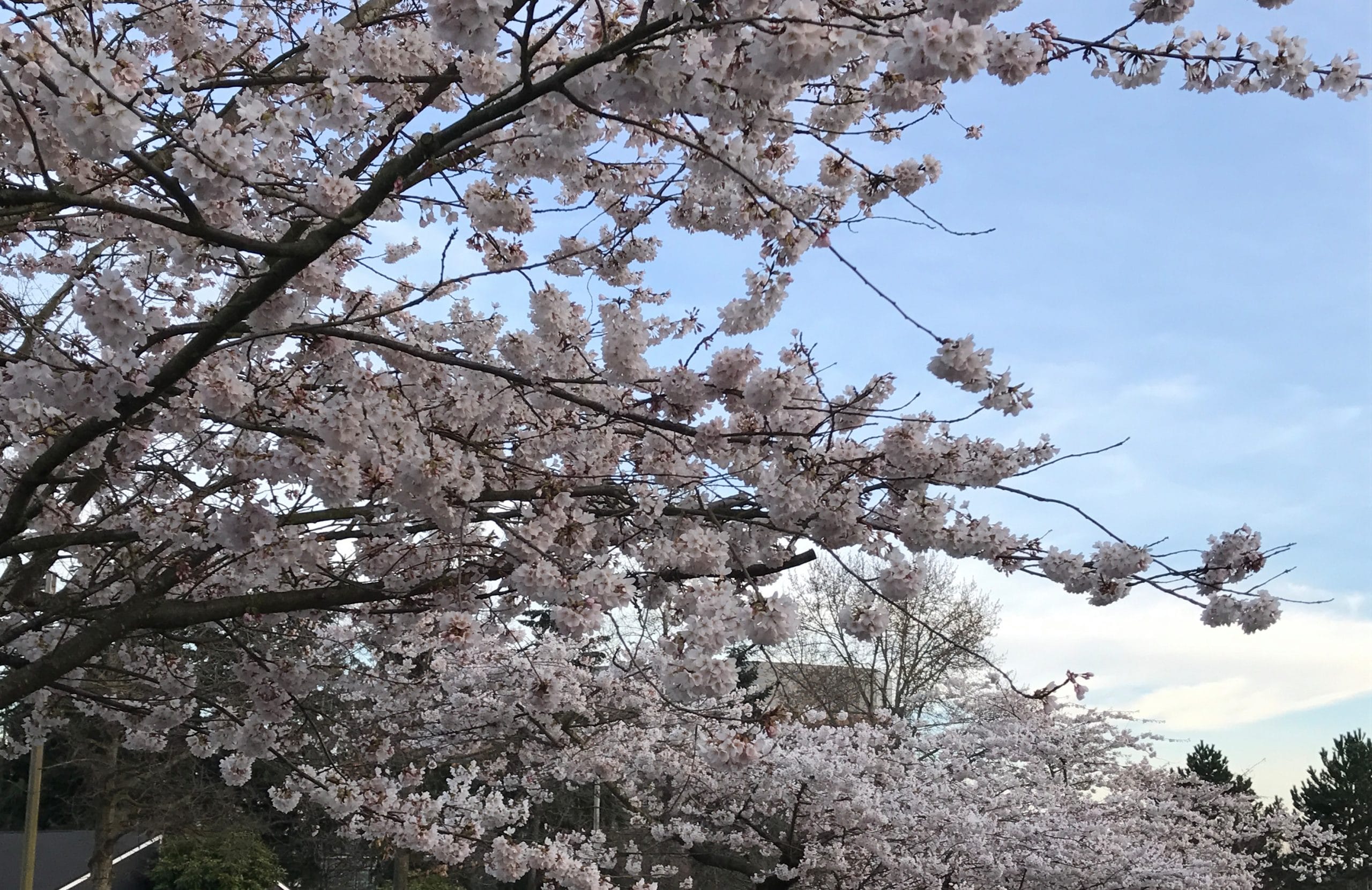 It’s the beginning of National Poetry Month (and my birthday month,) so even though we’re still in a weather-whomp of rain and lower temps, I’ve been cheered by the appearance of more singing birds (one that insists on singing outside our bedroom at 6 AM every morning,) more trees blossoming, and finally. a few bulbs in my garden blooming – the pink hyacinths in my boxes have appeared healthy and hearty after our cold, wet winter. These are the cherry blossoms down the street from our house, our in full snowy blushy splendor. The Japanese call the time of the advance of the cherry blossoms “sakura zensen.” To the right, you can also see Glenn and I posing with some new magnolia blossoms in the Kirkland neighborhood, where Google and Facebook employees wonder by, bearded and ensconced in their phones. This was also a day I got a bunch of medical tests done, all of which came back with mostly good news. No liver cancer, for one, which was a concern, and a negative tumor marker test on a rarer kind of carcinoid, plus only minor problems with liver function from all the tumors in there, which was also a concern.
 I started the month by getting another round of a cough and sinus thing (probably from going into two different doctor’s offices for the lab tests above) but I did manage to squeak out a poem yesterday, so we’ll hope for the same today! I’ve been inspired by reading Siri Hustvedt’s new book, A Woman Looking at Men Looking at Women: Essays on Art, Sex, and the Mind. Fascinating stuff! I love reading about art and gender, and Siri has such a fierce intellect, she just automatically makes me want to write something. I also really am loving Aimee Mann’s new album “Mental Illness,” and tweeted that my fave rhyme so far this month is her rhyme in the song “Good for Me” of “smoke machine” with “taste of dopamine.” I love art and music, and learning more about them, but am terrible at singing, instruments – I can do a little piano and guitar, neither all that well – and making art. It’s a good thing I have poetry!
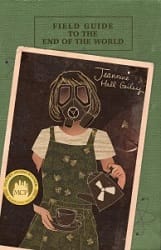
So I wanted to post another April poem, this time apocalypse-oriented, from Field Guide to the End of the World:
Spring Flowers, Medical Testing, and Submission Parties
- At March 30, 2017
- By Jeannine Gailey
- In Blog
- 2
Looking for Spring
 Spring has been late to visit the Pacific Northwest this year, so I’ve been desperately seeking signs of spring. In this spirit, we took a drive up to La Conner, home of The Tulip Festival, where at this time the last two years all the tulips were already up. This trip, just a few fields of daffodils and a few ornamental trees were in bloom. Around my neck of the woods in Woodinville, I found some plum and cherry blossoms. At this point with all the wet and cold we’ve had, we need all the flowers we can get!
I’m going in for some more medical testing today, which is always nerve-wracking, especially the tumor marker tests, which can be tricky and misleading and very scary. Wish me luck! I purposefully try to schedule something pleasant afterwards and nothing stressful beforehand. Today involves two different sets of doctor offices in two different systems, which is a bit more complex than usual…
Submission Parties!
No, it’s not a sexy thing, it’s a poetry submission thing!
Last week I had a “Submission Party” with a few poet friends via Google Hangout, and it was really fun – and three of us had acceptances within a few days! It was a good way to motivate yourself during what can be a dreary time of year and help some of us get our of our usual submission ruts. (I tend to send to the same journals over and over, for instance.) I very much recommend doing this with your friends if you can get them together – we had a few prep rules that helped – preparing a poetry packet in advance, bring at least three places you’d like to send and share, and have your spreadsheet and cover letter templates at the ready!
-

- Me in the daffodils

-

- cherry blossom closeup

-
- plum blossom lane (smelled like candy!)

-
- plum blossom closeup

-

- Glenn and I in the La Conner daffodils

I am looking forward to April, National Poetry Month, my birthday month, Easter and baby animals! We did see a mother deer with her baby in the grass yesterday while we were stalking flowers in our neighborhood. How about you? What are your plans for April? Anything ambitious? I’m doing a local college visit at Highline College and a reading at Soul Food Books with some other Two Sylvias Press authors on April 20.
Interview with Stephanie Wytovich and Cheers to KCLS Library
- At March 23, 2017
- By Jeannine Gailey
- In Blog
- 0
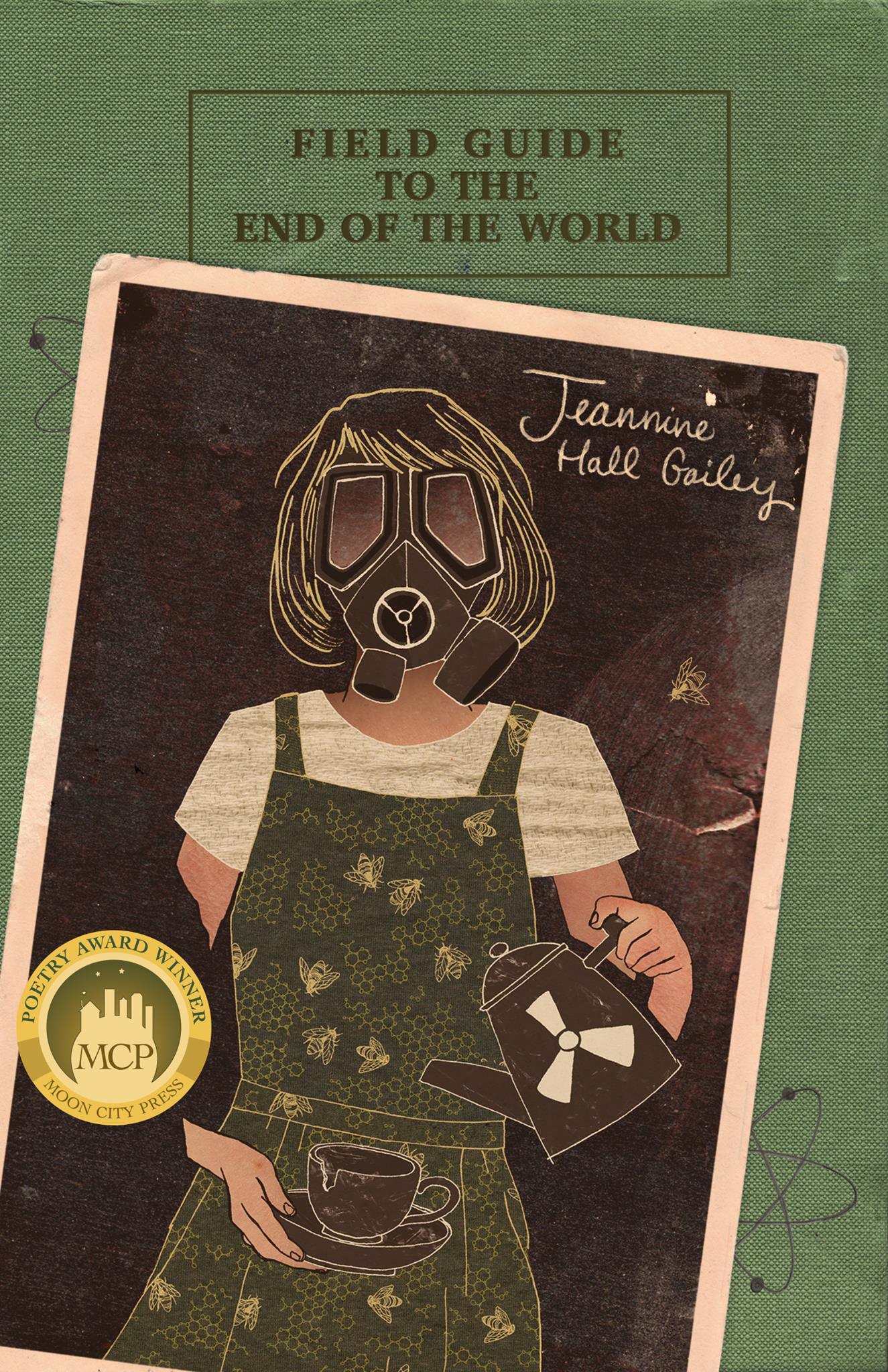 Thanks to Stephanie Wytovich, amazing horror writer – she is on the Bram Stoker finalist ballot this year for her poetry book, Brothel – for taking the time to interview me today on apocalypses, my new book Field Guide to the End of the World, my thoughts on the future of science fiction, and advice for writers (spoiler alert: stay weird!)
http://stephaniewytovich.blogspot.com/2017/03/author-interview-getting-apocalyptic.html
I have to say I have found the horror writing community to be so warm and welcoming, especially for such a spooky and scary genre! Stephanie is a great example, as are the writers in the local Seattle chapter I’ve met with. I’m very happy I joined the Horror Writers Association last year and encourage other poets to do the same!
Also, I was super touched that my local library tweeted about my new book yesterday:
Zombie strippers and Martha Stewart can both be found in the whimsical poetry of Field Guide to the End of the World https://t.co/kj38CN4dN7 pic.twitter.com/U1D0h3syUf
— King County Library (@KCLS) March 23, 2017
KCLS is one of the best library systems I’ve every belonged to (and I’ve belonged to libraries since my mom first got me a card at 6!) I really appreciate their support of local writers!
Signs of Spring, a New Review of Field Guide on The Pedestal, and Spring Poems
- At March 20, 2017
- By Jeannine Gailey
- In Blog
- 0
First, thanks so much to The Pedestal and Stephanie Chan for this excellent, thoughtful review of Field Guide to the End of the World. Here’s a little bit from the end of the review:
She makes the end of the world strangely relatable, filled with details of normalcy that have been flipped on their heads. Field Guide to the End of the World feels very much like a collection of postcards, poems sent from a series of desolate vacation spots, each inscribed “Wish you were here”—with romantic nostalgia for a future that may or may not come to be.”
(If you’d like to purchase a signed copy of Field Guide to the End of the World, you can do so here! And here it is on Amazon in case you’re just dying to write your own review 🙂 Did I mention I’m in the middle of revising and trying to finish my PR for Poets book? I’ve re-organized it into more bite-size chapters and interview tips, and So I thought I’d practice a little of what I’ve been writing about.)
Had a bit of a hard week with the aftermath of more medical testing – I’ve got a couple more important ones to do, then hope I can get a break for a while, as in, no results will be worrisome and require even worse follow-up testing. And at the end of the month, a new Aimee Mann album drops – “Mental Illness,” so I’ve got that to look forward to!
Today’s the first day of spring, and yesterday we had actual sunshine (after two months of record cold and wet) so I went out hunting for signs of spring. Nothing in my own garden is blooming yet, but we put roses, blueberries, and sweet peas in the ground anyway. Here are a signs of spring from all around town…plum blossoms, camellias, and other early blooms:


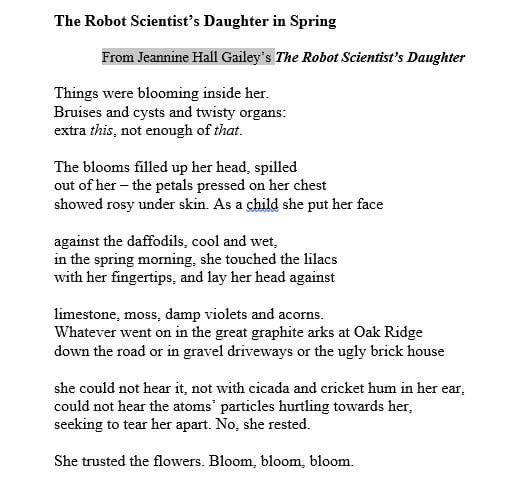
I thought I’d post a poem from my previous book, The Robot Scientist’s Daughter, called “The Robot Scientist’s Daughter in Spring,” as appropriate for today:
Success, Ambition, and the Body: How Do We Define Success as Writers? And What Do We Do When Circumstances Defy our Expectations?
- At March 16, 2017
- By Jeannine Gailey
- In Blog
- 5
I am staring down my 44th birthday next month, in the middle of a bunch of medical testing I had to put off while I was sick the previous couple of months. I have noticed that many of my conversations with friends lately – younger friends in their twenties and early thirties, older friends in their mid-fifties and sixties – are about whether or not we are feeling successful in our lives as writers.
What does success mean to us? Is it a full-time, tenure-track teaching job (I used to think so!) What about getting an NEA grant? (Though now, after seeing the Trump budget proposal which I dearly hope will be turned down by Congress, the NEA may in fact disappear, so,…) What about getting a poem published in a dream publication? What about getting your first book published? What about your second? What gives you happiness and satisfaction in your work? Would a MacArthur Genius Grant make you feel happy with what you have done, or would it drive you to work harder? Do you just want to get paid enough to cover rent and food?
I asked this question of Facebook and got a myriad of answers from writers just starting out and writers who have several of the accomplishments I’ve listed above. (You can check out the thread here at this link, I think: https://www.facebook.com/webbish6/posts/10155904705729951)
You can see that success, satisfaction, happiness with your work on a writer can be hard to define, can be a moving target, and can often feel like it depends on external factors we cannot control.
I was talking to a writer friend of mine who, like me, is often limited in her drive to succeed by what her body is able to do (or is not able to do.) I had to turn down a reading visit I dearly wanted to do next month because I have been so sick this year and I was worried the travel would send me back to the hospital. When I have to do stuff like that, it feels like crap. I feel like a failure. Though I know I can do a Skype visit (which I love! And thank goodness for technology!) I miss the in person visiting. I’m one of those writers who actually likes being around people – other writers, students, etc.
When I consider applying for full-time jobs I’m worried my body would not be able to handle…but on some days when I feel optimistic, I feel like I could do…when I wonder if I’m letting down my publishers by not traveling more to promote my books, or skipping AWP… I’m running into the problem of drive versus limitation. My friend whose been laid off from her job of twenty years and is stressed out looking for something new, or my friend who’s looking for her first job that can sustain her financially – they are also running into limitations, different ones. Our lives are defying our ambition, our plans for success, our road to what a writer is supposed to be able to do and be.
I wrote last year when I was diagnosed with terminal cancer that I was happy with what I’ve accomplished so far in life, and you know what? That’s still mostly true. I’ve been Poet Laureate of my city, I’ve published five books, all with publishers I consider friends. I’ve published in a few “dream” publications. But now that I’m looking at the possibility of a little more time, and the possibility of being slightly more mobile (I’m mostly not in a wheelchair or on a cane right now, due to 6 grueling years of twice-weekly physical therapy for neurological issues) it feels like I SHOULD be doing more than I am. But I’m still worn out, the cancer tests keep going, my immune system has been a big FAIL for three months. I’m grateful that I may not be facing death in six months. But I’m also anxious about what I should be doing in the meantime.
Last night I turned in two articles, turned in the judging of a poetry contest, and finished my first organized draft of what will become my sixth book eventually (possible titles: Post-Life? Sitting by Yourself at the End of the World? Self-Portrait as Accident?) and am thinking of what I can do to help promote Field Guide to the End of the World that I’m not already doing. And you know, today, I’m getting ready to go undergo more tests at a medical office which will take a couple of hours, and I’m like – can I get a submission in? Or write a new poem?
My ideas about what I expect for my life are different now, my ideas about what success as a writer consists of has changed. Sure, I would love a part-time job I could actually do from home, I would love a best-selling book or more prestigious book reviews or an award for Field Guide to the End of the World, I would love an unexpected award or fellowship out of nowhere, but I’m thankful for what I do have: a whole bunch of poems I’m pretty proud of, a great bunch of writer friends around the globe who are supportive and helpful when I need it, a spouse who values the work I do (even when it doesn’t bring in the kind of money I’d like it to.) I am thankful for today, which I would usually classify as a “bad day,” as it involved a company coming to cut down one of my backyard trees, a birch that’s gotten infested with birch beetles, which was sad, the news about Trump wanting to cut Meals on Wheels, which at least several of my house-bound relatives are reliant on, the NEA, and PBS, and the aforementioned several-hour-long medical testing. But the sun shone a little today, I made plans about new things to plant, and when I get home, I’m going to make more plans, submission and writing plans. That’s what we do to truly succeed as writers: we hold on to hope, we plant seeds, we try again. We keep writing.
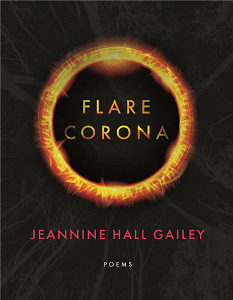
 Jeannine Hall Gailey served as the second Poet Laureate of Redmond, Washington and the author of Becoming the Villainess, She Returns to the Floating World, Unexplained Fevers, The Robot Scientist’s Daughter, and winner of the Moon City Press Book Prize and SFPA’s Elgin Award, Field Guide to the End of the World. Her latest, Flare, Corona from BOA Editions, was a finalist for the Washington State Book Award. She’s also the author of PR for Poets, a Guidebook to Publicity and Marketing. Her work has been featured on NPR’s The Writer’s Almanac, Verse Daily and The Year’s Best Fantasy and Horror. Her poems have appeared in The American Poetry Review, Poetry, and JAMA.