Prairie Schooner Spring 2011

Check out the new Spring issue of Prairie Schooner, including the online version of one of my new poems from the Robot Scientist’s Daughter manuscript, “Knoxville, 1979.” (The other poem, “Foxfire Books: In Case of Emergency, Learn to Make Glass” is more apocalyptic. The whole issue is really wonderful I think.) Lesley Wheeler and Robert Wrigley are also up as featured poets.
A sad note: this was Hilda Raz’s last issue as editor of Prairie Schooner, as she is retiring.
Why I Write About Japan, with links, Part I
When Asked Why I Write Poems About Japanese Mythology
— A letter from the suburbs of Seattle to the suburbs of Tokyo
I will send my voices out over the water
where the same cedars that litter my coast
used to tower over yours. Once green,
your cities have nibbled forests into bonsai.
Our hinoki trees are shipped across the ocean
for your sacred temples now.
Postcards of volcanoes rise from a blue sky
in the background of our homes, we share
zones of tsunami, seasons of weeping cherry.
I read about women’s spirits
haunting peony lanterns in the forest.
Men follow them, fall in love
with women long dead. In shallow graves
rotted with tree roots, they still sing.
And here in pages hammered
from your language into mine,
sometimes with clumsy fists,
I have listened to the bush-warbler
mourn her children, the fox-wife’s eyes
in the darkness have warned me
of the growling of dogs and fire.
And when they disappear in silence,
it is not really silence. Their echoes
burn themselves into stone,
into the living screens of my childhood,
fill my mouth with ghosts.
Ghosts sit in my mouth and sing.
Our grandfathers were at war.
I grew up in the birthplace
of bombs that poisoned children,
burned holes into your sacred earth.
Their poison is part of me.
In the shelter of a shrine, a small girl
holds an umbrella. She becomes a white bird.
She whispers and a thousand cranes,
a thousand burning flowers
pile up inside me, spill out onto these pages.
Forgive me, ghosts, for my hard,
unbeautiful hands, for my tripping tongue,
as you demand a healed future, some untorn prayer.
This poem was written some years ago in response to a question from Marvin Bell about why I decided to write the book, She Returns to the Floating World. It was published in Redactions and will appear in the upcoming book.
The Japanese disaster has weighed on me heavily for the past week or so, and I thought I would write here a little bit about how my life has been tied to Japanese culture since my early childhood. Then I’ll post some links from other sources more useful and possibly more coherent and lovely than my own, including meditations on the quake by Mari L’Esperance and Marie Mutsuki Mockett.
Part I
My father was a robotics expert, and so, as a child living in California and Tennessee in the seventies, we had frequent visitors from Japan, mostly other robotics experts, and family trips to Japan happened on a regular basis – once I had measles so I couldn’t go, another time I had scarlet fever…etc…so although every other member of my family has been to Japan, I never got a chance to go. (This is still true!) My father and brothers would come back with stories, dolls, paintings, new words. I had a collection of Japanese picture books and folk tales, and occasionally, the wives of my father’s business associates would teach me how to make a dessert (I remember something with rice and red bean paste) or teach me how to say a few words in Japanese, or how to sing a Japanese song.
I watched my first Miyazaki movie, Nausicaa of the Valley of the Wind, when I was ten years old, on an ancient primordial version of the Disney Channel. My brother and I sat transfixed, and watched the movie over and over again, its figure of a girl riding on top of giant caterpillars, a boy and girl trapped underneath a poisonous forest in a crystal cavern, frightening war figures and women warriors with metal limbs. This was my first introduction to Japanese pop culture, before we watched Transformers and Voltron and the other imports that would become popular in the eighties. At this same time, I read a terrifying book about the bombing of Hiroshima told from the perspective of a young girl (don’t remember the name of this novel, it was in our school library so I never owned it.)
I started to make the connection between the work done by my father at the neighboring Oak Ridge National Labs as a consultant for nuclear waste disposal methods and the bomb that was dropped on Hiroshima. (In case you’re wondering why I’m anti-nuclear bomb, anti-nuclear power, this set of incidents – watching Nausicaa, the book on Hiroshima, and early fourth-grade era research on nuclear pollution impacts – are probably key. And that grad-level class on Ecotoxicology I took during my Pre-Med days. Plus growing up with a Geiger counter in my basement and helping Dad edit papers on nuclear waste cleanup in high school, pretty bleak stuff in case you’re wondering.)
Part II to come.
Some links:
Marie L’Esperance’s meditation on the quake
Marie Mutsuki Mockett’s meditation on Japan from the NY Times
The Future on Nuclear Energy Around the World
My second book’s publisher, Kitsune Books, is donating a portion of their sales to the Japanese Red Cross
All About You: Review of Sky Burial, Interview with Rachel Zucker, and Other News
This morning my review of Dana Levin’s Sky Burial went up on The Rumpus. Check it out! Dana Levin is one of my favorite poets, and this fierce new book is definitely worth a read. Then buy her other books, Wedding Day and In the Surgical Theatre.
Victoria Chang interviews another one of my favorite poets, Rachel Zucker, on her blog. Thanks Victoria!
C. Dale Young had two poems up on Poetry Daily. You know, C. Dale’s poems always surprise me with their spirituality. He makes me remember my own spiritual side, which I don’t address very often in writing.
Oliver de la Paz has an interview up on the Ploughshares Blog.
And yet another favorite poet, Matthea Harvey, won a big old award.
Ever wonder what the Vida count would look like for sci fi? Wonder no more.
Kelli’s kicking off another grand poetry giveaway!
Today is a celebration of you guys and all your hard work!
Losing Knut, Reading Reviews, and Supermoons
 Amid the news of a Libyan war, the continuing disaster in Japan, I admit a little bit of more trivial news stood out to me: the death of a little four-year-old polar bear named Knut. Knut was rejected by his mother and hand-raised in a German zoo. He became a cover model for global warming and environmentalism. Unfortunately, sometimes mothers reject their cubs because there is something wrong with them; a heart defect, or other genetic problems. Knut’s cause of death was not known, but it is uncommon for polar bears in captivity to drop dead so young. (Note to self: glad my mother did not decide to reject me. A recent x-ray revealed an extra bone in my ankle! Even more mutations surprise me every day!) Anyway, here is a picture of Knut with his handler, Thomas Doerflein, who also died young at 44 of a heart attack.
In other news, instead of just talking about it, actually wrote a review of a poetry book, and now it’s up: Erika Meitner’s Makeshift Instructions for Vigilant Girls reviewed at Barn Owl Review.
Japan, nuclear disaster, donations, and Marie Howe
I’m sorry to say that the situation in Japan has not gotten better in the last few days. I spent the last couple of years researching the effects of radioactive contamination in my childhood hometown of Oak Ridge, Tennessee, for my third MS, “The Robot Scientist’s Daughter.” The kinds of things – cesium in the body, radioactivity in the food chain – deer, wasps, swallows, increased risks of thyroid cancer and leukemia – that I found make me even more dismayed when I read about the problems with the nuclear reactors in Japan. Exposed rods = very bad. Cesium leaked into the environment now will probably still be there in thirty years. It accumulates in the human body and builds up over time, like many nuclear contaminants like Strontium-90.
I’m going to donate all proceeds from my first book, Becoming the Villainess, sold in the next week or two, to Doctors Without Borders, so if you’d like to order, click here.
I’m trying to write a new dedication for my second book with Kitsune Books, She Returns to the Floating World, to honor the victims and survivors of the terrible events of the last week. I believe Kitsune Books is going to look for a way to donate a portion of the profits to Japanese earthquake disaster charities as well. All my words seem so pitiful and weak in the face of so much devastation and loss. Nothing seems adequate.
Last night I went to see Marie Howe, one of my favorite poets, read in downtown Seattle. I was happy to see some of my poetry friends, and listen to such a wonderful warm poet read her work, which was spunky and funny and direct. Howe’s What the Living Do, about her life in the wake of her brother’s death from AIDS, is a book I’ve read over and over. It embraces the pain, the every-dayness, of surviving. In the end, poetry is something we create as an after-effect of surviving, as a testament to humanity’s ability to observe and survive and create in words some evidence of this.
Here’s a poem about Cesium, one of the nuclear products being released into Japan’s ecosystem as we speak, from Cincinnati Review’s Winter 2010 issue.
Cesium Burns Blue
Copper burns green. Sodium yellow,
strontium red. Watch the flaming lights
that blaze across your skies, America –
there are burning satellites
even now being swallowed by your horizon,
the detritus of space programs long defunct,
the hollowed masterpieces of dead scientists.
Someone is lying on a grassy hill,
counting shooting stars,
wondering what happens
when they hit the ground.
In my back yard, they lit cesium
to measure the glow.
Hold it in your hand:
foxfire, wormwood, glow worm.
Cesium lights the rain,
absorbed in the skin,
unstable, unstable
dancing away, ticking away
in bones, fingernails, brain.
Sick burns through, burns blue.
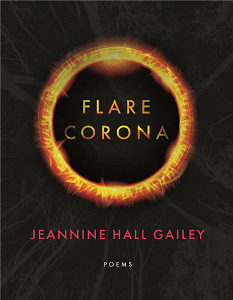
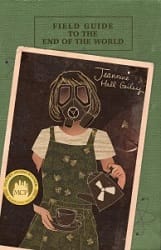
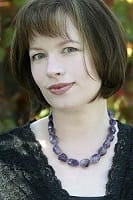 Jeannine Hall Gailey served as the second Poet Laureate of Redmond, Washington and the author of Becoming the Villainess, She Returns to the Floating World, Unexplained Fevers, The Robot Scientist’s Daughter, and winner of the Moon City Press Book Prize and SFPA’s Elgin Award, Field Guide to the End of the World. Her latest, Flare, Corona from BOA Editions, was a finalist for the Washington State Book Award. She’s also the author of PR for Poets, a Guidebook to Publicity and Marketing. Her work has been featured on NPR’s The Writer’s Almanac, Verse Daily and The Year’s Best Fantasy and Horror. Her poems have appeared in The American Poetry Review, Poetry, and JAMA.