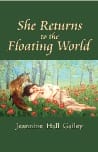

Had a fantastic time today for my reading-Q&A-teaching guest thing with poet Jared Leising’s creative writing poetry class today at Cascadia Community College. The entire 25-something person class enthusiastically participated in class (and even returned to class after a freak fire alarm in the middle of the “exercise” section of the class, which, I have to admit, as an undergrad I might not have done.) These students asked intelligent questions that indicated they’d actually read my book – in advance. Knock me over with a feather. Then a bunch of the students bought books. (!!) And, apparently, if all poetry readers were like this class, books of poetry about comic books and Miyazaki would fly off the shelves. One girl even brought up Selkie wives! I mean, who knows about Selkies? Cool, right? And there was a Mary Biddinger doppleganger in the class. Anyway, it was a great experience, definitely worth the two-hour trip each way. If I could go do that every day, feeling like I was actually helping and encouraging people, I would be a happy girl.
Funny aside: one student asked if I had any advice for aspiring writers. When I told her the old “read” advice, she said, “I mean the good, special, real advice.” Ha!
Poets Earning a Living?
So, an interesting article by Eavan Boland, and brought up in a Harriet post by Don Share, about the idea of the “poet at work.” Here’s the quote that Don posts (though the whole article is pretty interesting:)
“Whether we like it or not, the contemporary poet is increasingly skill-based. Or expected to be. He or she can — or should — lecture, lead a workshop, run an introductory class, teach composition, write a review, give a conference paper. In pursuit of all this, they are also expected to travel neatly, punctually, and soberly…. I want to be clear here. These are not negligible skills for the poet in the world. I certainly wanted to acquire them when I was young. All of them seemed to me a way of talking about or living with poetry. They still do. And I still believe many if not most poets engage them for exactly that reason.Nevertheless, I’m nagged at by the thought that many of the poets I admired when I was young were not skill-based. The opposite in fact. To think of Patrick Kavanagh or Charlotte Mew leading workshops or flying to a strange city to give a reading is to stumble straight into anomaly.And yet skills are an integral part of the poet’s world — and prospects — today…”
I think of the poets I know who are successful in the world of academia. They all dazzle with that set of skills Boland speaks of – socially gracious, doggedly grading papers and guiding students, devotedly travelling from reading venue to venue, without ever seeming to blink or wrinkle a skirt (or perhaps they do wrinkle, but I didn’t notice.) Those same people would probably be highly promotable in a corporation – perhaps as communications managers, in PR, or marketing. The kind of person that shines at AWP would be the same person who shines at any kind of business conference, but with more English degrees. I don’t know that those skills have anything to do with the ability to write great poetry; in fact, they probably don’t. But they surely don’t exclude people from writing great poetry; I’ve heard great poetry from both personable efficient type A’s and drug-addicted, misanthropic loners, from warm huggable folks and people you would hate to be stuck at a table with. But those skills are a bonus, even a necessity, for an academic job-hunter.
Of course, academia is not the only place a poet can earn a living – look at Charles Jensen, working for the non-profit out in Arizona, or Peter Pereira, serving the community as a doctor. Diane Wakoski claims that before she entered academia, she earned a living by sending out letters to venues that might pay her to read her work, and she travelled two days out of every three for years. She must have been tough, healthy, and a heck of a reader.
As I think about the big “what to do next” question, I wonder how to put my particular set of skills, likes and dislikes, abilities, and degrees to work. I know working 90 hours a week as a manager at a Microsoft or AT&T again would probably make writing poetry impossible. But how about working 40 as a technical editor, or copywriter? I’m going over to Cascadia Community College this week to give a little reading and teach a class as a guest. I like doing this kind of thing, just like the youth arts teaching stuff. I like teaching, I think I might even be good at it. I have good people skills, and I’m pretty enthusiastic about the subject matter. But even the process of applying for teaching jobs at universities is daunting to me, though – so much bureaucracy. If you don’t like bureaucracy, should you enter academia?
Of course, it’s too late for me to be born into money…and I missed out on late nineties stock speculation – Maybe I could acquire a friendly sponsor?
So again, I come to the question of: how do you earn a living as a poet? Is it possible? Is it even something we should try to do? Should we instead starve nobly in attics? There is very little “write poetry for money” kind of work out there. Grants and prizes make, perhaps, an extended writing vacation at a residency possible, take the worry out of postage and contest fees, but even the big ones (like the NEA) wouldn’t give you enough funds to survive a year in most cities of size.
So, our work as a poet becomes: anything that makes money, besides writing poetry. Possibilities: Teaching. Writing journalistic articles for magazines, sites and newsletters. Writing and editing technical or marketing material for a corporation or consulting group. Building web sites, or engines, or any job that lets you have enough time to write. I know writers who wait tables, and serve coffee, so that they can keep their brains free for writing. Which is the best option for you, dear poet? Which is the best option for me?

Some of my favorite poetry lines about April, courtesy of Edna St. Vincent:
“It is not enough that yearly, down this hill,
April
Comes like an idiot, babbling and strewing flowers.”
Thanks for all your birthday wishes! It was even a teensy bit sunny today, but still not warm. And we saw majestic bald eagles, little deer in our yards, hummingbirds and goldfinches. Banner wildlife, Washington State, if not banner weather…
And C. Dale, I did love Virgin Airlines – especially on the way home, when we got bumped up to first class!
On the last day of April, here are the last two drafts on NaPoWriMo, or the April of 1001 poems…(Be careful. These poem drafts will self-destruct.)
Poof!
*
Poof!
Home to 48 degrees and the gray rain again….
But before we left sunny CA, we had the chance to visit Monterey Aquarium with the many species of river otter, spend some time climbing the soft-sand-and-jagged-rock beaches at Pacific Grove, where we witnessed a sea lion playing with its newborn baby, watch surfers, visit a mall and eat artichoke pizza (with really fresh artichokes,) buy strawberries for a dollar at a roadside stand and eat them right there. I also had lunch with a friend in San Jose. San Jose is kind of what Phoenix would be like if you dropped it in between San Francisco and Monterey – a flat, strip-mally, dry, warm city – functional, but not beautiful. Well, with less grackles than Phoenix (I do love those grackles!) I much preferred the part of Silicon Valley with hills and greenery – Redwood City, where Oracle lives, and Mountain View. And of course Pacific Grove, about an hour south of San Jose, with its quirky little bookstores and restaurants and Monarch Butterfly sanctuaries, seemed a lot like Port Townsend, with better weather and more dramatic beaches. I’m really sorry I missed the chance to go North of San Fran to Marin County, where I was supposed to visit this March but my health got in the way. I’ve heard lots of good things.
I like Seattle, but I have to say I was feeling whoever wrote this for the Seattle Times:
http://seattletimes.nwsource.com/html/living/2004371152_moeletter27.html
I’ve never moved away from a place simply for health reasons, but I might have to start this year. Hey, who knew living with so much drizzle could be bad for someone with mold allergies and asthma? I felt so much better after a few days in the sunshine and warmth. Plus, it turns out not sitting at my computer all day makes me feel a lot better.
Turning 35 tomorrow: where to go next, what to do next. What to do until the sun comes back to the Northwest?
 Jeannine Hall Gailey served as the second Poet Laureate of Redmond, Washington and the author of Becoming the Villainess, She Returns to the Floating World, Unexplained Fevers, The Robot Scientist’s Daughter, and winner of the Moon City Press Book Prize and SFPA’s Elgin Award, Field Guide to the End of the World. Her latest, Flare, Corona from BOA Editions, was a finalist for the Washington State Book Award. She’s also the author of PR for Poets, a Guidebook to Publicity and Marketing. Her work has been featured on NPR’s The Writer’s Almanac, Verse Daily and The Year’s Best Fantasy and Horror. Her poems have appeared in The American Poetry Review, Poetry, and JAMA.