How to Get Your Book Reviewed, Living in Hospitals, and Hoping for Better
- At September 19, 2018
- By Jeannine Gailey
- In Blog
 8
8


Hummingbird in last fuchsias
Living in Hospitals, Missing My Muse
Sorry to have been absent so much, my friends. Unfortunately, I was recently (up til the last few hours) in the hospital. And I’ve been in the hospital more than out in the last few weeks. Short version: can’t seem to keep down food, doctors don’t know if it’s because of brain problems or GI problems, but it’s certainly gotten old in a hurry. I have talked more to doctors lately than my muse, and I have more needle marks in my arms from the last month than, well, seems entirely wholesome. I have missed thinking about you, about poetry, about the beauties of nature (although the view of trees from my hospital did help.)
I am hopeful that after this last hospitalization I will be at least on track to being better and able to do more that I love. I love this season, and I have already missed too much of Seattle’s shy and brief fall beauties. Not to mention writing, editing, and reading time. Please, I know you all have troubles, but if you have some spare prayers or good wishes, send them my way.
 How to Get Your Poetry Book Reviewed

While I was away, Trish Hopkinson kindly hosted a blog post of mine about the most frequently asked question I get at presentation on PR for Poets, and that is, “How do I get my poetry book reviewed?”
A challenging topic to answer in just a few bon mots in a presentation, so here is a longer form answer; I hope it is helpful to you, but if you have any extra advice, please leave a comment at her blog or here at mine! I’m always learning and certainly could always use more reviews of my books, LOL.
 Hoping for Better

Yes, I’m hoping to turn a corner on the health front, but until then, I may be a little slower getting back to people (lots of doctor appointments, and the drugs I’m on right now to contain nausea don’t exactly make me the sharpest.) September is a wonderful time to read and discover poetry, to write, and to celebrate poetry by going out to readings, book launches, etc. I miss going to bookstores and readings. I’m sorry I’ve been so isolated lately. I do hope you all forgive me if I continue to be away more than here for a while. When you see me next, hopefully my brain and internal systems will be functioning more normally. Halloween is around the corner, which is one of Glenn’s favorite holidays. He’s been so great at taking care of me while I’ve been barely humanish and a great deal of trouble, so I hope to make it as festive as possible around here. There’s my raven headband for luck!
September’s Here! A Respite, a Poet Party, and the Beginning of a New Season
- At September 02, 2018
- By Jeannine Gailey
- In Blog
- 0
 September is here!

And with it, it seems, clearer skies, cooler temperatures, and an irresistible back-to-school vibe.
Yesterday was the first day in a long time (a month?) that I felt good enough to actually go and explore my beautiful neighborhood a bit. (My goal is to get downtown to some of the Seattle attractions I was too sick to visit for most of the summer.) We saw hot air balloons, two fields of sunflowers, went to the Chateau Ste Michelle winery and walked around their lake and had an encounter with a ton of ducks and about six deer. It was just sunny enough and about 70 degrees, and it felt so good to stretch my legs and get out of the house – it made an amazing difference in my mood.
 Respite

There’s something so hopeful about September, isn’t there? Even though here in the Northwest it means the beginning of the rainy season is just ahead, the turning of leaves, the abundance of squash and apples at the farmer’s markets, and for me, a freedom from the heat and a nostalgia for the productivity of a new school season, even though I’m not teaching right now. For poets, it’s also submission season! I admit, when I wrote my last post, I was feeling a little more discouraged than usual, especially thinking about sending out my sixth book manuscript – hey, it happens to the best of us from time to time – and took a few days off from thinking about submitting, wrote a couple of poems. I was surprised by the outpouring of interest in the post and the dialogue it engendered. I’m afraid I didn’t totally solve the problem of ageism in poetry single-handed, though, talking a little about it might lead to positive changes, right? At least I hope so.

Purple!
Poet Party Today
If you’re on Twitter, today at 6 PM PST I’ll be hosting be the September submission #Poetparty, so bring your journal announcements and submission questions with you. I took a little hiatus over the summer, but as people get back into the regular routines, so will #poetparty.
This month I’ll be judging a poetry contest and editing a friend’s manuscript, as well as sending out my own stuff. I’m hoping my brain will be better in the cooler weather.
A New Hope
Yes, it’s a Star Wars joke. But beginning a new season does bring about a feeling of hope, doesn’t it? One of the moments that yesterday brought about a change in mood, I admit, was standing at the edge of the lake, the sun shining and the waxwings and goldfinches darting around, I thought about myself not as a sick person, or a science experiment, or about the pain I was experiencing, for ten minutes. Ten minutes. I’ve been having a minimum of three doctor appointments a week, complete with the rigamarole of testing, for the last month, and next week, sadly, will be no different. I hate feeling like a pincushion or a problem for others to solve. I’ve literally developed a permanent scar from having so many blood draws in my arm. Reading about MS research made me more depressed – failures of new treatments, complications with another. I’m anxious because my neurologist is encouraging me to start a new MS drug – and none of them are very good, and none of them are without serious side effects. I’ve been having anxiety dreams about working at AT&T and IBM again, feeling productive again – I miss feeling productive. Poetry, sadly, doesn’t pay the bills or give you much of a feeling of accomplishment (See my last post.)

Double balloon morning

Deer visitors
Being a “professional patient” robs me, sometimes, of my feelings of humanity, of being more than a broken, poorly functioning machine. But for those ten minutes I was feeling the world, not myself, if that makes sense. I didn’t worry about the news, or what I was getting done. There is something healing about taking a time out for nature, an unscheduled break, an extra day of weekend without worrying about chores or responsibility. There is something renewing about the transition of seasons. My husband jokes that I start celebrating spring and fall a month before they actually arrive, and Seattle doesn’t have the dramatic seasons of the northeast. But Seattle in September is this: cooler, still blue-skied days, perfect nights where you can see the stars, and sunflowers in the garden. Who wouldn’t want to celebrate that?
Grappling with Middle Age and Being a Mid-Career Poet
- At August 30, 2018
- By Jeannine Gailey
- In Blog
- 6

Willows Lodge garden, late August
Grappling with Middle Age and Mid-Career Poets
Oof, boy it’s been a week for poetry news – more scandal (another dude who started two MFA programs caught in sexual abuse going back to the seventies), more controversy (white guys saying some stuff about race they probably shouldn’t, mostly, in places like The Sun and The Writer’s Chronicle) and then like a thousand announcements of gigantic fellowships/awards/prizes going to very young poets. Yeah. If that doesn’t make you want to get off Facebook and go write instead…
I posted something on Facebook about the dearth of opportunities for poets after that first or second book prize, the lack of prestige presses reading open submissions or anything but first book contest entries, a whole poetry system that seems to spin on publicizing the young and the new. I guess they are more photogenic! LOL. Not to be bitter and old, but you know, great poets aren’t always the most photogenic or the hippest. Sometimes they are (gasp) over 40! They don’t always go to Iowa or live in NYC! Sigh.
Anyway, the post generated so many responses (some heated) that I had to hide the thread, but it was interesting to read the variety of responses – older poets saying that had given up on “the po biz” or publishing even one book altogether, older poets saying they wanted to encourage younger poets but also wanted more outlets for poets their age. Some folks pointing out that this could be a problem of scarcity – a feeling that the majority of scarce energy, time, money, publicity was going only to some poets, leaving the rest empty-handed. The weird thing is, there’s less scarcity in poetry than usual – poetry books, everbody’s telling us, are selling more than ever. Or “how dare you? Don’t you want to encourage young poets?” (I do!) Or “You should only write for the joy of writing the poem.” (Yes, to a point…but I also write to share that with others…)
At the same time this week, I have been coming to terms with the fact that I am now squarely middle-aged. 45! There’s no arguing with it. Last year I was so concerned that I wasn’t going to live to see another year I didn’t have much energy to think about it, but now that I’ve lived another year, suddenly I’m faced with the smaller problems of aging (not just the full-blown scariness of cancer and MS). Bunions, teeth that have started to crumble under years of jaw-clenching stress, a thyroid gone wonky, weight gain. Little stuff, but stuff nonetheless. Yay! This is the glamorous poet life you want to read about, right?
I was joking with my mother asking what women were supposed to do for mid-life crises. I don’t really want a convertible or a new, younger husband, plastic surgery, or a year off to explore Thailand. Hrmph. Also, I don’t really have the money for most of that stuff (and I’m pretty happy with my current husband). I don’t want to try the newest miracle diet. I’ve already dyed my hair pink a couple of times (and probably will again). The picture at the top of the post is a picture of a nearby garden in late August, which has its own kind of over-ripe, aging beauty. A reminder that there is a beauty to every season. (Also, August has been showing up a lot in my poems lately.)
I was watching that old (and not great) Sylvia Plath movie with Gwyneth and James Bond and Dumbledore. When her ambition and life goals got thwarted, she often attempted suicide (and of course, she was struggling with mental illness that was poorly understood and treated at that time.) I understand the frustration but not the death wish. (And I wish the movie had focused less on her jealousy and mental illness and more on her weird cheeriness, humor, all-Americanism, her ambition but also her meanness – anyway, she was way more multi-dimensional than that movie gave her credit for.) But I do wonder – is there a point at which thirty year old Plath thought – I’m too old to make it now in poetry? I’m sure that there was. And that was…what, fifty years ago now? Have things changed for a middle-aged female poet much? I wonder as I contemplate sending out my sixth poetry manuscript – am I too old to make it now in poetry? (Of course, “make it” has a variable, interpretable meaning – I think Sylvia, who by thirty had already published one book of poetry to very few reviews and had just had her thinly veiled autobiographical novel, The Bell Jar, published – was pretty successful, since I didn’t publish a book til I was 32, and she had been winning fellowships and prizes since she was 20. Some people might look at might at me and say, “Hey, you’ve published five books and were just talking about your acceptances in the last post!” Yes, I’m thankful for the good things – the reviews and people teaching my book, every acceptance, the presses that too a chance on me. Success is relative, and one thing Sylvia and I might have in common is that terrible sin for a female writer: ambition.)
I wrote an essay a while back for The Rumpus called “the Amazing Disappearing Woman Writer,” talking about Ellen Bass’s rise to fame in her early years, her disappearance from the map of mainstream poetry, and a bit of a late triumphal return. That seems to be a pattern – people seem more willing to embrace a woman poet when she is young and sexy, forget about her in middle age, and cheer her again when (perhaps) she is seen as less of a threat, more of a mother figure, in her later years? It takes a lot of courage and persistence and work to try to stay in the spotlight. The ones that stay there, they are fighting to stay there. Or other people are fighting for them. Anyway, this is why you may notice that my book reviews often focus on women, and women in middle age particularly, ones that I don’t feel have had enough written about them. Some poets get way too much review space, and others way too little, and I’ll do what I can when I have the energy to try to put a spotlight on these women in their middle years.
But there remains the problem – the culture of poetry’s fetishism of young poets. The desire for the new. Instagram poetry could be a great way to reach more people with poetry – or a great way to shallow-up the world of poetry, focusing on the pretty image and the tiny, easily digestible poem. I don’t have the answers. But you might – if you have the power to buy a book of poetry, or reviewing one, think about giving your attention to a poet who might not be the flavor of the month or in the spotlight, but might speak uniquely to you. If you are a publisher or editor, think about your gatekeepers – if they’re all 22, that might be affecting what gets past them, because at 22, you feel 30 is old – and that gives you a different worldview than someone, say, in their fifties. (If they’re all 22 white able-bodied males, you may have even more thinking to do.) Think about diversifying opportunity. After all, Ellen Bass never stopped being a terrific writer – she just dropped off the radar for a while.
Celebrating Poetry Acceptances, Summer Up in Smoke, Fighting Your Limits
- At August 26, 2018
- By Jeannine Gailey
- In Blog
- 2
 Celebrating Some Good News – Poetry Acceptances

After a long summer with mostly bad news, the last week or so has been an amazing string of happy poetry news – lots of acceptances all at once! With poetry, it’s often a wall of rejections, followed by a bunch of acceptances, which makes it hard to celebrate when you should, because the wall of rejections feels so much more overwhelming than the brief flowering of acceptances. A couple of these acceptances were at dream journals – journals I used to think I’d never get into.
The bad news about the acceptances was writing those “withdrawal” e-mails, and realizing now almost all the poems in my newest poetry manuscript are published! I need a publisher who loves this book as much as I do. I’m ready to get it out into the world! Put out some good vibes for me.
 Summer Up in Smoke

Here in Seattle they are calling this “the lost summer” because for the past few weeks we’ve been hemmed in by terrible smoke, resulting in being shut-in (air that is hazardous for all people, including dogs and children.) This is a shot of the moon in the red air. Driving a couple of hours doesn’t solve anything, because the smoke from wildfires is coming in from literally every direction. I can’t wait for rain to get rid of this fire season. In Seattle we didn’t used to have to worry about this, but the weather news folks have been calling this “the new normal.”
The weather’s depressing low smoke veil just makes things like the news take on eerie significance. This morning, the deaths of John McCain, Neil Simon the playwright and a Florida video game tournament shooting. I’ve been trying to stay off social media and read books, watch classic movies, etc. My health has been so depressing by itself with the weeks-long stomach infection followed by a smoke-related sinus infection.
Fighting Your Limitations

Yes, so here is my mixed bag – some good news – followed by bad news – followed by just feeling sick for so long and frustrated I can’t go outside and enjoy my garden. There are still good things going on, but the news cycle and my own body have been against any brief hope or optimism.
Everyone has some limitations. I may have more physical limitations than most people, and this last month has been rotten – just bad luck, plus autoimmune stuff, plus being sensitive to bad air because of asthma. I love my garden, but I haven’t been able to get out and plant stuff, or even go to the gardening store for dreaming/planning sessions, in a while. It’s hard for my husband and I to go out on a date because 1. nausea 2. lack of fresh air, neither of which are great for romance. I want to spend more time reading, editing, sending out work, but I’ve got limited energy per day, so I have to do everything in small doses. So it’s hard to cheer yourself up when even your coping mechanisms seem hard to access.
How do we face life with limitations? It doesn’t mean you can’t do anything, but it means maybe you can’t do as much as you used to, or as much as you want to do. It means even when you have modest goals for your days, sometimes you give up and sleep all day instead. It means you go to doctors to get everything (diet, physical therapy, medications) as optimized as you can, but since you’re working against multiple complex problems, sometimes they tell you: you’re doing everything you can do, and we’re doing everything we can do, too. So that feel like being up against wall. But there is always the possibility of change on the horizon. I hope for that, for the possibility of doing more, of seeing more hope, of the lifting of the “Eye of Sauron” sun and thick layer of pollution so we can see our mountains, rivers, trees, and ocean again. It’s the same with my writing – even after a long period of rejection, there will be that time when everyone seems to like your work again. We have to hang on to hope, even when our vision is dimmed.
Talking Apocalypse, End of Summer, Hospital Trips (and Other Unplanned Trips)
- At August 18, 2018
- By Jeannine Gailey
- In Blog
- 2
 End of Summer

It’s getting to be the end of summer – people are celebrating the last hot days of August. Sending kids back to school, or preparing their own syllabi.
I’m personally looking forward to fewer 90 degree days and less wildfire smoke. Looking forward to feeling more energetic, getting to apple cider and pumpkin farm season. The end of summer here has been rough – worse air quality here than in Beijing last week and this coming week, constant heat and somehow also clouds. The best parts of a Seattle summer – the clear seventy-something days, the blue skies, seeing the water, mountains, and the flowers – are being squelched by this second-year-in-a-row disaster zone of fires in every direction. It certainly feels apocalyptic. And then, when you’re looking of your friend’s pictures on Instagram of various fab vacations, you get the type of trip you don’t plan for.

Hospital Trips (and Other Trips You Don’t Want to Take)
Speaking of disaster zones…sorry I’ve been absent – I’ve been really sick, not even really able to do any reading, or sending out work, which always sucks. I was in the hospital a couple of days ago, giving me flashbacks of last summer, where I had four trips to the hospital during August. That really persistent bug plus the MS just overwhelmed my immune system and I couldn’t really function. Some weird stuff. They’ve found some new problems in my stomach, they want to check me for new brain/spine lesions, and of course, my thyroid/checking in for carcinoid too. I’m doing a little better now (more nausea meds plus a new antibiotic for the bug) but it’s a reminder that I have to appreciate the good days, and find a way not to lose hope during the bad ones. I have so many doctor appointments and tests coming up…sigh. Sometimes I feel I have no identity outside of “weird sick person.” When I’m in a bad spell, sometimes it feels like “normal” will never come back.
Here’s a dahlia from our garden to remind us of (hopefully) better days to come…
 Talking Apocalypse

But on the plus side, after having to cancel a reading the day after I got out of the hospital, I took a whole bunch of prescription drugs and set out to conquer the world – two days after.
Brick & Mortar Books in Redmond hosted a panel on apocalypses, including me, YA author (The Last One) Alexandria Oliva, and Gather the Daughters author Jennie Melamed, last night. It was great – a good sized audience, great questions, and the two other authors were wonderful. I was so happy that I turned a corner – I was really nervous I’d have to cancel. It was a nice reminder that I am more than just a sick person or a super mutant patient of a bunch of specialists.
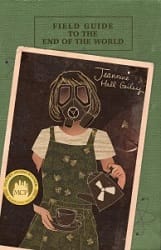
It was also nice to sell some copies of Field Guide to the End of the World, talk to other writers about writing, and talk to an audience about the joys of poetry. Things that remind me of the good parts of being a writer. Today I got an acceptance in my inbox of two poems, which was a nice reminder, too, that it the middle of what feels like an endless stretch of bad, there might be good things waiting. Wishing you a similar promise of good things to come.
-

- me in the garden before the event – first time I’d put on makeup in over a week!

-

- Alexandra, Jennie, and me

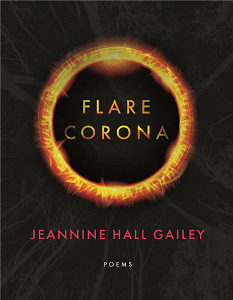
 Jeannine Hall Gailey served as the second Poet Laureate of Redmond, Washington and the author of Becoming the Villainess, She Returns to the Floating World, Unexplained Fevers, The Robot Scientist’s Daughter, and winner of the Moon City Press Book Prize and SFPA’s Elgin Award, Field Guide to the End of the World. Her latest, Flare, Corona from BOA Editions, was a finalist for the Washington State Book Award. She’s also the author of PR for Poets, a Guidebook to Publicity and Marketing. Her work has been featured on NPR’s The Writer’s Almanac, Verse Daily and The Year’s Best Fantasy and Horror. Her poems have appeared in The American Poetry Review, Poetry, and JAMA.